Promoting and equitably assisting organizations in the integration of animal-assisted therapies for the physical, mental, and emotional benefit of individuals in public and private settings, one paw at a time.
In honor of Black History Month, each week I will delve into the heartwarming bond between Black voices and their cherished canine companions.
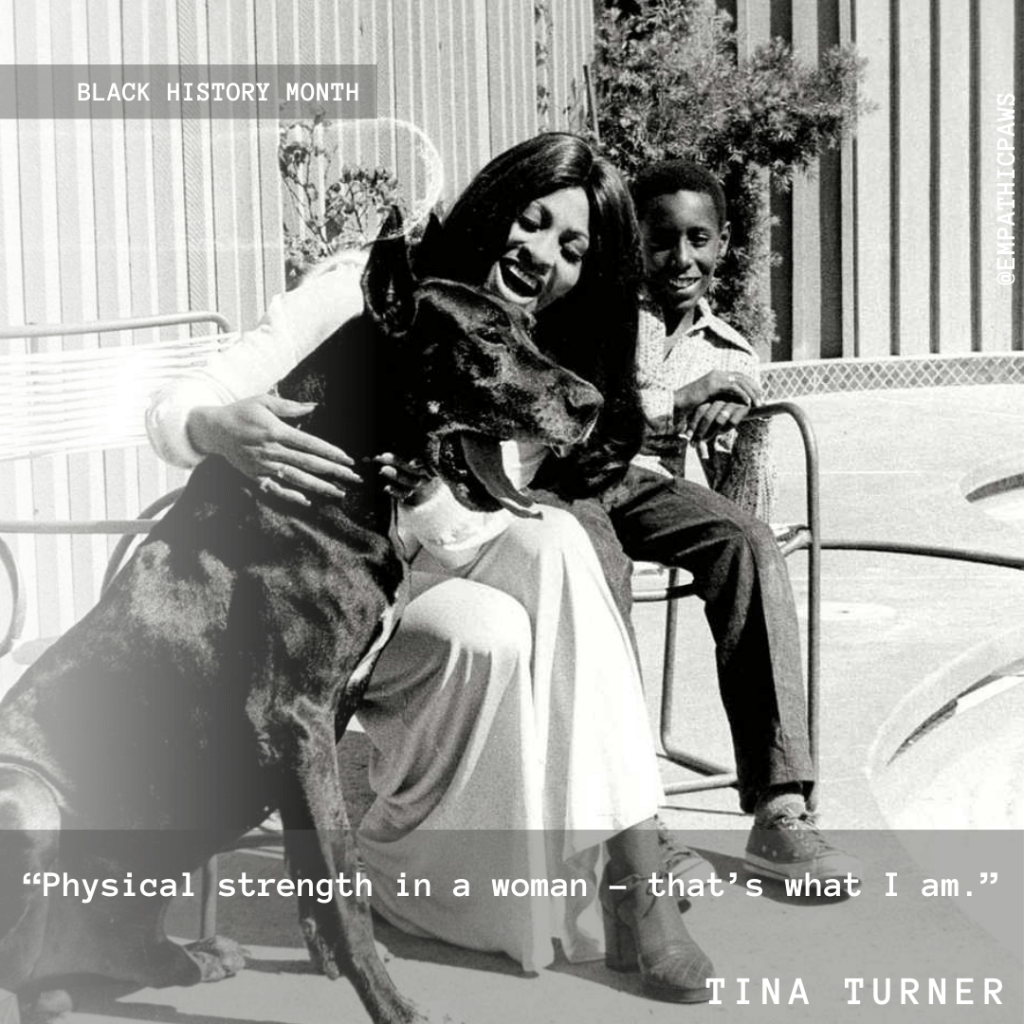
For my final post, I pay tribute to the remarkable life of the iconic Tina Turner, a music legend who reshaped the rock ‘n’ roll landscape and is forever immortalized as the #Queen of Rock ‘n’ Roll. Tina’s electrifying performances, soulful voice, and resilient spirit made her a music icon and one of my favorite artists to karaoke!
I personally found myself even more inspired by Tina after learning about this 1971 image depicting Tina, her son Ronnie, and their majestic Great Dane, Onyx. You see, this image encapsulates the dynamic energy of the rock legend and the serene strength of a canine companion, solidifying the position held by many, other than myself, that dogs are not just pets; they are steadfast companions, offering a unique and irreplaceable bond, one that transcends barriers imposed by others and the society in which they live.
Additionally, the image suggests Onyx exemplified the quintessential #GreatDane attributes, loyalty and a gentle demeanor, not because of his regal posture, but more so by the body language of Onyx’s humans—Tina’s loving embrace of Onyx, the position of her arm and her beaming smile, not to mention her son’s joyous expression. In this moment, the trio appear to share simultaneous happiness.
I’m left to wonder about the myriad of ways Onyx may have offered Tina unwavering reinforcements through the highs and lows of the early days of her illustrious career, including her personal hardships and quest for true love. In the whirlwind of a demanding career, one may consider that the presence of a loyal canine friend, like Onyx, served as a grounding force, for dogs, with their intuitive understanding and unconditional love, fulfill an area of need within their person.
Tina and Onyx, another beautiful example of the human-animal bond to further substantiate my personal belief that standing alongside every great woman is a stoic canine companion (or four). At the end of the day, dogs really are “Simply the Best.”
Please consider a visit to my Instagram to view posts honoring the incomparable Black voices of Billie Holiday, Oprah, Pauli Murray, and their respective love of dogs.
In honor of Black History Month, each week, I will delve into the heartwarming bond between Black voices and their cherished canine companions. This week, I honor the trailblazing Pauli Murray – a civil rights activist, legal scholar, and champion for equality.
Along with Pauli’s immense contributions to life as we know it today, Pauli was a steadfast dog lover and it is Pauli’s enduring love for dogs that is beautifully captured in this moment. Pictured here you will find an image of Pauli and cherished companion, “Doc” – officially known as “Black and White We Rise Together,” on the lawn of Benedict College (Farber Archives, 1967).
Throughout Pauli’s remarkable life, dogs transcended the role of mere pets; they were steadfast allies, bearing witness to Pauli’s tireless advocacy for justice, equality, and ideals.
Accompanying their groundbreaking contributions, Pauli’s connection with their canine companions is a testament to the enduring strength found in companionship and the human-animal bond. “Doc” stands as one of the many loyal dogs integral to Pauli’s story, quite possibly offering solace, understanding, and unconditional love.
I am inspired by the thought of Pauli Murray making these profound contributions, accomplishing monumental feats all the while having a loyal canine companion equally steadfast by their side—a symbol of companionship, unwavering support, and a unique kind of partnership, but the most true form of love.
Imagine the comfort of having a faithful friend, witnessing tireless advocacy, celebrating triumphs, and offering solace during challenges. This bond may very well have evoked feelings of determination, resilience, and reaffirmed Pauli’s commitment to making a difference.
Pauli and “Doc,” a testament to the extraordinary impact that the companionship of a beloved dog can have on one’s life, the role they play in the narrative of accomplishments, and the inspiration to continue on my own advocacy journey, with gratitude and love for the pack that remains by my side.
Please consider a visit to my Instagram to view posts honoring the incomparable Black voices of Billie Holiday and Oprah, and their respective love of dogs.
In an era shaped by technological advancements and evolving educational paradigms, students face an ever-growing need to showcase their skills and accomplishments comprehensively and accessibly. This is where the concept of Digital Knowledge Portfolios becomes a pivotal tool in the academic journey, especially for those pursuing the International Baccalaureate (IB) Middle Years Programme (MYP), Diploma Programme (DP), and beyond.
Digital Knowledge Portfolios serve as dynamic repositories, housing a student’s academic achievements, reflections, and growth over time. Within the context of the IB framework, they play a crucial role in aligning with the program’s core principles and objectives.
Understanding the IB MYP Framework
The MYP emphasizes holistic learning, encouraging students to explore connections between disciplines while fostering critical thinking and communication skills. It’s within this interdisciplinary approach that Digital Knowledge Portfolios find their stride, enabling students to document projects, essays, artistic creations, and other endeavors that exhibit their multifaceted talents.
When transitioning to the DP, these portfolios become even more vital. The program’s rigorous demands necessitate evidence of research, creativity, and reflection – elements that can be effectively showcased through digital portfolios. Students demonstrate their growth, track their academic journey, and exhibit the skills and attributes sought after in the DP curriculum.
The Power of Reflection and Connection
Digital Knowledge Portfolios are not just repositories of work; they are reflective spaces where students can articulate their learning process, challenges faced, and growth achieved. Through this reflective practice, students gain a deeper understanding of their strengths and areas for improvement, aligning with the IB’s emphasis on metacognition and self-awareness.
Moreover, these portfolios bridge the gap between academic endeavors and future aspirations. They serve as tangible evidence of a student’s capabilities, aiding college admissions, scholarship applications, and career pursuits. As the world increasingly values digital literacy and the ability to curate one’s online presence, the Digital Knowledge Portfolios become invaluable assets.
Aligning IB Command Terms within the Digital Knowledge Portfolio
The International Baccalaureate (IB) program is renowned for its rigorous academic standards and precise language used to articulate student expectations. Central to this I IB language are Command Terms – key words that direct students on how to approach their learning.
Integrating Command Terms Strategically
Integrating the IB’s Command Terms within the Digital Knowledge Portfolio is instrumental in showcasing a student’s mastery of these skills as it pertains to the rigors of the IB’s program.
First, students must determine and demonstrate understanding of the terminology. Within the Digital Knowledge Portfolio, sections are dedicated to honoring the IB’s definition of the Command Term, as well as designated spaces for students to define the Command Terms in their own words. Clearly defining the Command Terms, in their own words, confirms a foundational understanding of the IB’s terminology and students’ ownership of learning.
Then, students strategically align their work to the content specific Command Terms. Students identify an artifact, include an image and/or a direct link to the artifact, and then justify their rationale for the selected artifact.
Hypothetical Artifacts & Justification
In this section, I put forth hypothetical artifacts and justification aligned to some of the Command Terms to showcase how a student might demonstrate engagement in the IB curriculum framework and ownership of learning.
Define: The artifact might be an essay or research paper where the student meticulously defines and clarifies key terms within a specific subject area. The justification here would involve highlighting how this artifact serves to establish a foundational understanding of the topic under discussion.
Explain: An artifact showcasing an elaborate project presentation or an instructional video might justify its inclusion by emphasizing how it succinctly explains complex concepts or methodologies, showcasing the student’s adeptness in simplifying intricate ideas.
Evaluate: If a portfolio entry involves a reflective piece where the student assesses the efficacy of a scientific experiment or a historical analysis, the justification would focus on how this artifact demonstrates the student’s capacity for critical evaluation.
Discuss: In the case of a recorded debate or a written dialogue on socio-political issues, the justification would elucidate how this artifact displays the student’s ability to engage in meaningful discussions, considering multiple perspectives.
Compare and Contrast: An artifact might feature a project that compares and contrasts different literary works or scientific theories, justifying its inclusion by highlighting how it showcases the student’s understanding of interdisciplinary connections.
Conclusion
By consciously aligning their work to the IB Command Terms within the Digital Knowledge Portfolio, students not only showcase their understanding of these terms but also demonstrate their ability to engage with the academic material at a higher level. This strategic curation enhances the depth of the Digital Knowledge Portfolio, presenting a comprehensive overview of a student’s academic journey while explicitly highlighting their mastery of the IB’s language and expectations.
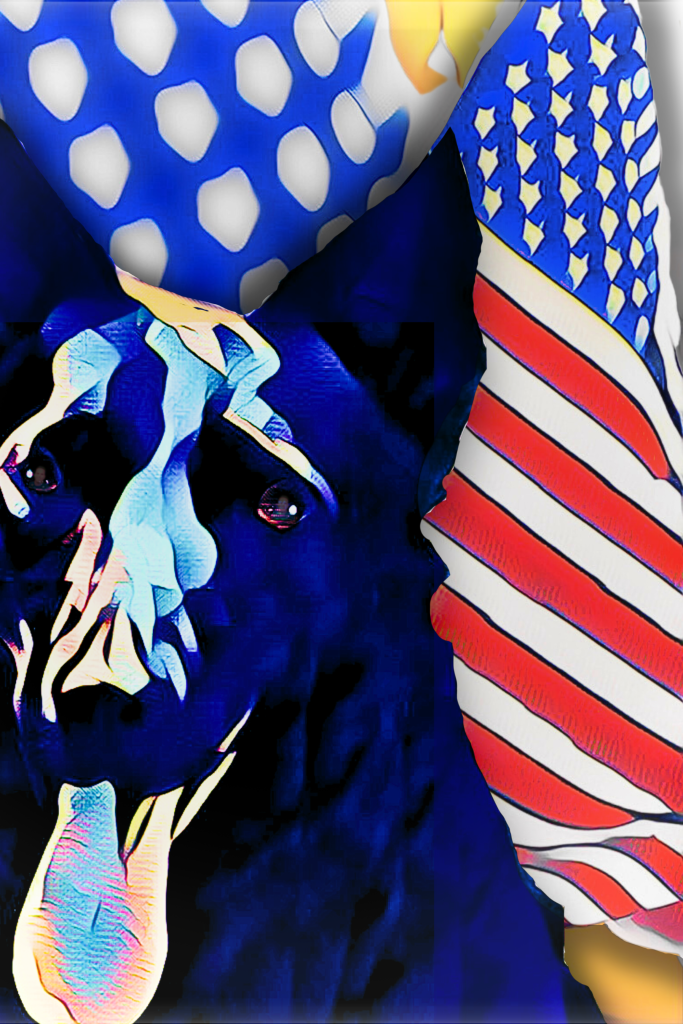
NYPD K9 Steven, named after the late Manhattan Detective Steven McDonald, passed away after a battle with cancer; he was 7 years old. K9 Steven, a Dutch Shepherd, was more than a working dog for the NYPD. He transcended his role as a police dog, mirroring the heroic spirit of his namesake and partner, Officer Joe Brayuha.
For six years, K9 Steven and Officer Joe Brayuha formed an inseparable partnership that showcased an unparalleled commitment to their duty. Together, they undertook deployments with NY Task Force 1, demonstrating their versatility, resilience, and unwavering readiness to rise to challenges in moments of crisis. The trials they overcame together, and the unspoken camaraderie they embodied, oh the stories they must have exchanged…
I felt compelled to reach out to Officer Brayuha and our conversations, though brief, resonated deeply. He shared that K9 Steven had an extraordinary ability to connect with people, “he loved everyone he met.” And as I continued to read Officer Brayuha’s response, it became very clear why, as a dog-lover and advocate for animal-assisted therapies, I was curious to learn more about their bond—a bond that, in essence, is more similar than different from the bond I have with my own dogs, and probably more similar than different from your understanding of the human-animal bond.
K9 Steven and Officer Brayuha are, in fact, archetypal beings themselves, and when combined, they form an archetypal duo, the same archetypal duo easily recognized in movies, literature, and typed across front page headlines of real life. They are the quintessential archetypal duo that navigate archetypal situations together, rely on each other in countless ways to make it through archetypal conflicts and to overcome archetypal antagonists.
In many ways, K9 Steven emerged as a modern-day representation of the tragic hero archetype, bravely confronting cancer head-on, Sadly, when our furry friends receive a cancer diagnosis, it is a very tough archetypal villain to defeat.
Which is why there comes a time when the tragic hero must say goodbye, and that goodbye is especially hard when there is nothing more either archetypal character can do to prevent the inevitable closure to a plot line neither wants to end.
And as is life, the story resumes.
This time though, the onus to continue the duo’s mission and K9 Steven’s legacy doesn’t just fall on Officer Joe Brayuha—it’s a collective effort. And my small part is represented in this post.
I created a digital collage of K9 Steven, entitled “Good Boy,” and found my creative inspiration from reading about K9 Steven and viewing his Instagram. If you look close you can observe the Chrysler Building and even Officer Brayuha. It is my intention to share a digital copy with Officer Brayuha as well as get a framed copy to him. I hope it will serve as a reminder of the duo’s positive impact, and their continued impact on others.
K9 Steven was most definitely a “good boy.” You’ll be missed, buddy.
My original creation; a digital design to welcome Instagram viewers to visit this blog post. My inspiration for this graphic stems from my love of the ocean, Montauk, and of course, dogs | J. Maricevic, 2023.
I recently read a funny meme. It was something along the lines of, “there are some people who should never have met my dog.” That might even be the exact wording, but I’m not quite sure.
I thought it was a funny post. I even considered reposting it. I thought about being cute and crossing out “dog” and replacing it with “dogs” (because I have four), or changing it to something like, “there are just some people who will never meet my dog, or dogs,” or maybe even, “there are just some people who will never meet my dog, or dogs, again,” because, well…
Listen, I know there are some people who simply do not deserve to be around any living creature due to their decision to treat an innocent being inhumanely. Let me be very clear on that point. Any unkind or abusive treatment is an obvious red flag, a scarlet letter forever emblazoned on a person’s chest, and that’s right, that person will never, ever be around your dogs, or my dogs, nor should they be around any other dogs or innocent beings.
So yes, there is at least one possible exception to the should never meet my dogs scenario. But was the concept behind the post, while produced in jest, further perpetuating negative thinking, energy and creating disharmony?
And then I got to thinking…
Why would there even be a person, or people, in an individual’s life who should never have met a person’s dog, or dogs, or never have the chance to meet a person’s dog in the future, or never have the opportunity to see them again? Yup, that’s a rhetorical question. You and I both have our own answers to our whys.
In normal Jess-fashion, I contemplated, reflected, and personalized the thought to better empathize with a person who holds such strong sentiments, and even take a moment to better empathize with myself.
I reverted back to when I was able to tangibly embrace my passion (that’s 4 years old). Talk about a lot of years, and a lot of memories, and a lot of “stuff” to sift through. Memories, moments, and faces– the flickers of my mental time capsule, going at Mach speed. And with each face, memory, and moment, there were a few, not many, which did include people who, for all intents and purposes, were/are tied up in that silly little meme I referenced at the beginning of my post.
[Enter Thinking]
Ironically enough, the people who, in theory, should never have met my dogs, are the very people who, at the time, probably needed to meet my dogs the most. There are probably people I have yet to meet, who need to meet my dogs. There might even be people who have met my dogs, who really do need to meet them again. I am not quite sure how I feel about coming to such a realization. We fear the unknown right? Or is it that we fear the known?
My original creation; a mock-meme which I like to call, Probably the Ones who Needed to Meet them the Most. This image appears in my most recent instagram post | J. Maricevic, 2023.
A Transformative Impression
Dogs have a unique way of touching lives and teaching valuable lessons through their ability to bring joy, companionship, and help others become more patient, empathic, and responsible (Maricevic, 2022). Meeting another person’s dog can be a transformative experience for some individuals, even if they have had limited exposure to dogs or pets in general. It’s also possible that emotional competency development can happen without directly interacting with a person’s dog (Maricevic, 2022). It can also happen for a person who observes others interact with their furry family member.
Yes, that means when one person is able to witness (1) how another interacts with a dog, (2) how one person can love another being other than themselves or (3) a demonstration of reciprocal and unconditional love in return, those observations alone have the potential to leave a positive impression on a person’s psyche (Maricevic, 2022). Not just any impression, a transformative impression; an impression for the better.
Interacting either directly or indirectly with a dog can model what it looks and feels like to give and receive unconditional love, how to develop trust, embrace responsibilities, and the importance of living in the present moment (Maricevic, 2022). Such observations can also provide an opportunity for empathic growth, as others learn to understand the needs and behaviors of the do, in turn strengthens a person’s ability to develop and form bonds over time with humans and dogs (Maricevic, 2022).
Let’s not forget, dogs are known to have a positive impact on mental health, reducing stress and anxiety. For people who may be struggling emotionally or socially, a dog could provide a source of comfort, support, and a means for connecting with others during moments when feeling isolated, or even ostracized from the world. Dogs serve as a bridge for connectivity, helping to establish, solidify, and even mend relationships.
Got Hope?
At first thought, there might be people who come to mind who should never have met a person’s dog, or never will get the chance to meet a person’s dog, or those who will never have the chance to meet a person’s dog again. Now, minus the aforementioned exception, I challenge that initial thinking. In fact, I propose those should never or will never statements, shift to maybe one day statements.
If one is to change from a never mindset, to a maybe mindset, does that potentiality provide more space for positive thoughts, and less negativity? Does a change from a never mindset, to a maybe mindset create a space for an unexpected connection, a misunderstanding understood, a missed connection redirected, or serendipitous happenstance?
Admittedly, a change in mindset may never bring a moment to reality, and even if it does present itself, the moment might be fleeting or the opportunity anticlimactic. Those maybes may never happen at all. Even so, if there exists an opportunity for personal growth and positive experiences, and that opportunity starts within the individual themselves through self-empowerment and self-actualization, and there is no harm being done to oneself physically or emotionally, no harm being done to another person physically or emotionally, and no harm done to any person’s dog or dogs, then perhaps it’s worthwhile in the long run?
Perhaps, at least start with a shift in mindset. Perhaps be open to the maybe?
Maybe, one day [fill in the blank}.
Easier said than done, you say?
Maybe.
But I figure, on this rainy summer’s day, it’s worth a try. Chalk it up to needing some Vitamin D, being over all this rain, or an exercise in strength conditioning…. ’tis the season to bulk up the mental and emotional fortitude needed for the time when the radiant rays of sunshine give way to crisp fall days.
Inspired by the picturesque Hudson River Valley, where my love and appreciation for dogs first blossomed, I proudly present to you the debut of the new and improved logo for Empathic Paws!
Newly designed logo for Empathic Paws/J. Maricevic (2023)
A Splash of Visual Rhetorical Devices
Allow your eyes to follow the flow of a river, through the protective hills of the valley. Let your vision glance downward towards the river’s end– calm, cool waters.
My self-designed logo captures the rolling hills, meandering river, and lush greenery to create a captivating representation of comfort, security, and love, which in my opinion, is the essence of the Hudson Valley region of New York State, and the place I called home throughout my formative years.
In the central foreground of the logo, resides the graceful silhouettes of my beloved dogs— Judge, Daisy, Bravo, and Bud. Each purposefully placed in a layered, three-dimensional effect, with thoughtful consideration given to their personalities, sizes, and unique demeanors. The convergence of stylistic features and the representation of the “pack” at the center, symbolize the unwavering influence and immeasurable joy that Judge, Daisy, Bravo, and Bud bring to everyone they meet.
At its core, this new logo embodies the motif of home. A home, to me, is a sanctuary, where cherished memories are created, and the presence of a faithful canine companion remains steadfast. As I reflect upon the place where my love for dogs took root, I am reminded of life’s constant flow and its ability to lead us to unexpected destinations. The new Empathic Paws logo symbolizes this journey, showcasing the transformation and growth that brought me, my son, and our dogs to the vibrant Sound Shore region we now call home.
To Honor the Pack, is to Love the Pack
Some may argue that too much thought was put into a logo, but I disagree. The new Empathic Paws logo holds deep significance, not just because I designed it, or because it represents my personal journey from one home to another, and definitely not because it has cute graphics of dogs.
You see, Empathic Paws is not just an idea; it is a passion born from the profound love and appreciation I have for each and every canine companion I am fortunate enough to cherish. It is only appropriate that my new logo serve to honor the influence of my extraordinary pack, forever intertwined with the timeless spirits of their predecessors.
A Shout-Out to the Research
Let me put my “doctor-lens” on the topic for a quick second.
I know from my own qualitative research findings, as well as personal experience, the human-animal bond has the potential to be the antidote for many visible and invisible traumas humans carry with them (Maricevic, 2022).
Research (Maricevic, 2022) suggests the bond itself may cultivate feelings such as, but not limited to, unconditional love, safety, empowerment, happiness, fulfillment, calm, reassurance, confidence, inclusion, recognition, value, and a sense of being heard.
On a macro level, I believe the new logo symbolizes the incredible impact dogs can have on humanity, if given the opportunity to do this much-needed work. The captivating visual composition is aesthetically pleasing to the eye, utilizing soothing blues, vibrant greens, and golden hues, a color palette to evoke a sense of tranquility and vitality, mirroring the warmth and happiness reflective of the positive impact of the human-animal bond (Maricevic, 2022).
An inviting visual representation of the heart and soul of Empathic Paws, this logo is a testament to the unwavering bond shared with our four-legged friends and the power that resides within the gentle paw of a canine companion.
An Ideological Extension of that Cliché, Explained
Do you recognize an archetypal theme attached to the home motif? I’ll help you out a little bit. Regardless of life’s trajectory or physical location, a home is a place that includes the omnipresence of something larger than oneself, to make a person feel what they know in their hearts they deserve to feel in all facets of life, and to reciprocate that feeling, to others, in return.
By that self-proclaimed definition, home is not just a physical place, nor is it defined solely by the traditional sense of the word. Home is a state of being. Which means, for me, home is where my canine companions reside, whether they are standing by my side or resting in my heart. I find comfort in knowing that this logo is an ideological extension of that age-old cliché. You know, the one about homes and hearts? I find comfort in knowing that no matter where life takes me, I am always able to feel, because home is where the dogs are, and thus I am, forever home.
With heartfelt dedication, Empathic Paws strives to extend the genuine feeling of solace and warmth that emanates from the omnipresence of dogs to others longing to feel. It is within this opportunity that individuals can develop deep connections with canine companions, granting them a sense of comfort, belonging, and the unmistakable feeling of home.
I do hope you enjoy the new representation of Empathic Paws. In the coming weeks, you will see a slight restructuring of empathicpaws.com. The slow roll-out of these changes looks to incorporate aspects of the new logo to the site. During this time, you will still be able to access the site and reach out to me if needed. Thank you for reading!
I recently stumbled upon a TikTok post featuring a table-read for the sketch comedy show, The Muppet Show (1976 – 1981). The clip, posted by TikTok user, @muppetmarissa, includes the voice-overlay of creative mind and Muppet creator, Jim Henson, along with his perspective on the collaborative creative process. The clip progresses, there are many other voices of Muppet Legendary, and then comes the wave of nostalgia.
The Fabric
Now, if you made it this far, it should come as no surprise to learn the obvious. I am a huge Jim Henson fan. I mean, I am writing a reflection on educational leadership with an ode to The Muppets. Don’t worry, it has a purpose, I promise.
I am unsure where @muppetmarissa found this particular clip, but very much look forward to viewing what appears to be a documentary on Jim Henson that I have yet to review. I do know there is a highly anticipated documentary in the works about Jim Henson, directed and produced by the dynamic duo of Ron Howard and Brian Glazer. The release date of the Disney Original Documentary is still to be determined and you can read more about it here in this 2022 press release by The Jim Henson Company.
You see, I consider myself a creative. I allow myself the time, space, and flexibility to be creative in all aspects of my personal and professional interests. I credit my creative identity and all my ventures, from childhood to this very moment, to Jim Henson, his circle of like-minded creatives, the imaginary world they conjured for us kids in the 80s, and how that imaginary world has now transcended space and time.
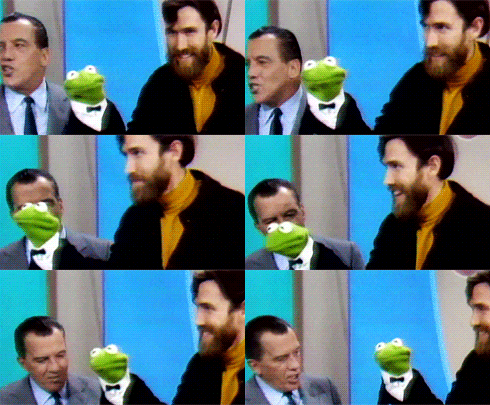
Ed Sullivan, Kermit the Frog and Jim Henson; The Ed Sullivan Show, N.D.
Shared Experience
I also know, I am not the only one who feels this way. Take actor Jason Segel, for example. Segal is best known for his role in the sitcom How I Met Your Mother (2005 – 2014), writing and starring in the iconic film, Forgetting Sarah Marshall (2008), writing and staring in the recent the AppleTV series, Shrinking (2023), and [drumroll please], his love of The Muppets.
Segel does not shy away from his love and appreciation for The Muppets, and even refers to them as his “childhood idols.” An additional interest worth noting is Segel’s idolization of Kermit the Frog, the amphibian embodiment of Henson’s legacy. Segel reveres Kermit almost as much as I revere the little green frog. During an interview to promote his mid-2000s film, The Muppets (2011), Segel was asked to divulge his favorite Muppet, to which he replied “… it’s Kermit. It’s always been Kermit.” I get it.
I get Segel’s #ItsAlwaysBeenKermit belief statement because quite frankly, I have an #ItsAlwaysBeenKermit belief statement, too. So here it goes, my Kermit belief statement:
Everything I learned in life, I learned from a little green frog.
I really get it.
In 2011, Segal took it upon himself to dust off the Muppet memories for us “80s kids,” thanks to writing and staring alongside them for their return to the big screen. That summer, I took my son, who was then 4 years old, along with his cousins, to see Segal’s major motion picture production. We sat in a quaint, Berkshire, Massachusetts movie theater. What could be better than a summertime movie, in the Berkshires, and watching The Muppets? Nothing. There is nothing better. Trust me.
The lights dimmed. The credits rolled, and so did the tears. Let me be more specific. The credits rolled, and so did my tears.
I wish I could say I was overcome with emotion because it was my son’s first time in a movie theater– it wasn’t that. No, it wasn’t tears of joy. Tears of sadness? Nah. Nope, not tears longing for the days of yesterday. I pretty much cried throughout the entire movie.
The Act of Being
For the duration of the film, the adult me was very cognizant of the fact that I was in a theater, surrounded by children, one of them being my own, to watch a film in which my own childhood icons paraded on screen. The film, for all intents and purposes, was presented under the auspices of a children’s movie. But to me, I knew this film was not exclusively targeted to the 4-12 year old demographic, but to their parents, guardians, aunts, uncles, neighbors– to those “80s kids.”
The Muppets (2011) was a film targeted to me, and my tears were tears of being; being seen, heard and valued.
It was so very apparent, how by watching this film, my personal roadmap, goals, dreams, and aspirations were emphatically validated, and not just by any other person, by another like-minded creative, personally and professionally influenced by Henson and his Muppets.
Jason Segel got it– he got me.
I was beingseen, valued, and heard as a person in need of a reminder, a reminder to remember….and I wasn’t the only one. I wasn’t the only one positively influenced by the creative masterminds behind The Muppets. I wasn’t the only one still using the efforts of ingenious creatives, like Henson, to fuel my purpose. I wasn’t the only one who wanted to genuinely find opportunities to advocate for empathy and understanding, to leave my mark on this world, and make it just a little brighter than it was the day before.
There are people, like Segel, who are like me. There are people, like Segel, who, like me, want others to know that even during some of life’s most [fill in the blank] moments, they are seen, heard and valued.
Educational Leadership
As I reflect on my own educational leadership journey, there is the running motif and thematic concept within my writing and it is centered around those three words: seen, valued, and heard (I’ve coined it “the trifecta”). All individuals in an organization need to feel truly seen, valued, and heard for a plethora of reasons; the multitude of stakeholders: who is the cultivator of “the trifecta” one day and who is the receiver the next; interwoven relationships between district, school building leadership and the trickle down effect; leadership philosophy and philosophical approaches to management, transactional vs. transformational…
Now, enter students into the equation. Students must feel seen, heard and valued, and if teachers are the ones to help cultivate and nurture “the trifecta,” then teachers must also be a receiver of those feelings, which then means district and school building leadership must …. round and round we go.
All stakeholders must have equitable access to “the trifecta.” Easier said than done? Meh.
Everything I learned in life, I learned from a little green frog.
I get it, because I believe it. And I also believe in order to cultivate authentic opportunities for others to feel all those things, and more, it takes creative ingenuity, it requires safety and security, transparency, honesty, love, kindness, trust, empathy …. it requires a Kermit-like mindset.
A Kermit-Like Mindset to Leadership and Beyond! That reads as if it’s got some potential, and that is where the next chapter of my leadership journey will start.
During my most recent school building leadership internship course, students were to read one of five articles and provide a response. Below you will find my original thoughts inspired by the reading and analysis of Larry Ferlazzo’s the March 7, 2022 EducationWeek article, entitled, “It’s Time to Debunk the Myths About Standardized Tests.” I had fun writing this piece and hope you enjoy the read.
Standardized tests. Okay, fine. To appease the quantitative data driven mind reading this response, I will give you the token line you know I am programmed to say. Yes, the data produced from standardized tests provides insight into the abilities and deficiencies of students, areas in need of improvement, yada yada. Can you pick up on the sarcasm? Well, it’s there, along with a dramatic eye roll.
Please do not confuse my position around the quantitative data put forth by standardized assessments with my position on data as a whole. I actually love data. Data! Data! Data! I love data. I think that might make for a good bumper sticker, maybe a t-shirt. No, I really do.
Data is evidence.
Data is what I need to prove my point, to validate my position, because my position is never enough to stand on its own, it needs some support.
For example, I can’t rely on a singular data set when it comes to making a statement like the New York Yankees are the best team in baseball (we all know they are the best team in baseball, but still). And that singular data set cannot be my own opinion. Sound the bias alarms.
Following this line of thinking, why should one type of data set, say the data from standardized tests, trump all other data collected specific to evaluating a student’s performance? There is still the need for multiple data points for triangulation purposes, a system of checks and balances, etc, to ensure the findings reflect the data, the data-driven findings are reliable and sound, otherwise, nullify the recommendations.
Data does have a place, but only when that data is well-rounded data and truly meaningful to reflect and act upon. Data becomes meaningful when it reveals evidence, from multiple sources, to support or negate a school or district’s current curricular pathway, or the degree in which teaching practices/protocols established within that school or district effectively meet, or exceed, district, state, national, and at times external learning standards and benchmarks.
The data of value, the data I’m talking about, is the data the standardized test fails to produce.
The data of value, the data I’m talking about is the data society has deemed as a less valuable marker.
You see, data most definitely has value, but that data is “no good,” especially when it suggests there are inequities at play.
That data is “no good,” when it takes a stand-alone moment in time, and gives that moment such tremendous power, quite possibly the power to determine the trajectory of one’s academic career, maybe even their life.
That data is “no good,” when it stems from an assessment catered to the student with just the right amount of socio-economic clout. Clout that, in turn, provides a cushion of support for almost guaranteed success, but does not guarantee the success of their classmate because of that impenetrable socio-economic stratosphere.
Any data produced from an assessment that reveals society’s interference and influence on determining who deserves an opportunity and who does not, is of no value. And it is society, government, the hierarchy established by the macro, and carried out by the micro, that continues to perpetuate this vicious cycle. What does all this “no good” data really try to remedy, or prevent from happening, anyway?
[and then there was silence]
Exactly.
There is no better time than now to make the academic playing field an equitable one, not one determined by the perfunctory toss of a scantron and test booklet– one to the student the system wishes to promote, and one to the student the system wishes to leave behind.
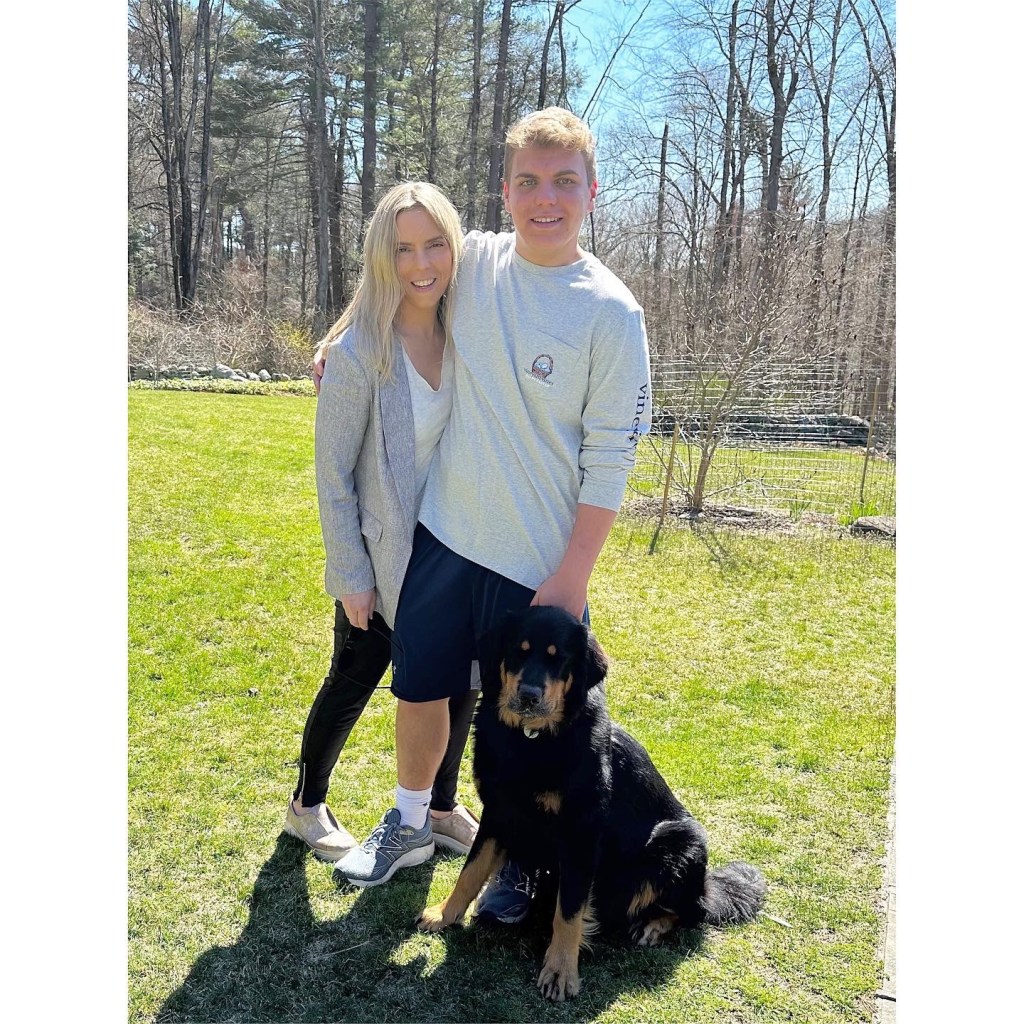
On the daily, I am the recipient of beautiful, heartfelt comments commending the person that stands by my side in this photo. Many of those comments conclude with a variation of the phrase, “it takes a village.” To which I reply, “Yes, yes it does…”
I am so proud to stand next to my not-so-little-boy, a young man who proudly holds a love for all beings, great and small. It’s a love delicately nurtured and handed down from those who came before him, before me.
Our shared empathic love for animals and ability to recognize the powerful benefits of the human-animal bond is innately within our core— the result of a generational love that transcends all barriers within a given space and time.
And from that love shines a hopeful conviction; he too will use this coveted passion and make this world a better place (in fact, he already is).
For it takes a village— yes, yes it does. But not just any village, it takes a dog-friendly village.
It takes a dog-friendly village to nurture the loving boy and guide him as he becomes the loving man he is destined to be.




 Empathic Paws