Yes, Your IB World High School Needs a Therapy Dog—Here’s Why

Today is World Mental Health Day, a perfect moment to highlight the well-being of students, faculty, and staff, particularly in high-pressure environments like those of International Baccalaureate (IB) World Schools. The IB program, renowned for its rigorous academic standards, challenges students to think critically, act compassionately, and manage complex workloads. However, with this academic intensity comes an ever-growing need to support the emotional and mental health of students who are managing exacerbating feelings resulting from a myriad of factors, one of which being the pandemic (Maricevic, 2022).

As Olli-Pekka Heinonen, Director General of the International Baccalaureate, emphasized in a recent commentary, the IB is re-evaluating education to prioritize well-being in every decision. Therefore, school and district leaders must consider alternative solutions to address the ever-evolving landscape of the 21st-century learner. One such solution is the integration of therapy dogs into the IB high school setting, a decision which not only enhances student well-being but also seamlessly aligns with the IB’s holistic educational approach.

Serving as a unique form of emotional support, therapy dogs in the high school setting transcends traditional methods of student care, fostering empathy, reducing stress, and cultivating a more inclusive school environment (Maricevic, 2022). Their presence encourages students to develop key attributes from the IB Learner Profile, such as being caring, balanced, and reflective, while also promoting emotional resilience. By bridging the gap between academic pressures and personal well-being, therapy dogs help create a learning environment where students can focus, engage, and perform to their fullest potential.

Therapy Dogs: More Than a Comfort, a Core Resource

Therapy dogs offer far more than comfort during stressful times; they play a crucial role in cultivating emotional intelligence and resilience—key components of the IB Learner Profile. Attributes such as being caring, balanced, and reflective are not merely learned from textbooks but are nurtured through lived experiences, often with the guidance of compassionate role models. Therapy dogs provide a unique opportunity for students to develop these traits by offering an empathetic, non-judgmental presence (Maricevic, 2022).

According to Heinonen (2023), well-being is central to learning; without it, students’ minds and bodies become burdened, making academic success increasingly difficult to achieve. Therapy dogs have been shown to alleviate stress, lower anxiety, and increase feelings of belonging—elements crucial for creating a positive learning atmosphere (Maricevic, 2022). By helping students manage academic pressure and emotional strain, therapy dogs directly contribute to the IB’s goal of developing balanced, reflective learners (Maricevic, 2022).

Addressing the Well-Being Crisis

The pandemic has created an undeniable shift in how schools conceptualize well-being. As remote learning became the norm and face-to-face interactions dwindled, students and educators alike experienced heightened levels of stress and uncertainty (Heinonen, 2023). A survey conducted under the #BetterTogether initiative revealed that two in five individuals have faced personal mental health struggles during the pandemic (Heinonen, 2023). Heinonen’s (2023) inclusion of #BetterTogether’s findings reflects the growing concerns voiced by parents and educators worldwide, who are advocating for a more holistic approach to education—one that prioritizes not only academic achievement but also the social and emotional development of students (Maricevic, 2022).

The good news is that the IB Organization appears to recognize these challenges, as it prides itself on a whole-school approach to well-being (Heinonen, 2023). As Heinonen (2023) notes, this approach encompasses every aspect of school life, not merely exam results or curriculum delivery. This is why the inclusion of therapy dogs in IB World Schools aligns perfectly with such a philosophical and pedagogical position, providing a means to support the mental health of students, faculty, staff, and the entire learning community. By fostering a supportive, calming environment, therapy dogs help mitigate the effects of stress, build community, and promote emotional resilience—elements that are key to long-term academic success (Maricevic, 2022).

Mitigating Concerns and Overcoming Barriers

As with any new initiative, the introduction of therapy dogs raises concerns about logistics, allergies, and liability. However, with careful planning and clear policies, these challenges—including allergies, sensitivities, safety, and cultural considerations—can be effectively addressed (Maricevic, 2022). For instance, schools can establish designated dog-free zones for students and staff with allergies or sensitivities, ensuring their comfort while still allowing others to benefit from the therapy dog program (Maricevic, 2022). Another approach is to partner with certified therapy dog organizations to ensure the animals are well-trained for school environments, addressing safety concerns (Maricevic, 2022). Moreover, cultural differences can be respected by making participation voluntary and providing education on the role and benefits of therapy dogs (Maricevic, 2022). With these precautions in place, the program can be smoothly integrated into the school community, offering emotional support without compromising the needs or preferences of others (Maricevic, 2022).

Building a Holistic Educational Experience

Therapy dogs align with the IB’s mission to foster emotional, social, and academic growth, making them a vital addition to IB schools. Heinonen’s (2023) call to redesign education with a focus on well-being underscores the importance of such resources. Therapy dogs serve as more than mere add-ons; they assist students and educators in navigating the pressures of a complex world. By enhancing emotional well-being, therapy dogs enable students to engage more deeply with the curriculum, fostering a growth mindset that encourages them to embrace challenges and learn from mistakes (Maricevic, 2022).

A Call to Action on World Mental Health Day

As we observe World Mental Health Day, there has never been a more urgent time to advocate for innovative solutions that address the well-being of students and educators. Therapy dogs offer a practical, impactful way to enhance emotional resilience, reduce stress, and foster a sense of belonging—qualities that are essential for the success of any educational program, particularly one as demanding as the IB.

Incorporating therapy dogs into secondary IB World Schools is not about diluting academic rigor (Maricevic, 2022). Instead, this programmatic addition represents a commitment to fostering holistic student development—one that recognizes the inseparability of emotional well-being and academic success (Maricevic, 2022). As Heinonen stated, “We know that the time to intervene in the well-being crisis is now” (2023). School and district leadership must act with intentionality, creating environments that prioritize progress over perfection and place student well-being at the heart of learning.

By welcoming therapy dogs into the fold, IB schools can demonstrate their continued commitment to creating a better, more compassionate world—one that nurtures the whole student, mind and heart—one paw at a time.

From Wellness Days to Therapy Dogs: Building a Healthier School Culture for the 21st Century

Photo by Karolina Kaboompics on Pexels.com

The concept of a school wellness initiative isn’t new; it has been a growing focus for many years among administrators, faculty, staff, and students as schools increasingly recognize the link between student health and academic success. For instance, in their 1991 article “Schoolsite Health Promotion: Establishing a Wellness Culture in Gwinnett County, Georgia,” David M. Hayes and Leslie F. Lambert discussed creating a wellness culture during a time when health promotion was becoming integrated into educational settings. Hayes and Lambert (1991) highlighted the importance of supporting students’ physical, mental, and emotional health to improve both well-being and academic outcomes. While this was a forward-thinking approach at the time, today’s landscape reveals that the need for such programs are even more urgent, as new challenges further reinforce the importance of comprehensive wellness initiatives in schools.

The Wellness Culture: Then and Now

In Gwinnett County, the health promotion programs aimed to build a comprehensive wellness culture focused on physical fitness, nutrition, and mental health (Hayes and Lambert, 1991). These efforts responded to concerns about childhood obesity, sedentary lifestyles, and rising stress among students (Hayes and Lambert, 1991). The goal was to create an environment where students could thrive physically and academically. While these initiatives successfully addressed student health issues at the time, the challenges highlighted in 1991 have only intensified, emphasizing the need for expanded wellness efforts.

Which brings one to wonder, if a 1991 wellness initiative was effective for the teens of Gwinnett County, wouldn’t a similar program benefit today’s teens? Absolutely! The adolescents of 1991 and 2024 face similar challenges—until they don’t. Today’s students contend with added pressures attached to increased technology use, social media, competitive academic environment, and the ongoing mental health crises exacerbated by the COVID-19 pandemic. It’s safe to conclude that the need for robust wellness initiatives in high schools has never been greater.

There is no harm in acknowledging the heightened need for sustained wellness programs, but to ignore the glaring evidence of its existence is a disservice to 21st-century learners. Students today face traditional adolescent stressors as well as the long-term effects of isolation and disrupted learning environments. Anxiety, depression, and other mental health concerns have surged, and schools must prioritize mental health with the same urgency as academics and athletics.

Expanding Wellness Programs to Meet Current Needs

While the program highlighted in Hayes and Lambert’s (1991) article laid the foundation for integrating physical fitness and mental health initiatives, today’s schools must adopt even more comprehensive approaches. A Wellness Day is an excellent starting point to emphasize emotional health, with the long-term goal of evolving this one-day initiative into ongoing support systems to address the whole students’ needs on the daily.

The Importance of Prioritizing Wellness in High Schools

Schools that prioritize emotional wellness send a powerful message: emotional health is just as important as academic achievement. And for high schools that have yet to implement a Wellness Day, now is the time to consider the lasting positive impact such an initiative can have on the learning environment. A day dedicated to mental health—through activities like meditation, art therapy, nature walks, or interacting with therapy dogs—offers a much-needed break from students’ regular routines.

Here’s some more good news attached to a school’s Wellness Day! A Wellness Day doesn’t have to be a standalone event. A Wellness Day can serve as a gateway to broader, ongoing wellness programs and one such program could be the inclusion of therapy dogs. Beyond the immediate benefits of stress relief and emotional support, a Wellness Day could introduce students to the long-term advantages of a therapy dog program, creating lasting improvements in their well-being.

The Impact of Therapy Dogs on Student Well-Being

The benefits of therapy dogs in schools are well-documented. Numerous studies have shown that providing students with an opportunity to interact with therapy dogs can reduce anxiety, lower stress, and improve overall mood (Maricevic, 2022). This is due in part to the therapy dogs ability to provide a calming presence, helping students feel more at ease in stressful environments, or as they manage invisible traumas (Maricevic, 2022). More good news attached to the presence of therapy dogs in the high school setting! Therapy dogs don’t just help students with specific needs—they offer support to anyone feeling overwhelmed, whether from exams, social difficulties, or other stressors, discretely and in a non-judgmental manner (Maricevic, 2022).

By incorporating therapy dogs into a Wellness Day, schools can introduce students and staff to the positive effects of animal-assisted therapy programs, potentially paving the way for a permanent addition of such support systems in schools.

Moving Toward a Wellness-Focused School Culture

For schools seeking to strengthen their commitment to student well-being, starting with a Wellness Day is a simple yet impactful first step. But it doesn’t have to stop there. By exploring the benefits of therapy dogs during a Wellness Day event, schools can build a wellness-focused culture that extends beyond a single day. A therapy dog program can offer continuous support for students, with therapy dogs available in counseling offices, classrooms, or even libraries, creating a more nurturing environment year-round.

While implementing a therapy dog program requires planning and collaboration, the potential benefits make it well worth the effort. Schools can partner with local therapy dog organizations or work with faculty and staff members who might have extensive training as a certified therapy dog handlers to ensure the program’s success.

The Need Remains

Ultimately, creating space for emotional wellness in high schools is not just a trend—it’s an investment in students’ futures. The article by Hayes and Lambert (1991) reflected a critical moment in the promotion of school wellness, but the need for wellness programs has only grown since the early 1990s. Today’s students face more complex mental health challenges, and schools must continue to prioritize student wellness by expanding programs to include initiatives like therapy dogs and sustained emotional support. The wellness culture envisioned in the 90s must now evolve to meet current needs, ensuring that schools remain spaces where students’ mental, emotional, and physical health are valued as much as academic success. By fostering an innovative wellness culture that prioritizes holistic health, schools can create a supportive environment where high school students are equipped to face both academic and personal challenges with resilience and confidence.

Kudos to those high schools making it happen.

The Power of Empathy: How Therapy Dogs in High School Can Fill an Empathy Void

Photo by Ivan Babydov on Pexels.com

Empathy is a cornerstone of human connection, fostering relationships and emotional well-being. In an insightful CNN article, Dr. Katie Hurley highlights the contagious nature of empathy and the crucial role parents play in modeling it for their teens. However, what happens when a teen lacks an empathic parent or guardian? How can these adolescents learn to cultivate empathy? One promising solution lies in the unique power of the canine companion.

The Empathy Deficit

Dr. Hurley’s article underscores the importance of parental warmth and emotional support in developing a teen’s empathy. The study Dr. Hurley references demonstrates a clear generational transmission of empathic behaviors from parents to children and beyond. But for teens who do not have access to such nurturing environments, this pathway to empathy can be obstructed, leading to potential emotional and social difficulties.

Benefits of Therapy Dogs

Enter therapy dogs. These specially trained animals offer unconditional love, companionship, and emotional support, which can be incredibly beneficial for teens struggling with empathy development. Therapy dogs have been shown to help individuals, particularly those with emotional and social challenges, to open up and engage in empathic behaviors.

Emotional Support: Therapy dogs provide a non-judgmental and consistent source of emotional support. Their presence can help teens feel understood and valued, which is essential for building self-esteem and emotional resilience (Maricevic, 2022).

Stress Reduction: Interacting with therapy dogs has been proven to reduce stress levels, which can create a more conducive environment for learning and practicing empathy. Lower stress levels allow teens to focus more on others’ feelings and less on their own anxieties (Maricevic, 2022).

Social Skills Improvement: Therapy dogs encourage social interactions. Teens may feel more comfortable practicing empathy and social skills with a dog first, which can then translate to better interactions with peers (Maricevic, 2022).

Modeling Empathy: By caring for and understanding the needs of a therapy dog, teens can learn to recognize and respond to emotions, a skill that is directly transferable to human relationships (Maricevic, 2022).

Real-Life Applications: Therapy Dogs in High School Settings

Several schools and therapy programs have successfully integrated therapy dogs to help students develop empathy and other social skills (Maricevic, 2022). For instance, programs like “Reading to Dogs” in libraries and schools encourage children and teens to read aloud to therapy dogs, improving their reading skills and building a sense of empathy and connection.

While the absence of an empathic parent can pose significant challenges for a teen’s emotional development, therapy dogs offer a viable and effective alternative to cultivate empathy. By providing emotional support, reducing stress, improving social skills, and modeling empathic behaviors, therapy dogs can fill a crucial gap, ensuring that all teens have the opportunity to develop this essential human trait (Maricevic, 2022).

Which is why the integration of therapy dogs in high school settings is an innovative approach that has proven to be highly beneficial in fostering empathy, reducing stress, and enhancing social skills among students (Maricevic, 2022). Here are some specific ways therapy dogs can make a significant impact in high schools:

Stress Relief and Mental Health Support

High school can be an incredibly stressful time for students due to academic pressures, social dynamics, and the challenges of adolescence (Maricevic, 2022). Therapy dogs can provide a calming presence, helping students manage stress and anxiety. Schools that have implemented therapy dog programs often report noticeable improvements in the overall mental health of their students (Maricevic, 2022).

Counseling Sessions: Therapy dogs can be incorporated into school counseling sessions. Their presence helps create a more relaxed environment, making it easier for students to open up and discuss their feelings and issues (Maricevic, 2022). This can be particularly beneficial for students who are reluctant to seek help from a counselor.

Stress-Relief Zones: Some high schools have established designated areas where students can interact with therapy dogs during breaks or free periods (Maricevic, 2022). These stress-relief zones provide a much-needed respite from the pressures of school life and offer a safe space for students to unwind and recharge.

Crisis Intervention: In the aftermath of traumatic events, therapy dogs can be brought in to provide comfort and emotional support to students. Their calming presence can help students feel safer and more secure, aiding in the healing process (Maricevic, 2022).

Enhancing Empathy and Social Skills

Therapy dogs can play a crucial role in teaching students empathy and improving their social skills. Interacting with dogs requires understanding their needs and emotions, which can translate into better interpersonal skills among students (Maricevic, 2022).

Empathy Workshops: Schools can organize workshops where students learn about empathy and emotional intelligence through interactions with therapy dogs. These workshops can include activities such as caring for the dogs, understanding their body language, and practicing gentle and respectful handling. These experiences can help students develop a deeper understanding of empathy, which they can then apply in their interactions with peers (Maricevic, 2022).

Social Skills Groups: Therapy dogs can be used in social skills groups to help students practice and enhance their social interactions. For example, students with social anxiety or autism spectrum disorders can benefit greatly from the presence of a therapy dog, which can act as a social bridge, making it easier for them to engage with others (Maricevic, 2022)

Peer Mediation Programs: Therapy dogs can be integrated into peer mediation programs, where students help resolve conflicts among their peers. The presence of a therapy dog can create a more relaxed atmosphere, making it easier for students to communicate openly and resolve their issues amicably (Maricevic, 2022).

Academic Benefits

The presence of therapy dogs in high schools can also have positive effects on academic performance (Maricevic, 2022). By reducing stress and creating a more supportive and relaxed environment, students may find it easier to focus and perform better academically (Maricevic, 2022).

Reading Programs: Similar to programs in elementary schools, high schools can implement reading programs where students read aloud to therapy dogs. This can be particularly beneficial for students who struggle with reading or have low confidence in their reading abilities. The non-judgmental presence of a dog can help them practice without fear of criticism, improving their skills and confidence over time (Maricevic, 2022).

Attendance and Engagement: Schools that have therapy dog programs often see improvements in student attendance and engagement. The presence of therapy dogs can make school a more welcoming and enjoyable place, encouraging students to attend regularly and participate more actively in their classes (Maricevic, 2022).

Exam Stress Reduction: During exam periods, therapy dogs can be brought in to help students cope with the heightened stress and anxiety. Short interactions with therapy dogs before exams can help calm students and improve their focus and performance (Maricevic, 2022).

Building a Supportive School Community

Therapy dogs can help create a more supportive and inclusive school community by bringing students, teachers, and staff together (Maricevic, 2022).

Community Events: Schools can host events and activities centered around therapy dogs, such as “dog days” where therapy dogs visit the school, or fundraising events for local animal shelters. These events can foster a sense of community and shared purpose among students and staff (Maricevic, 2022).

Teacher and Staff Support: Therapy dogs can also provide support for teachers and staff, who often face high levels of stress. A happier and more relaxed staff can contribute to a more positive school environment, benefiting everyone in the school community (Maricevic, 2022).

Positive School Culture: The presence of therapy dogs can contribute to a more positive school culture by promoting kindness, compassion, and empathy. Students may be more inclined to engage in positive behaviors and support their peers, creating a more inclusive and welcoming environment (Maricevic, 2022).

As schools continue to explore innovative ways to support their students, therapy dog programs stand out as a promising and impactful solution. The presence of therapy dogs in schools not only provides immediate emotional and psychological benefits but also helps in building lifelong skills of empathy and compassion in students. By addressing the emotional needs of teens, especially those lacking empathic parental or guardian support, therapy dogs can help create a generation of more understanding, resilient, and emotionally intelligent individuals.

A Generational Love

On the daily, I am the recipient of beautiful, heartfelt comments commending the person that stands by my side in this photo. Many of those comments conclude with a variation of the phrase, “it takes a village.” To which I reply, “Yes, yes it does…”

I am so proud to stand next to my not-so-little-boy, a young man who proudly holds a love for all beings, great and small. It’s a love delicately nurtured and handed down from those who came before him, before me.

Our shared empathic love for animals and ability to recognize the powerful benefits of the human-animal bond is innately within our core— the result of a generational love that transcends all barriers within a given space and time.

And from that love shines a hopeful conviction; he too will use this coveted passion and make this world a better place (in fact, he already is).

For it takes a village— yes, yes it does. But not just any village, it takes a dog-friendly village.

It takes a dog-friendly village to nurture the loving boy and guide him as he becomes the loving man he is destined to be.

Me, Jacob, & Bravo

Let Me Remind You

An excerpt from my most recent blog, “Dog Save the People: My Conversation with John Bartlett.”

21st century students need more of the tangible, more ways to feel safe, secure, valued and loved, with opportunities to reciprocate those feelings towards another, without judgement (Maricevic, 2022).

Dr. Jessica Maricevic
Why therapy dogs? Why now?

This pseudo post-COVID America has unearthed a tremendous amount of pain, a pain some have tried desperately to suppress, or flat out ignore. Secondary stakeholders who acknowledge the macro reality of the invasive impact of the current geo-political climate are better equipped to consider the micro implications in the high school setting. And to those stakeholders who believe they must personally observe the influence of the macro reality in the micro setting, see with their own eyes presentable evidence of societal stressors, complex anxieties and invisible traumas to adequately address the social and emotional needs of students…

Well, read a little bit more of this post, because today’s high school students are carrying more than a load of books and a laptop with little to no storage.

So say you.

I’ll hold off on the details of my own research and findings for the time being simply to prove you don’t need to read academic journals and peer reviewed articles to establish an understanding of this crisis.

Yet, even with their respective leans, the conscious decision to report on the social and emotional concerns of teens suggests a unified effort to convey the severity of this stark reality.

Dr. Jessica Maricevic

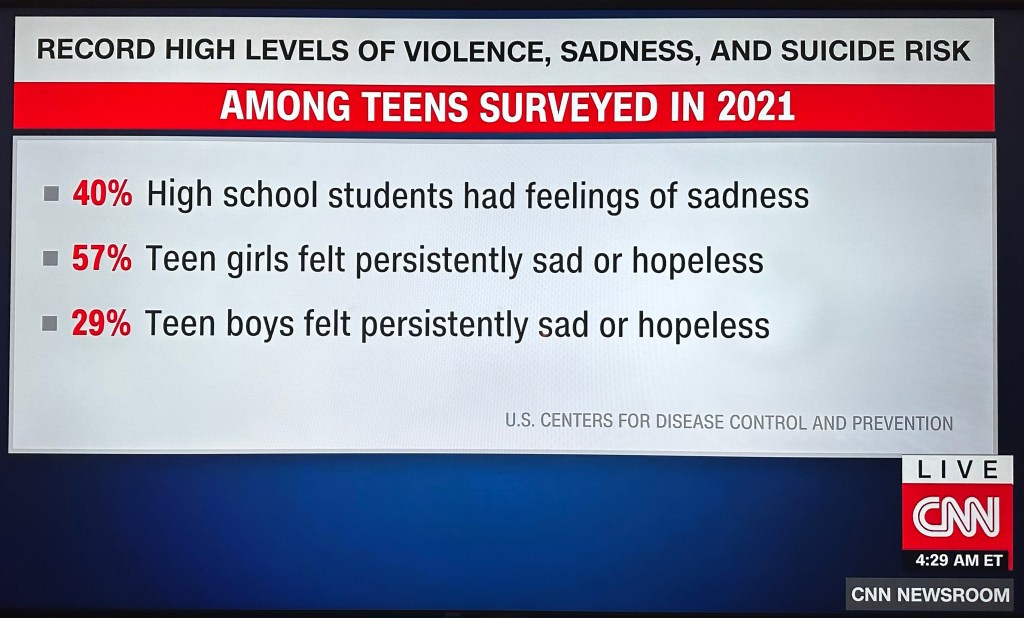
Here are some statistics presented from three national cable news outlets within the last 12 months:

An image I captured from my television during an early morning CNN live broadcast (February 14, 2023).
Read Elizabeth Pritchett’s article in its entirety: Teenage brains aged faster
April 26, 2022 segment from MSNBC’s Morning Joe; guest Harvard University’s John Della Volpe.

Understand, the above sources are a mere snapshot of reporting from three national cable news outlets, and yes I am well aware each source brings with it their own distinct bias. Yet, even with their respective leans, the conscious decision to report on the social and emotional concerns of teens suggests a unified effort to convey the severity of this stark reality.

It is extremely important to note the three news outlets referenced here in this post have observed an increase in viewership during the years of 2016 – 20220 (Pew Research Center, 2023). The research suggests such an increase in viewership is most likely connected to presidential elections, societal conflicts, and the coronavirus pandemic (Pew Research Center, 2023).

Hypothetically, if the Pew Research Center reports either (1) a decrease the numbers of viewers, (2) a plateau of viewership (it remains at its current rate), or (3) a continued upward viewership trend for the period of 2020-2023, millions of Americans would still receive the message loud and clear, teens are hurting, they need something more, and it’s up to the adults in their lives to make it happen.

Back in my day…

As students go from class to class, they carry the weight of the world and the plight of America’s transgressions on their shoulders, they are accompanied by feelings of sadness, hopelessness, feeling down, and depressed. And then, some students hold their breath when a school wide announcement interrupts a class period without warning, flinch upon hearing an unsuspecting sound, and ask what if questions the day after cable news outlets, those very outlets referenced above, consume airwaves with incessant reporting of yet another unthinkable event.

Even with all of this chaos, students aren’t desensitized by their reality. They remain hyper vigilant, in-tune to their emotional responses, and astute to the emotional affect of others in their orbit. But that doesn’t mean they are okay.

The last thing adolescents need is another adult telling them how to manage life as a teenager, or why they need grit and perseverance to get through “these unprecedented times.” Unfortunately, the reality for today’s teens requires more than “Back in my day” talks and harping on trendy jargon (I wish it were that easy). Couple that with the contradictory expectations to prioritize emotional wellbeing and academic performance— students need something more than whatever is provided at the secondary level to meet or exceed their social and emotional needs.

I can hear stakeholders’ “yeah, but…” phrases, ready to launch their counter claims:

Yeah, but their grades are fine.

Yeah, but they’re participating in sports.

Yeah, but they’re not alone in the cafeteria.

Yeah, but they’re taking selfies.

Yeah, but they’re friends with that student; they’re not a bully.

Yeah, but they seem happy.

It’s time to stop assuming. It’s time to stop dismissing the teenage experience. It’s time to start listening, and infuse differentiated support systems that are more real-world centric.

21st century students need more of the tangible, more ways to feel safe, secure, valued and loved, with opportunities to reciprocate those feelings towards another, without judgement (Maricevic, 2022).

Establish a therapy dog program (start today).

Now more than ever, therapy dogs are a viable resource to meet those needs for all high school students— no matter the zip code, regional location or poverty designation of a given school or district.

Yeah, but…

I know, I know! You’re asking yourself, “Yeah, but what about the challenges?” Mitigating challenges, is a totally different blog all together, but believe you me, I’ve got it all covered. I will tell you this, any perceived challenges from fears to allergies can be addressed to ensure the efficacy of board policy and the sustainability of an in-house therapy dog program in your high school (Maricevic, 2022).

This is my original gif which includes slides displaying my research and findings. These slides appeared in my Fall 2022 presentation to members of Association of Professional Humane Educators (and that presentation was an awesome experience).

I’ll also tell you that any stakeholder who flat out says no to an in-house therapy dog program to meet the social and emotional needs of students, is saying no for the sake of saying no (Maricevic, 2022). Don’t forget it.

The student-therapy dog relationship in the high school setting is an indelible, transformative fixture, a relationship with the infinite ability to transcend the four year high school experience. My findings suggest the omnipresence of a therapy dog in the high school setting does more than influence the social-emotional competency development in adolescents (Maricevic, 2022). In fact, the organic development of the student-therapy dog relationship may very well be the antidote to [feel free to fill in the blank to reflect the needs of your students and high school] (Maricevic, 2022).

My study reveals much more about the therapy dog phenomenon, its profound impact on secondary students and the high school setting. I’m proud to say my study also exposes inequities that must be addressed to ensure all students are afforded the opportunity to benefit from the student-therapy dog relationship during their high school years.

The above is a mere snippet of some of the points touched upon during my conversation with John Bartlett, host and founder of Dog Save the People. I encourage you to listen to the podcast in its entirety through any of the following platforms:

And let’s connect! Share your thoughts! Questions! I look forward to it.

Dog Save the People: My Conversation with John Bartlett

Me & Judge: Dog Save the People.

In the fall of 2022, I received an email from the amazing production team behind John Bartlett’s podcast, Dog Save the People. John and his team stumbled upon my website, were intrigued by the novel nature of my qualitative study, impressed by my steadfast research-based mission to dispel misconceptions around therapy dogs in high schools, desire to educate stakeholders on why therapy dogs are needed, and how to implement a therapy dog program with efficacy.

Dog Save the People have welcomed some unbelievable guests. Writers, professors, even Nobel Prize recipients, and now, to be added to this list, Dr. Jessica Maricevic— I’m humbled.

So here I am, and yeah, I know, I was always “here,” but I am forever grateful for Dog Save the People’s equally steadfast position to illuminate the voices of others (which in this episode, happens to be my voice).

Thank you John Bartlett, for providing a platform for my research, honoring my commitment to secondary education, the student-therapy dog relationship, and helping me educate others on how a vital relationship like the one between a high school student and a therapy dog needs to be an equitable norm for all high school students across America.

I welcome you to listen to the episode in its entirety (click here) and to explore some additional thoughts below.


Why therapy dogs? Why now?

This pseudo post-COVID America has unearthed a tremendous amount of pain, a pain some have tried desperately to suppress, or flat out ignore. Secondary stakeholders who acknowledge the macro reality of the invasive impact of the current geo-political climate are better equipped to consider the micro implications in the high school setting. And to those stakeholders who believe they must personally observe the influence of the macro reality in the micro setting, see with their own eyes presentable evidence of societal stressors, complex anxieties and invisible traumas to adequately address the social and emotional needs of students… well, read a little bit more of this post, because today’s high school students are carrying more than a load of books and a laptop with little to no storage.

So say you.

I’ll hold off on the details of my own research and findings for the time being simply to prove you don’t need to read academic journals and peer reviewed articles to establish an understanding of this crisis. Here are some statistics presented from three national cable news outlets within the last 12 months:

An image I captured from my television during an early morning CNN live broadcast (February 14, 2023).
Read Elizabeth Pritchett’s article in its entirety: Teenage brains aged faster
April 26, 2022 segment from MSNBC’s Morning Joe; guest Harvard University’s John Della Volpe.

Understand, the above sources are a mere snapshot of reporting from three national cable news outlets, and yes I am well aware each source brings with it their own distinct bias. Yet, even with their respective leans, the conscious decision to report on the social and emotional concerns of teens suggests a unified effort to convey a stark reality to their audiences.

It is extremely important to note the three news outlets referenced here in this post have observed an increase in viewership during the years of 2016 – 20220 (Pew Research Center, 2023). The research suggests such an increase in viewership is most likely connected to presidential elections, societal conflicts, and the coronavirus pandemic (Pew Research Center, 2023).

Hypothetically, if the Pew Research Center reports either (1) a decrease the numbers of viewers, (2) a plateau of viewership (it remains at its current rate), or (3) a continued upward viewership trend for the period of 2020-2023, millions of Americans would still receive the message loud and clear, teens are hurting, they need something more, and it’s up to the adults in their lives to make it happen.

Back in my day…

As students go from class to class, carry the weight of the world and the plight of America’s transgressions on their shoulders, they are accompanied by feelings of sadness, hopelessness, feeling down, and depressed. And then, some students hold their breath when a school wide announcement interrupts a class period without warning, flinch upon hearing an unsuspecting sound, and ask what if questions the day after cable news outlets, those very outlets referenced above, consume airwaves with incessant reporting of yet another unthinkable event.

Even with all of this chaos, students aren’t desensitized by their reality. They remain hyper vigilant, in-tune to their emotional responses, and astute to the emotional affect of others in their orbit. But that doesn’t mean they are okay.

The last thing adolescents need is another adult telling them how to manage life as a teenager, or why they need grit and perseverance to get through “these unprecedented times.” Unfortunately, the reality for today’s teens requires more than “Back in my day” talks and harping on trendy jargon (I wish it were that easy). Couple that with the contradictory expectations to prioritize emotional wellbeing and academic performance— students need something more than whatever is provided at the secondary level to meet or exceed their social and emotional needs.

I can hear stakeholders’ “yeah, but…” phrases, ready to launch their counter claims:

Yeah, but their grades are fine.

Yeah, but they’re participating in sports.

Yeah, but they’re not alone in the cafeteria.

Yeah, but they’re taking selfies.

Yeah, but they’re friends with that student; they’re not a bully.

Yeah, but they seem happy.

It’s time to stop assuming. It’s time to stop dismissing the teenage experience. It’s time to start listening, and infuse differentiated support systems that are more real-world centric.

21st century students need more of the tangible, more ways to feel safe, secure, valued and loved, with opportunities to reciprocate those feelings towards another, without judgement (Maricevic, 2022).

Establish a therapy dog program (start today).

Now more than ever, therapy dogs are a viable resource to meet those needs for all high school students— no matter the zip code, regional location or poverty designation of a given school or district.

Yeah, but…

I know, I know! You’re asking yourself, “Yeah, but what about the challenges?” Mitigating challenges, is a totally different blog all together, but believe you me, I’ve got it all covered. I will tell you this, any perceived challenges from fears to allergies can be addressed to ensure the efficacy of board policy and the sustainability of an in-house therapy dog program in your high school (Maricevic, 2022).

This is my original gif which includes slides displaying my research and findings. These slides appeared in my Fall 2022 presentation to members of Association of Professional Humane Educators (and that presentation was an awesome experience).

I’ll also tell you that any stakeholder who flat out says no to an in-house therapy dog program to meet the social and emotional needs of students, is saying no for the sake of saying no (Maricevic, 2022). Don’t forget it.

The student-therapy dog relationship in the high school setting is an indelible, transformative fixture, a relationship with the infinite ability to transcend the four year high school experience. My findings suggest the omnipresence of a therapy dog in the high school setting does more than influence the social-emotional competency development in adolescents (Maricevic, 2022). In fact, the organic development of the student-therapy dog relationship may very well be the antidote to [feel free to fill in the blank to reflect the needs of your students and high school] (Maricevic, 2022).

My study reveals much more about the therapy dog phenomenon, its profound impact on secondary students and the high school setting. I’m proud to say my study also exposes inequities that must be addressed to ensure all students are afforded the opportunity to benefit from the student-therapy dog relationship during their high school years.

The above is a mere snippet of some of the points touched upon during my conversation with John Bartlett, host and founder of Dog Save the People. I encourage you to listen to the podcast in its entirety through any of the following platforms:

And let’s connect! Share your thoughts! Questions! I look forward to it.