Promoting and equitably assisting organizations in the integration of animal-assisted therapies for the physical, mental, and emotional benefit of individuals in public and private settings, one paw at a time.
As a passionate writer, educator, researcher, and the founder of Empathic Paws, my dedication lies in bringing the incredible benefits of therapy dogs to adolescents in your high school.
My Journey
My educational journey includes a bachelor’s degree in English Literature from Stonehill College, a master’s degree in Curriculum and Teaching from Teachers College, Columbia University, and a Doctorate in Educational Leadership from Manhattanville College. Since 2005, I’ve been committed to the adolescent learner, developing curriculum that nurtures empathy, advocacy, and social responsibility for secondary students. This commitment is what led me to my groundbreaking qualitative research in “Therapy Dogs in Secondary Schools: Implementation Processes & Relationships to Students’ Social-Emotional Competencies,” and equips me in providing invaluable insights to the therapy dog implementation process.
The Power of the Paw
Not only am I a dedicated professional, but I also live with my family, which includes our four dogs, in the dog-friendly Sound Shore region of Westchester County, New York. My commitment to Empathic Paws goes beyond my professional life (I too have benefited from the human-animal bond for close to four decades.), making me the perfect champion for bringing therapy dogs into your school environment.
I firmly believe in the untapped potential of the human-animal bond as a genuine way to address the social-emotional needs of a school community, and beyond. Empathic Paws is dedicated to supporting institutions in incorporating animal-assisted therapies, including therapy dogs, utilizing research-based policy and programmatic protocols to meet and potentially exceed the physical, mental, and emotional needs of all stakeholders.
The Empathic Paws’ Approach
To ensure a smooth and successful integration of a therapy dog program in your school, I will use my original 10 Empathic Steps to Establishing a Therapy Dog Program in Your High School. The 10 Empathic steps to Establishing a Therapy Dog Program in Your High School will assist in implementing, establishing, and maintaining the long-term sustainability of a customized therapy dog program for your specific school and identified area of need, as well as educate, honor and empower stakeholders by:
Presenting comprehensive information on animal-assisted therapies and related topics to ensure all stakeholders are well-informed prior to the implementation process.
Remaining rooted in collaboration and empowerment, identified stakeholders will be included in the process.
Providing empathic guidance and expertise to navigate every step of the implementation process
There is no better thought than knowing your visit to Empathic Paws means you are one step closer to creating a unique therapy dog program that enriches the lives of your students and members of your learning community. Together, let’s harness the transformative power of the human-animal bond and enhance the well-being of all who call your high school home.
Get in touch
Ready to start the process? Don’t hesitate to send a message.
For those of you new to @empathicpaws, I am Dr. Jessica Maricevic, humane-ed reform and animal-assisted therapies advocate, and I am so very glad you’re here.
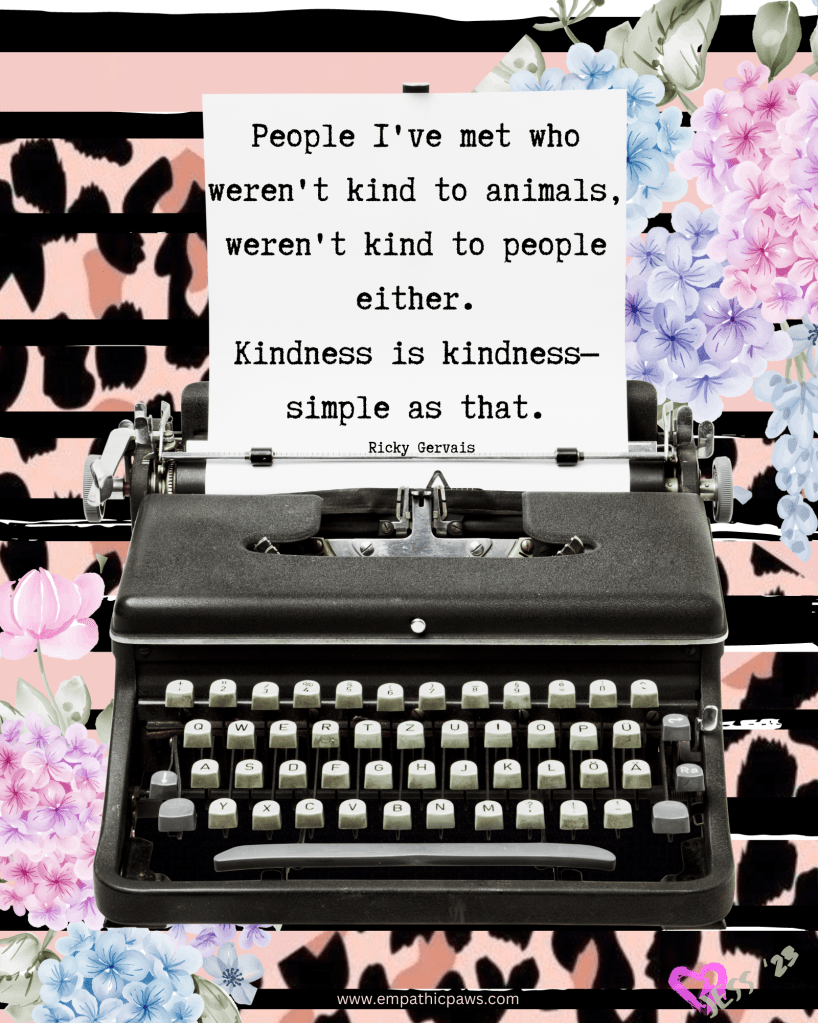
My most recent original graphic design is inspired by the words of comedian and humane advocate, Ricky Gervais. Let’s further the conversation around the interconnectedness of the human-animal relationship and social-emotional competency development and use Mr. Gervais’s words as a springboard.
The human-animal bond serves as a positive influence upon one’s social-emotional competency development, the sustainability of SECs and subsequent evolution of these traits throughout a person’s lifetime. And with that in mind, more consideration is needed within learning organizations on ways to infuse the human-animal relationship to further the radius of influence upon the social capital within the organization.
Allow Mr. Gervais’s words along with my original visual creation to serve as a conversation starter around the human-animal bond and the need to increase opportunities for such bonding in the high school setting.
I recently stumbled upon a TikTok post featuring a table-read for the sketch comedy show, The Muppet Show (1976 – 1981). The clip, posted by TikTok user, @muppetmarissa, includes the voice-overlay of creative mind and Muppet creator, Jim Henson, along with his perspective on the collaborative creative process. The clip progresses, there are many other voices of Muppet Legendary, and then comes the wave of nostalgia.
The Fabric
Now, if you made it this far, it should come as no surprise to learn the obvious. I am a huge Jim Henson fan. I mean, I am writing a reflection on educational leadership with an ode to The Muppets. Don’t worry, it has a purpose, I promise.
I am unsure where @muppetmarissa found this particular clip, but very much look forward to viewing what appears to be a documentary on Jim Henson that I have yet to review. I do know there is a highly anticipated documentary in the works about Jim Henson, directed and produced by the dynamic duo of Ron Howard and Brian Glazer. The release date of the Disney Original Documentary is still to be determined and you can read more about it here in this 2022 press release by The Jim Henson Company.
You see, I consider myself a creative. I allow myself the time, space, and flexibility to be creative in all aspects of my personal and professional interests. I credit my creative identity and all my ventures, from childhood to this very moment, to Jim Henson, his circle of like-minded creatives, the imaginary world they conjured for us kids in the 80s, and how that imaginary world has now transcended space and time.
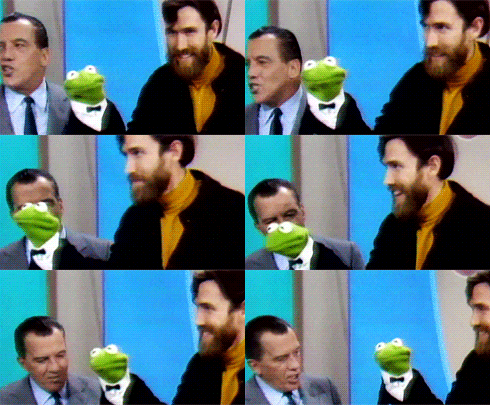
Ed Sullivan, Kermit the Frog and Jim Henson; The Ed Sullivan Show, N.D.
Shared Experience
I also know, I am not the only one who feels this way. Take actor Jason Segel, for example. Segal is best known for his role in the sitcom How I Met Your Mother (2005 – 2014), writing and starring in the iconic film, Forgetting Sarah Marshall (2008), writing and staring in the recent the AppleTV series, Shrinking (2023), and [drumroll please], his love of The Muppets.
Segel does not shy away from his love and appreciation for The Muppets, and even refers to them as his “childhood idols.” An additional interest worth noting is Segel’s idolization of Kermit the Frog, the amphibian embodiment of Henson’s legacy. Segel reveres Kermit almost as much as I revere the little green frog. During an interview to promote his mid-2000s film, The Muppets (2011), Segel was asked to divulge his favorite Muppet, to which he replied “… it’s Kermit. It’s always been Kermit.” I get it.
I get Segel’s #ItsAlwaysBeenKermit belief statement because quite frankly, I have an #ItsAlwaysBeenKermit belief statement, too. So here it goes, my Kermit belief statement:
Everything I learned in life, I learned from a little green frog.
I really get it.
In 2011, Segal took it upon himself to dust off the Muppet memories for us “80s kids,” thanks to writing and staring alongside them for their return to the big screen. That summer, I took my son, who was then 4 years old, along with his cousins, to see Segal’s major motion picture production. We sat in a quaint, Berkshire, Massachusetts movie theater. What could be better than a summertime movie, in the Berkshires, and watching The Muppets? Nothing. There is nothing better. Trust me.
The lights dimmed. The credits rolled, and so did the tears. Let me be more specific. The credits rolled, and so did my tears.
I wish I could say I was overcome with emotion because it was my son’s first time in a movie theater– it wasn’t that. No, it wasn’t tears of joy. Tears of sadness? Nah. Nope, not tears longing for the days of yesterday. I pretty much cried throughout the entire movie.
The Act of Being
For the duration of the film, the adult me was very cognizant of the fact that I was in a theater, surrounded by children, one of them being my own, to watch a film in which my own childhood icons paraded on screen. The film, for all intents and purposes, was presented under the auspices of a children’s movie. But to me, I knew this film was not exclusively targeted to the 4-12 year old demographic, but to their parents, guardians, aunts, uncles, neighbors– to those “80s kids.”
The Muppets (2011) was a film targeted to me, and my tears were tears of being; being seen, heard and valued.
It was so very apparent, how by watching this film, my personal roadmap, goals, dreams, and aspirations were emphatically validated, and not just by any other person, by another like-minded creative, personally and professionally influenced by Henson and his Muppets.
Jason Segel got it– he got me.
I was beingseen, valued, and heard as a person in need of a reminder, a reminder to remember….and I wasn’t the only one. I wasn’t the only one positively influenced by the creative masterminds behind The Muppets. I wasn’t the only one still using the efforts of ingenious creatives, like Henson, to fuel my purpose. I wasn’t the only one who wanted to genuinely find opportunities to advocate for empathy and understanding, to leave my mark on this world, and make it just a little brighter than it was the day before.
There are people, like Segel, who are like me. There are people, like Segel, who, like me, want others to know that even during some of life’s most [fill in the blank] moments, they are seen, heard and valued.
Educational Leadership
As I reflect on my own educational leadership journey, there is the running motif and thematic concept within my writing and it is centered around those three words: seen, valued, and heard (I’ve coined it “the trifecta”). All individuals in an organization need to feel truly seen, valued, and heard for a plethora of reasons; the multitude of stakeholders: who is the cultivator of “the trifecta” one day and who is the receiver the next; interwoven relationships between district, school building leadership and the trickle down effect; leadership philosophy and philosophical approaches to management, transactional vs. transformational…
Now, enter students into the equation. Students must feel seen, heard and valued, and if teachers are the ones to help cultivate and nurture “the trifecta,” then teachers must also be a receiver of those feelings, which then means district and school building leadership must …. round and round we go.
All stakeholders must have equitable access to “the trifecta.” Easier said than done? Meh.
Everything I learned in life, I learned from a little green frog.
I get it, because I believe it. And I also believe in order to cultivate authentic opportunities for others to feel all those things, and more, it takes creative ingenuity, it requires safety and security, transparency, honesty, love, kindness, trust, empathy …. it requires a Kermit-like mindset.
A Kermit-Like Mindset to Leadership and Beyond! That reads as if it’s got some potential, and that is where the next chapter of my leadership journey will start.
During my most recent school building leadership internship course, students were to read one of five articles and provide a response. Below you will find my original thoughts inspired by the reading and analysis of Larry Ferlazzo’s the March 7, 2022 EducationWeek article, entitled, “It’s Time to Debunk the Myths About Standardized Tests.” I had fun writing this piece and hope you enjoy the read.
Standardized tests. Okay, fine. To appease the quantitative data driven mind reading this response, I will give you the token line you know I am programmed to say. Yes, the data produced from standardized tests provides insight into the abilities and deficiencies of students, areas in need of improvement, yada yada. Can you pick up on the sarcasm? Well, it’s there, along with a dramatic eye roll.
Please do not confuse my position around the quantitative data put forth by standardized assessments with my position on data as a whole. I actually love data. Data! Data! Data! I love data. I think that might make for a good bumper sticker, maybe a t-shirt. No, I really do.
Data is evidence.
Data is what I need to prove my point, to validate my position, because my position is never enough to stand on its own, it needs some support.
For example, I can’t rely on a singular data set when it comes to making a statement like the New York Yankees are the best team in baseball (we all know they are the best team in baseball, but still). And that singular data set cannot be my own opinion. Sound the bias alarms.
Following this line of thinking, why should one type of data set, say the data from standardized tests, trump all other data collected specific to evaluating a student’s performance? There is still the need for multiple data points for triangulation purposes, a system of checks and balances, etc, to ensure the findings reflect the data, the data-driven findings are reliable and sound, otherwise, nullify the recommendations.
Data does have a place, but only when that data is well-rounded data and truly meaningful to reflect and act upon. Data becomes meaningful when it reveals evidence, from multiple sources, to support or negate a school or district’s current curricular pathway, or the degree in which teaching practices/protocols established within that school or district effectively meet, or exceed, district, state, national, and at times external learning standards and benchmarks.
The data of value, the data I’m talking about, is the data the standardized test fails to produce.
The data of value, the data I’m talking about is the data society has deemed as a less valuable marker.
You see, data most definitely has value, but that data is “no good,” especially when it suggests there are inequities at play.
That data is “no good,” when it takes a stand-alone moment in time, and gives that moment such tremendous power, quite possibly the power to determine the trajectory of one’s academic career, maybe even their life.
That data is “no good,” when it stems from an assessment catered to the student with just the right amount of socio-economic clout. Clout that, in turn, provides a cushion of support for almost guaranteed success, but does not guarantee the success of their classmate because of that impenetrable socio-economic stratosphere.
Any data produced from an assessment that reveals society’s interference and influence on determining who deserves an opportunity and who does not, is of no value. And it is society, government, the hierarchy established by the macro, and carried out by the micro, that continues to perpetuate this vicious cycle. What does all this “no good” data really try to remedy, or prevent from happening, anyway?
[and then there was silence]
Exactly.
There is no better time than now to make the academic playing field an equitable one, not one determined by the perfunctory toss of a scantron and test booklet– one to the student the system wishes to promote, and one to the student the system wishes to leave behind.
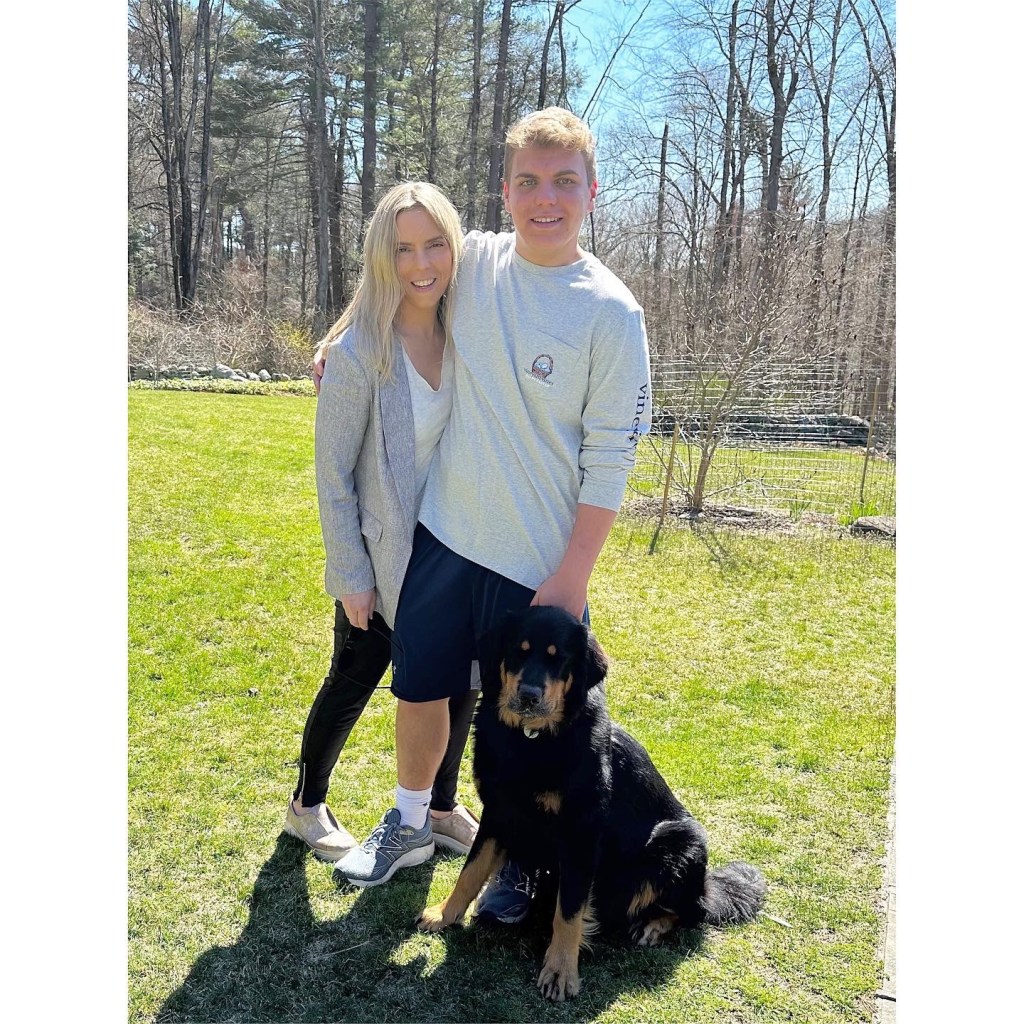
On the daily, I am the recipient of beautiful, heartfelt comments commending the person that stands by my side in this photo. Many of those comments conclude with a variation of the phrase, “it takes a village.” To which I reply, “Yes, yes it does…”
I am so proud to stand next to my not-so-little-boy, a young man who proudly holds a love for all beings, great and small. It’s a love delicately nurtured and handed down from those who came before him, before me.
Our shared empathic love for animals and ability to recognize the powerful benefits of the human-animal bond is innately within our core— the result of a generational love that transcends all barriers within a given space and time.
And from that love shines a hopeful conviction; he too will use this coveted passion and make this world a better place (in fact, he already is).
For it takes a village— yes, yes it does. But not just any village, it takes a dog-friendly village.
It takes a dog-friendly village to nurture the loving boy and guide him as he becomes the loving man he is destined to be.
An excerpt from my most recent blog, “Dog Save the People: My Conversation with John Bartlett.”
21st century students need more of the tangible, more ways to feel safe, secure, valued and loved, with opportunities to reciprocate those feelings towards another, without judgement (Maricevic, 2022).
Dr. Jessica Maricevic
Why therapy dogs? Why now?
This pseudo post-COVID America has unearthed a tremendous amount of pain, a pain some have tried desperately to suppress, or flat out ignore. Secondary stakeholders who acknowledge the macro reality of the invasive impact of the current geo-political climate are better equipped to consider the micro implications in the high school setting. And to those stakeholders who believe they must personally observe the influence of the macro reality in the micro setting, see with their own eyes presentable evidence of societal stressors, complex anxieties and invisible traumas to adequately address the social and emotional needs of students…
Well, read a little bit more of this post, because today’s high school students are carrying more than a load of books and a laptop with little to no storage.
So say you.
I’ll hold off on the details of my own research and findings for the time being simply to prove you don’t need to read academic journals and peer reviewed articles to establish an understanding of this crisis.
Yet, even with their respective leans, the conscious decision to report on the social and emotional concerns of teens suggests a unified effort to convey the severity of this stark reality.
Dr. Jessica Maricevic
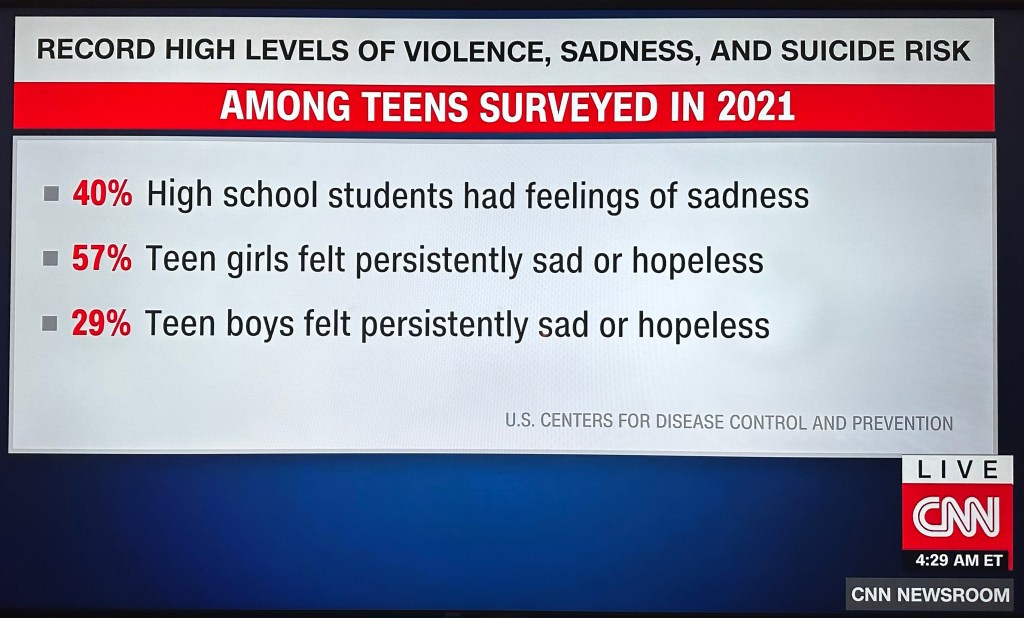
Here are some statistics presented from three national cable news outlets within the last 12 months:
An image I captured from my television during an early morning CNN live broadcast (February 14, 2023).Read Elizabeth Pritchett’s article in its entirety: Teenage brains aged faster…
April 26, 2022 segment from MSNBC’s Morning Joe; guest Harvard University’s John Della Volpe.
Understand, the above sources are a mere snapshot of reporting from three national cable news outlets, and yes I am well aware each source brings with it their own distinct bias. Yet, even with their respective leans, the conscious decision to report on the social and emotional concerns of teens suggests a unified effort to convey the severity of this stark reality.
It is extremely important to note the three news outlets referenced here in this post have observed an increase in viewership during the years of 2016 – 20220 (Pew Research Center, 2023). The research suggests such an increase in viewership is most likely connected to presidential elections, societal conflicts, and the coronavirus pandemic (Pew Research Center, 2023).
Hypothetically, if the Pew Research Center reports either (1) a decrease the numbers of viewers, (2) a plateau of viewership (it remains at its current rate), or (3) a continued upward viewership trend for the period of 2020-2023, millions of Americans would still receive the message loud and clear, teens are hurting, they need something more, and it’s up to the adults in their lives to make it happen.
As students go from class to class, they carry the weight of the world and the plight of America’s transgressions on their shoulders, they are accompanied by feelings of sadness, hopelessness, feeling down, and depressed. And then, some students hold their breath when a school wide announcement interrupts a class period without warning, flinch upon hearing an unsuspecting sound, and ask what if questions the day after cable news outlets, those very outlets referenced above, consume airwaves with incessant reporting of yet another unthinkable event.
Even with all of this chaos, students aren’t desensitized by their reality. They remain hyper vigilant, in-tune to their emotional responses, and astute to the emotional affect of others in their orbit. But that doesn’t mean they are okay.
The last thing adolescents need is another adult telling them how to manage life as a teenager, or why they need grit and perseverance to get through “these unprecedented times.” Unfortunately, the reality for today’s teens requires more than “Back in my day” talks and harping on trendy jargon (I wish it were that easy). Couple that with the contradictory expectations to prioritize emotional wellbeing and academic performance— students need something more than whatever is provided at the secondary level to meet or exceed their social and emotional needs.
I can hear stakeholders’ “yeah, but…” phrases, ready to launch their counter claims:
Yeah, but their grades are fine.
Yeah, but they’re participating in sports.
Yeah, but they’re not alone in the cafeteria.
Yeah, but they’re taking selfies.
Yeah, but they’re friends with that student; they’re not a bully.
Yeah, but they seem happy.
It’s time to stop assuming. It’s time to stop dismissing the teenage experience. It’s time to start listening, and infuse differentiated support systems that are more real-world centric.
21st century students need more of the tangible, more ways to feel safe, secure, valued and loved, with opportunities to reciprocate those feelings towards another, without judgement (Maricevic, 2022).
Establish a therapy dog program (start today).
Now more than ever, therapy dogs are a viable resourceto meet those needs for all high school students— no matter the zip code, regional location or poverty designation of a given school or district.
Yeah, but…
I know, I know! You’re asking yourself, “Yeah, but what about the challenges?” Mitigating challenges, is a totally different blog all together, but believe you me, I’ve got it all covered. I will tell you this, any perceived challenges from fears to allergies can be addressed to ensure the efficacy of board policy and the sustainability of an in-house therapy dog program in your high school (Maricevic, 2022).
This is my original gif which includes slides displaying my research and findings. These slides appeared in my Fall 2022 presentation to members of Association of Professional Humane Educators (and that presentation was an awesome experience).
I’ll also tell you that any stakeholder who flat out says no to an in-house therapy dog program to meet the social and emotional needs of students, is saying no for the sake of saying no (Maricevic, 2022). Don’t forget it.
The student-therapy dog relationship in the high school setting is an indelible, transformative fixture, a relationship with the infinite ability to transcend the four year high school experience. My findings suggest the omnipresence of a therapy dog in the high school setting does more than influence the social-emotional competency development in adolescents (Maricevic, 2022). In fact, the organic development of the student-therapy dog relationship may very well be the antidote to [feel free to fill in the blank to reflect the needs of your students and high school] (Maricevic, 2022).
My study reveals much more about the therapy dog phenomenon, its profound impact on secondary students and the high school setting. I’m proud to say my study also exposes inequities that must be addressed to ensure all students are afforded the opportunity to benefit from the student-therapy dog relationship during their high school years.
The above is a mere snippet of some of the points touched upon during my conversation with John Bartlett, host and founder of Dog Save the People. I encourage you to listen to the podcast in its entirety through any of the following platforms:
Even though you might think otherwise, an outing with your doggo is never just a walk. Found moments for cognitive stimulation, whether one-on-one with a doggo, like here with Judgie Boy or the entire pack, requires just as much from me, the human, as it does for my doggo(s). It also allows me to stay current with my doggo’s communicative ways and presents opportunities for creative ingenuity to keep the fun fresh (yes, even when revisiting cognitive challenges for practice, that’s fresh-fun too)!
Our human-animal bond is strengthened by infusing opportunities for cognitive stimulation when on any venture together. And it’s this active-time spent together that invigorates the body, mind & emotions; allows for new perspectives to the world on a micro & macro level; cultivates empathy… it’s never just a walk.
So give it a try! Spice up the active-time with your doggo. Start small. Make it manageable. Enhance the good stuff you’re already doing. Consider your usual active routine & possible on-the-spot opportunities the routine itself may provide (i.e. setting), try-out an added layer of cognitive stimulation (like I’m doing here with weaving between the pillars), evaluate your doggo’s response to the activity, reassess & revise as needed.
There is one non-negotiable, no negative reinforcement! If your doggo presents a hesitant response to the added activity, respect the presentation of the doggo’s feelings with love & reassurance. Empathize with your doggo, even say “let’s try again tomorrow,” & resume the enjoyable aspects of the routine as you and your doggo have established. Build upon the fun and cognitive stimulation, love the moment, love your doggo for trying something new, & give yourself a pat on the back while you’re at it, your efforts are noticed by the one who matters, your doggo.
Don’t have a doggo but still want “in” on some of this good stuff? Here are a few ideas:
Join a friend on a walk with their doggo(s)
#Volunteer at a local animal shelter
#Foster! Give some one-on-one active time to a doggo who needs it most! The result (1) you adopt the doggo or (2) get that doggo ready for their furever family
It’s tough to be the “New Kid on the Block.” But it’s much easier to be “the new kid,” to acclimate, get comfortable with new surroundings, manage new personalities, to feel included in what may, at first, seem like an impermeable pack, when someone reaches out a hand, or paw; a welcomed extension for all to see & emulate.
If you can put yourself in the “paws” of a puppy, a puppy attempting to navigate a new life, on a new street, with 14 other new doggos, from 10 different households, then you can empathize with the person to your left, and to your right. You can extend your hand, or paw, in an empathic gesture of kindness to the “new kid on the block.” You can dissolve those socially constructed barriers, and make that connection. Believe me, you can.
In this real-life scenario, and others like it, the human-animal relationship provides us humans with the necessary intra & interpersonal competency development to be better humans.
Furthermore, developing these social-emotional competencies, with the help of a furry friend, results in a transferable awareness to the way in which we interact with other humans.
So, next time, when you notice a “new kid,” on a new “block,” be an ally. Open your heart & mind to the benefits of getting to know someone, without passing judgment.
Think about that next time, when there’s a “new kid,” on a new “block,” will you choose to be an ally? Will you choose to open your heart and mind to the benefits of getting to know someone, without passing judgment? Will you think of the new puppy, on the new street?
Be the person who consciously considers life from someone else’s shoes, or paws. Be the one to welcome “the new kid on the block,” into your pack.
Judge under the photograph, “Love On the Beach,” by local fine arts photographer, Peter Mendelson.
I happened to get up from the banquette during a Zoom doctoral class- needed a little pistachio snack, sustenance for all this writing.
Between the time it took to grab a few pistachios and my return, Judge wiggled under the table and positioned himself in perfect proximity- he patiently awaited my return.
My stealthy, determined friend, (who by the way, was trying all night to accomplish this very feat captured in this post), achieved his goal.
Who says, “No dogs on the banquette?” Well, I did.
Until, I didn’t.
I rely on Judge. I want and need him around. What’s to say that Judge doesn’t feel the same wants and needs sometimes? Actions speak louder than words, and for that very reason, Judge can hop-on-up, any time.
And yes, this goes for Daisy too. She just had better things to do, like thrust a clean pair of socks, rolled tight, up in the air and catch it about 100 times. Needless to say, those socks went back into the wash.




 Empathic Paws