Promoting and equitably assisting organizations in the integration of animal-assisted therapies for the physical, mental, and emotional benefit of individuals in public and private settings, one paw at a time.
NYPD K9 Steven, named after the late Manhattan Detective Steven McDonald, passed away after a battle with cancer; he was 7 years old. K9 Steven, a Dutch Shepherd, was more than a working dog for the NYPD. He transcended his role as a police dog, mirroring the heroic spirit of his namesake and partner, Officer Joe Brayuha.
For six years, K9 Steven and Officer Joe Brayuha formed an inseparable partnership that showcased an unparalleled commitment to their duty. Together, they undertook deployments with NY Task Force 1, demonstrating their versatility, resilience, and unwavering readiness to rise to challenges in moments of crisis. The trials they overcame together, and the unspoken camaraderie they embodied, oh the stories they must have exchanged…
I felt compelled to reach out to Officer Brayuha and our conversations, though brief, resonated deeply. He shared that K9 Steven had an extraordinary ability to connect with people, “he loved everyone he met.” And as I continued to read Officer Brayuha’s response, it became very clear why, as a dog-lover and advocate for animal-assisted therapies, I was curious to learn more about their bond—a bond that, in essence, is more similar than different from the bond I have with my own dogs, and probably more similar than different from your understanding of the human-animal bond.
K9 Steven and Officer Brayuha are, in fact, archetypal beings themselves, and when combined, they form an archetypal duo, the same archetypal duo easily recognized in movies, literature, and typed across front page headlines of real life. They are the quintessential archetypal duo that navigate archetypal situations together, rely on each other in countless ways to make it through archetypal conflicts and to overcome archetypal antagonists.
In many ways, K9 Steven emerged as a modern-day representation of the tragic hero archetype, bravely confronting cancer head-on, Sadly, when our furry friends receive a cancer diagnosis, it is a very tough archetypal villain to defeat.
Which is why there comes a time when the tragic hero must say goodbye, and that goodbye is especially hard when there is nothing more either archetypal character can do to prevent the inevitable closure to a plot line neither wants to end.
And as is life, the story resumes.
This time though, the onus to continue the duo’s mission and K9 Steven’s legacy doesn’t just fall on Officer Joe Brayuha—it’s a collective effort. And my small part is represented in this post.
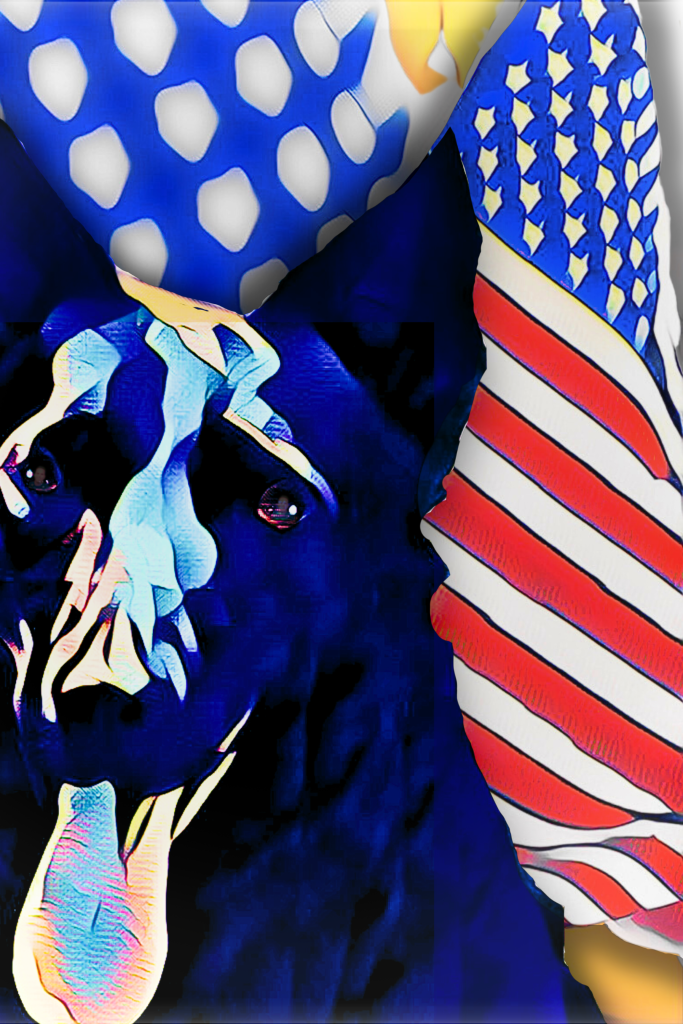
I created a digital collage of K9 Steven, entitled “Good Boy,” and found my creative inspiration from reading about K9 Steven and viewing his Instagram. If you look close you can observe the Chrysler Building and even Officer Brayuha. It is my intention to share a digital copy with Officer Brayuha as well as get a framed copy to him. I hope it will serve as a reminder of the duo’s positive impact, and their continued impact on others.
K9 Steven was most definitely a “good boy.” You’ll be missed, buddy.
My original creation; a digital design to welcome Instagram viewers to visit this blog post. My inspiration for this graphic stems from my love of the ocean, Montauk, and of course, dogs | J. Maricevic, 2023.
I recently read a funny meme. It was something along the lines of, “there are some people who should never have met my dog.” That might even be the exact wording, but I’m not quite sure.
I thought it was a funny post. I even considered reposting it. I thought about being cute and crossing out “dog” and replacing it with “dogs” (because I have four), or changing it to something like, “there are just some people who will never meet my dog, or dogs,” or maybe even, “there are just some people who will never meet my dog, or dogs, again,” because, well…
Listen, I know there are some people who simply do not deserve to be around any living creature due to their decision to treat an innocent being inhumanely. Let me be very clear on that point. Any unkind or abusive treatment is an obvious red flag, a scarlet letter forever emblazoned on a person’s chest, and that’s right, that person will never, ever be around your dogs, or my dogs, nor should they be around any other dogs or innocent beings.
So yes, there is at least one possible exception to the should never meet my dogs scenario. But was the concept behind the post, while produced in jest, further perpetuating negative thinking, energy and creating disharmony?
And then I got to thinking…
Why would there even be a person, or people, in an individual’s life who should never have met a person’s dog, or dogs, or never have the chance to meet a person’s dog in the future, or never have the opportunity to see them again? Yup, that’s a rhetorical question. You and I both have our own answers to our whys.
In normal Jess-fashion, I contemplated, reflected, and personalized the thought to better empathize with a person who holds such strong sentiments, and even take a moment to better empathize with myself.
I reverted back to when I was able to tangibly embrace my passion (that’s 4 years old). Talk about a lot of years, and a lot of memories, and a lot of “stuff” to sift through. Memories, moments, and faces– the flickers of my mental time capsule, going at Mach speed. And with each face, memory, and moment, there were a few, not many, which did include people who, for all intents and purposes, were/are tied up in that silly little meme I referenced at the beginning of my post.
[Enter Thinking]
Ironically enough, the people who, in theory, should never have met my dogs, are the very people who, at the time, probably needed to meet my dogs the most. There are probably people I have yet to meet, who need to meet my dogs. There might even be people who have met my dogs, who really do need to meet them again. I am not quite sure how I feel about coming to such a realization. We fear the unknown right? Or is it that we fear the known?
My original creation; a mock-meme which I like to call, Probably the Ones who Needed to Meet them the Most. This image appears in my most recent instagram post | J. Maricevic, 2023.
A Transformative Impression
Dogs have a unique way of touching lives and teaching valuable lessons through their ability to bring joy, companionship, and help others become more patient, empathic, and responsible (Maricevic, 2022). Meeting another person’s dog can be a transformative experience for some individuals, even if they have had limited exposure to dogs or pets in general. It’s also possible that emotional competency development can happen without directly interacting with a person’s dog (Maricevic, 2022). It can also happen for a person who observes others interact with their furry family member.
Yes, that means when one person is able to witness (1) how another interacts with a dog, (2) how one person can love another being other than themselves or (3) a demonstration of reciprocal and unconditional love in return, those observations alone have the potential to leave a positive impression on a person’s psyche (Maricevic, 2022). Not just any impression, a transformative impression; an impression for the better.
Interacting either directly or indirectly with a dog can model what it looks and feels like to give and receive unconditional love, how to develop trust, embrace responsibilities, and the importance of living in the present moment (Maricevic, 2022). Such observations can also provide an opportunity for empathic growth, as others learn to understand the needs and behaviors of the do, in turn strengthens a person’s ability to develop and form bonds over time with humans and dogs (Maricevic, 2022).
Let’s not forget, dogs are known to have a positive impact on mental health, reducing stress and anxiety. For people who may be struggling emotionally or socially, a dog could provide a source of comfort, support, and a means for connecting with others during moments when feeling isolated, or even ostracized from the world. Dogs serve as a bridge for connectivity, helping to establish, solidify, and even mend relationships.
Got Hope?
At first thought, there might be people who come to mind who should never have met a person’s dog, or never will get the chance to meet a person’s dog, or those who will never have the chance to meet a person’s dog again. Now, minus the aforementioned exception, I challenge that initial thinking. In fact, I propose those should never or will never statements, shift to maybe one day statements.
If one is to change from a never mindset, to a maybe mindset, does that potentiality provide more space for positive thoughts, and less negativity? Does a change from a never mindset, to a maybe mindset create a space for an unexpected connection, a misunderstanding understood, a missed connection redirected, or serendipitous happenstance?
Admittedly, a change in mindset may never bring a moment to reality, and even if it does present itself, the moment might be fleeting or the opportunity anticlimactic. Those maybes may never happen at all. Even so, if there exists an opportunity for personal growth and positive experiences, and that opportunity starts within the individual themselves through self-empowerment and self-actualization, and there is no harm being done to oneself physically or emotionally, no harm being done to another person physically or emotionally, and no harm done to any person’s dog or dogs, then perhaps it’s worthwhile in the long run?
Perhaps, at least start with a shift in mindset. Perhaps be open to the maybe?
Maybe, one day [fill in the blank}.
Easier said than done, you say?
Maybe.
But I figure, on this rainy summer’s day, it’s worth a try. Chalk it up to needing some Vitamin D, being over all this rain, or an exercise in strength conditioning…. ’tis the season to bulk up the mental and emotional fortitude needed for the time when the radiant rays of sunshine give way to crisp fall days.
For those of you new to @empathicpaws, I am Dr. Jessica Maricevic, humane-ed reform and animal-assisted therapies advocate, and I am so very glad you’re here.
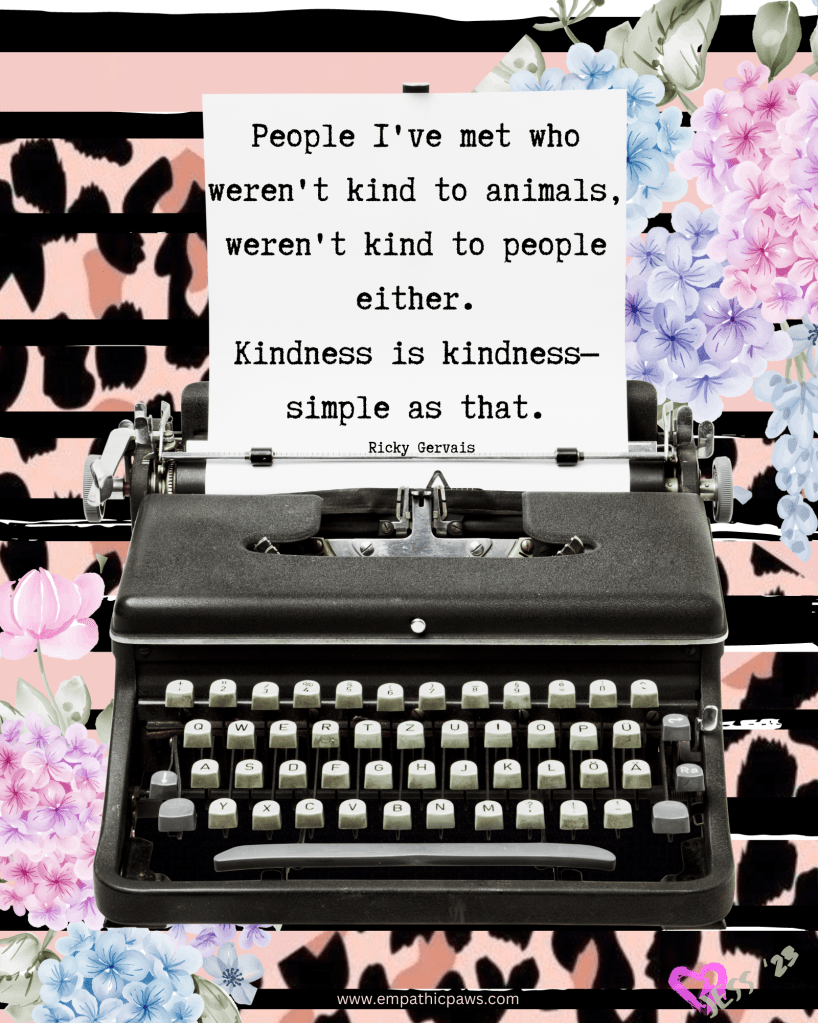
My most recent original graphic design is inspired by the words of comedian and humane advocate, Ricky Gervais. Let’s further the conversation around the interconnectedness of the human-animal relationship and social-emotional competency development and use Mr. Gervais’s words as a springboard.
The human-animal bond serves as a positive influence upon one’s social-emotional competency development, the sustainability of SECs and subsequent evolution of these traits throughout a person’s lifetime. And with that in mind, more consideration is needed within learning organizations on ways to infuse the human-animal relationship to further the radius of influence upon the social capital within the organization.
Allow Mr. Gervais’s words along with my original visual creation to serve as a conversation starter around the human-animal bond and the need to increase opportunities for such bonding in the high school setting.
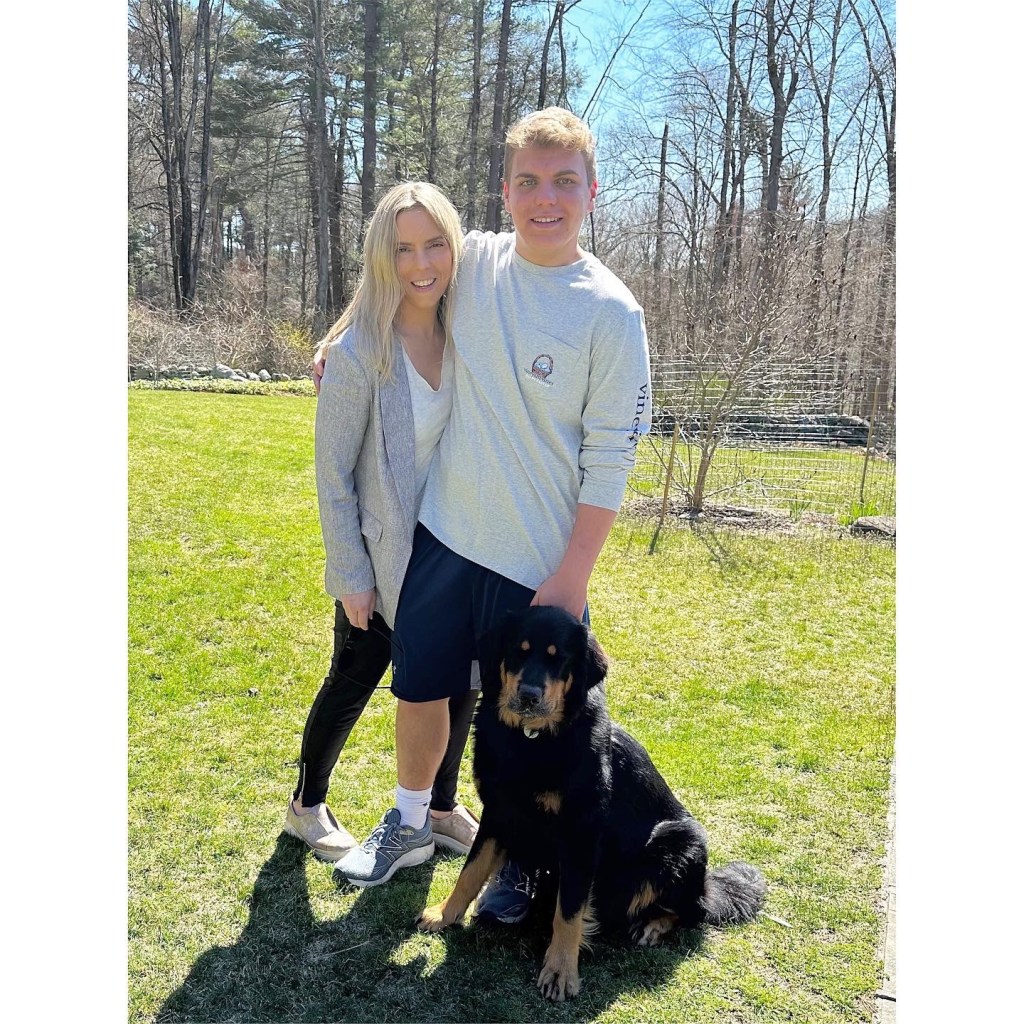
On the daily, I am the recipient of beautiful, heartfelt comments commending the person that stands by my side in this photo. Many of those comments conclude with a variation of the phrase, “it takes a village.” To which I reply, “Yes, yes it does…”
I am so proud to stand next to my not-so-little-boy, a young man who proudly holds a love for all beings, great and small. It’s a love delicately nurtured and handed down from those who came before him, before me.
Our shared empathic love for animals and ability to recognize the powerful benefits of the human-animal bond is innately within our core— the result of a generational love that transcends all barriers within a given space and time.
And from that love shines a hopeful conviction; he too will use this coveted passion and make this world a better place (in fact, he already is).
For it takes a village— yes, yes it does. But not just any village, it takes a dog-friendly village.
It takes a dog-friendly village to nurture the loving boy and guide him as he becomes the loving man he is destined to be.
An excerpt from my most recent blog, “Dog Save the People: My Conversation with John Bartlett.”
21st century students need more of the tangible, more ways to feel safe, secure, valued and loved, with opportunities to reciprocate those feelings towards another, without judgement (Maricevic, 2022).
Dr. Jessica Maricevic
Why therapy dogs? Why now?
This pseudo post-COVID America has unearthed a tremendous amount of pain, a pain some have tried desperately to suppress, or flat out ignore. Secondary stakeholders who acknowledge the macro reality of the invasive impact of the current geo-political climate are better equipped to consider the micro implications in the high school setting. And to those stakeholders who believe they must personally observe the influence of the macro reality in the micro setting, see with their own eyes presentable evidence of societal stressors, complex anxieties and invisible traumas to adequately address the social and emotional needs of students…
Well, read a little bit more of this post, because today’s high school students are carrying more than a load of books and a laptop with little to no storage.
So say you.
I’ll hold off on the details of my own research and findings for the time being simply to prove you don’t need to read academic journals and peer reviewed articles to establish an understanding of this crisis.
Yet, even with their respective leans, the conscious decision to report on the social and emotional concerns of teens suggests a unified effort to convey the severity of this stark reality.
Dr. Jessica Maricevic
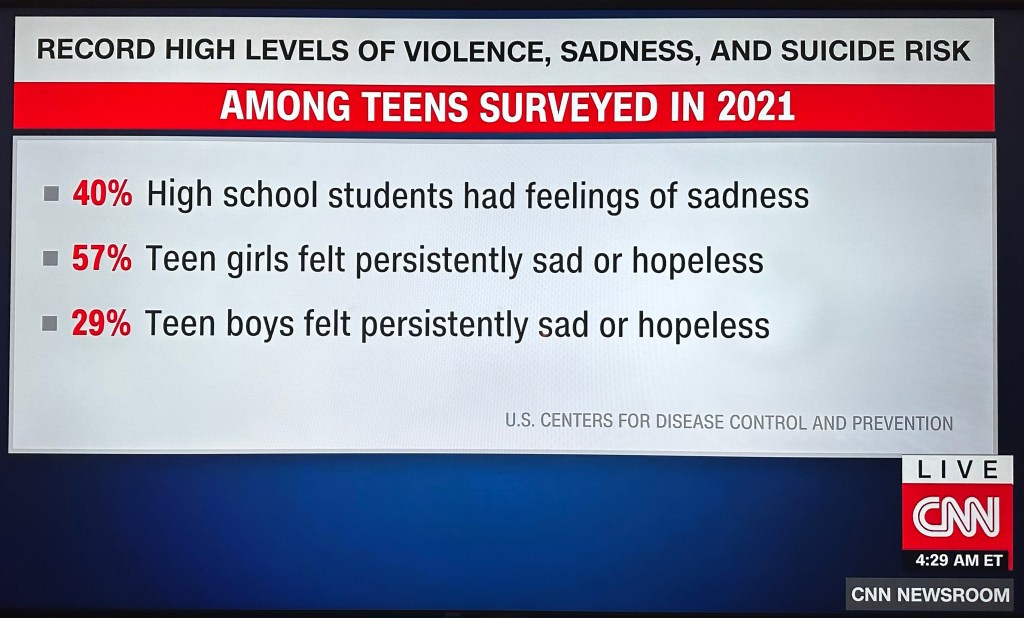
Here are some statistics presented from three national cable news outlets within the last 12 months:
An image I captured from my television during an early morning CNN live broadcast (February 14, 2023).Read Elizabeth Pritchett’s article in its entirety: Teenage brains aged faster…
April 26, 2022 segment from MSNBC’s Morning Joe; guest Harvard University’s John Della Volpe.
Understand, the above sources are a mere snapshot of reporting from three national cable news outlets, and yes I am well aware each source brings with it their own distinct bias. Yet, even with their respective leans, the conscious decision to report on the social and emotional concerns of teens suggests a unified effort to convey the severity of this stark reality.
It is extremely important to note the three news outlets referenced here in this post have observed an increase in viewership during the years of 2016 – 20220 (Pew Research Center, 2023). The research suggests such an increase in viewership is most likely connected to presidential elections, societal conflicts, and the coronavirus pandemic (Pew Research Center, 2023).
Hypothetically, if the Pew Research Center reports either (1) a decrease the numbers of viewers, (2) a plateau of viewership (it remains at its current rate), or (3) a continued upward viewership trend for the period of 2020-2023, millions of Americans would still receive the message loud and clear, teens are hurting, they need something more, and it’s up to the adults in their lives to make it happen.
As students go from class to class, they carry the weight of the world and the plight of America’s transgressions on their shoulders, they are accompanied by feelings of sadness, hopelessness, feeling down, and depressed. And then, some students hold their breath when a school wide announcement interrupts a class period without warning, flinch upon hearing an unsuspecting sound, and ask what if questions the day after cable news outlets, those very outlets referenced above, consume airwaves with incessant reporting of yet another unthinkable event.
Even with all of this chaos, students aren’t desensitized by their reality. They remain hyper vigilant, in-tune to their emotional responses, and astute to the emotional affect of others in their orbit. But that doesn’t mean they are okay.
The last thing adolescents need is another adult telling them how to manage life as a teenager, or why they need grit and perseverance to get through “these unprecedented times.” Unfortunately, the reality for today’s teens requires more than “Back in my day” talks and harping on trendy jargon (I wish it were that easy). Couple that with the contradictory expectations to prioritize emotional wellbeing and academic performance— students need something more than whatever is provided at the secondary level to meet or exceed their social and emotional needs.
I can hear stakeholders’ “yeah, but…” phrases, ready to launch their counter claims:
Yeah, but their grades are fine.
Yeah, but they’re participating in sports.
Yeah, but they’re not alone in the cafeteria.
Yeah, but they’re taking selfies.
Yeah, but they’re friends with that student; they’re not a bully.
Yeah, but they seem happy.
It’s time to stop assuming. It’s time to stop dismissing the teenage experience. It’s time to start listening, and infuse differentiated support systems that are more real-world centric.
21st century students need more of the tangible, more ways to feel safe, secure, valued and loved, with opportunities to reciprocate those feelings towards another, without judgement (Maricevic, 2022).
Establish a therapy dog program (start today).
Now more than ever, therapy dogs are a viable resourceto meet those needs for all high school students— no matter the zip code, regional location or poverty designation of a given school or district.
Yeah, but…
I know, I know! You’re asking yourself, “Yeah, but what about the challenges?” Mitigating challenges, is a totally different blog all together, but believe you me, I’ve got it all covered. I will tell you this, any perceived challenges from fears to allergies can be addressed to ensure the efficacy of board policy and the sustainability of an in-house therapy dog program in your high school (Maricevic, 2022).
This is my original gif which includes slides displaying my research and findings. These slides appeared in my Fall 2022 presentation to members of Association of Professional Humane Educators (and that presentation was an awesome experience).
I’ll also tell you that any stakeholder who flat out says no to an in-house therapy dog program to meet the social and emotional needs of students, is saying no for the sake of saying no (Maricevic, 2022). Don’t forget it.
The student-therapy dog relationship in the high school setting is an indelible, transformative fixture, a relationship with the infinite ability to transcend the four year high school experience. My findings suggest the omnipresence of a therapy dog in the high school setting does more than influence the social-emotional competency development in adolescents (Maricevic, 2022). In fact, the organic development of the student-therapy dog relationship may very well be the antidote to [feel free to fill in the blank to reflect the needs of your students and high school] (Maricevic, 2022).
My study reveals much more about the therapy dog phenomenon, its profound impact on secondary students and the high school setting. I’m proud to say my study also exposes inequities that must be addressed to ensure all students are afforded the opportunity to benefit from the student-therapy dog relationship during their high school years.
The above is a mere snippet of some of the points touched upon during my conversation with John Bartlett, host and founder of Dog Save the People. I encourage you to listen to the podcast in its entirety through any of the following platforms:
Even though you might think otherwise, an outing with your doggo is never just a walk. Found moments for cognitive stimulation, whether one-on-one with a doggo, like here with Judgie Boy or the entire pack, requires just as much from me, the human, as it does for my doggo(s). It also allows me to stay current with my doggo’s communicative ways and presents opportunities for creative ingenuity to keep the fun fresh (yes, even when revisiting cognitive challenges for practice, that’s fresh-fun too)!
Our human-animal bond is strengthened by infusing opportunities for cognitive stimulation when on any venture together. And it’s this active-time spent together that invigorates the body, mind & emotions; allows for new perspectives to the world on a micro & macro level; cultivates empathy… it’s never just a walk.
So give it a try! Spice up the active-time with your doggo. Start small. Make it manageable. Enhance the good stuff you’re already doing. Consider your usual active routine & possible on-the-spot opportunities the routine itself may provide (i.e. setting), try-out an added layer of cognitive stimulation (like I’m doing here with weaving between the pillars), evaluate your doggo’s response to the activity, reassess & revise as needed.
There is one non-negotiable, no negative reinforcement! If your doggo presents a hesitant response to the added activity, respect the presentation of the doggo’s feelings with love & reassurance. Empathize with your doggo, even say “let’s try again tomorrow,” & resume the enjoyable aspects of the routine as you and your doggo have established. Build upon the fun and cognitive stimulation, love the moment, love your doggo for trying something new, & give yourself a pat on the back while you’re at it, your efforts are noticed by the one who matters, your doggo.
Don’t have a doggo but still want “in” on some of this good stuff? Here are a few ideas:
Join a friend on a walk with their doggo(s)
#Volunteer at a local animal shelter
#Foster! Give some one-on-one active time to a doggo who needs it most! The result (1) you adopt the doggo or (2) get that doggo ready for their furever family
On any given day, for any given reason, the world can be a lonely, isolating place for a person navigating an internal challenge. And sometimes, those feelings are left to fester like an open sore to the person experiencing the emotions, emotions that may remain undetectable to the naked eye passing by (yes, there’s an allusion to Langston Hughes in this paragraph).
We all must be better to the stranger, the acquaintance, to those closest to us… we all must be better, for you never know of another person’s struggle…
And to be better requires courage, courage to be:
✨The individual to stand by the side of someone in the midst of a conflict…
✨The individual to stand up when bystanders appear to be oblivious to the reality of one’s struggle…
✨The individual to place assumptions aside and reach out to inquire about the well-being of another…
✨The one to say, “Sure, I’ll run alongside you!” without uttering a word…
✨The one to say, “You are not alone” without uttering a sound…
✨The one to take the kindness received, and pay it forward to another in need. #PayItForward…
Inspired by their collective canine courage, I share my artistic creation of Bravo supporting Daisy. Or is it Daisy supporting Bravo?
Is it really that important to distinguish which empathic set of paws is supporting the other? Maybe. Maybe not. Either way, Bravo and Daisy know that they have each other, no matter what the tide may bring. That, in itself, is just as much a comfort for the doggos as it is for their human.
There’s much to learn from our four legged friends— beings that possess the undeniable courage to do the right thing, allowing their actions to ‘speak’ louder than their … bark.
Judge under the photograph, “Love On the Beach,” by local fine arts photographer, Peter Mendelson.
I happened to get up from the banquette during a Zoom doctoral class- needed a little pistachio snack, sustenance for all this writing.
Between the time it took to grab a few pistachios and my return, Judge wiggled under the table and positioned himself in perfect proximity- he patiently awaited my return.
My stealthy, determined friend, (who by the way, was trying all night to accomplish this very feat captured in this post), achieved his goal.
Who says, “No dogs on the banquette?” Well, I did.
Until, I didn’t.
I rely on Judge. I want and need him around. What’s to say that Judge doesn’t feel the same wants and needs sometimes? Actions speak louder than words, and for that very reason, Judge can hop-on-up, any time.
And yes, this goes for Daisy too. She just had better things to do, like thrust a clean pair of socks, rolled tight, up in the air and catch it about 100 times. Needless to say, those socks went back into the wash.
A chilly Sunday evening brings me to think of warmer days.
Yes, I’m grateful for the faint summer breeze that lingers in my memory. I’m equally grateful for the night’s crisp, fall air, and for the love I receive, no matter the season, from the beautiful being that is Judge.
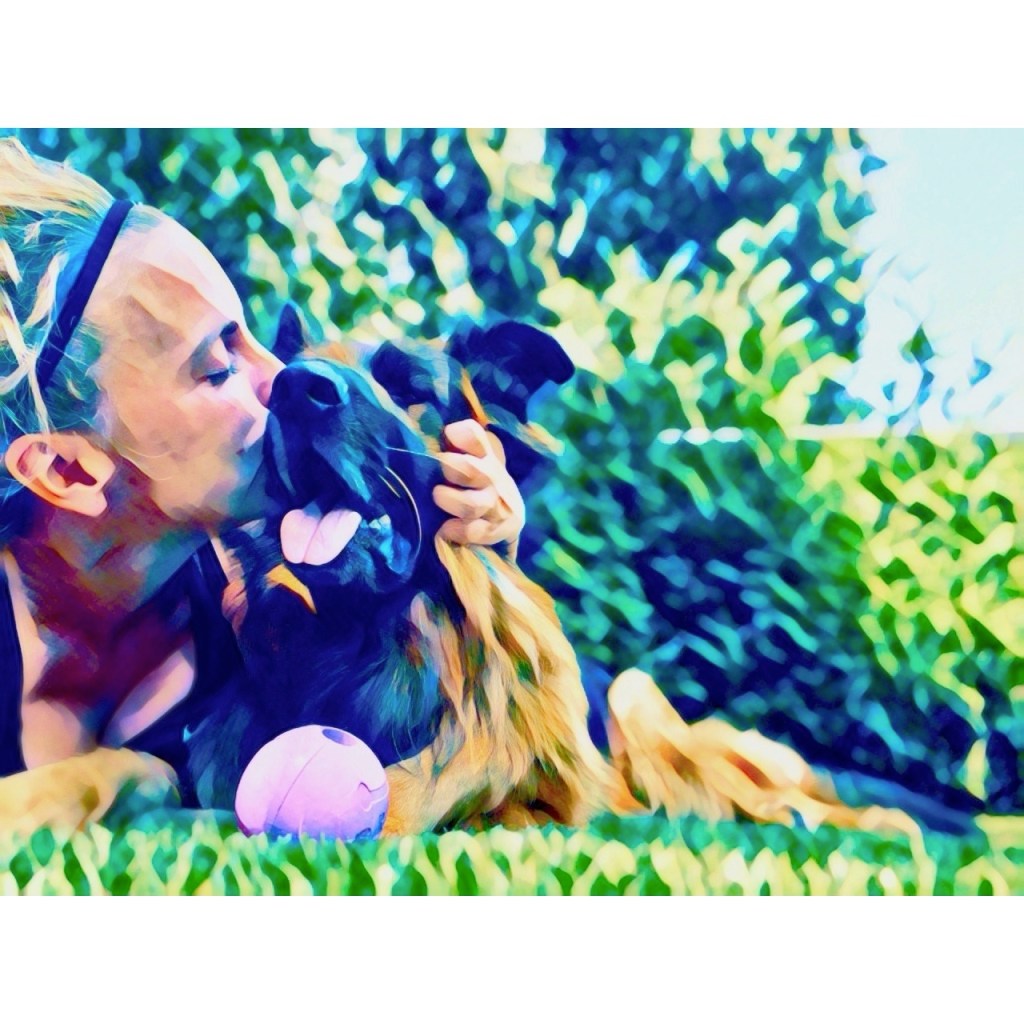
Judge’s love realigned my trajectory, pointed me in the very direction that I started out on when surprised with my very first puppy. I was 4 years old when this furry-best friend entered my life. From that day forward, there’s always been a dog, or two, or three, by my side.
As I reflect, it comes as no surprise to learn that the comedic legend, Gilda Radner, once said, “I think dogs are the most amazing creatures. They give unconditional love. For me they are the role model for being alive.”
From age 4, to this very moment, dogs have taught me how to love, to help, to be silly, to make mistakes, to listen, to comfort… how to be fierce in the name of justice, to stand in stoic support of the weary, to do what’s right…
Ah, there were never more truer words stated than those of Gilda Radner. Forever grateful that I, too, can attest to the validity of Radner’s perspective, all because of the unconditional love I received from my canine companions of yesterday, and from the unconditional love I continue to receive from my canine compass of today.
Let’s be honest, dogs know everything. Whether we verbally tell them our thoughts, or they feel our energy, or the energy of a situation; dogs know.
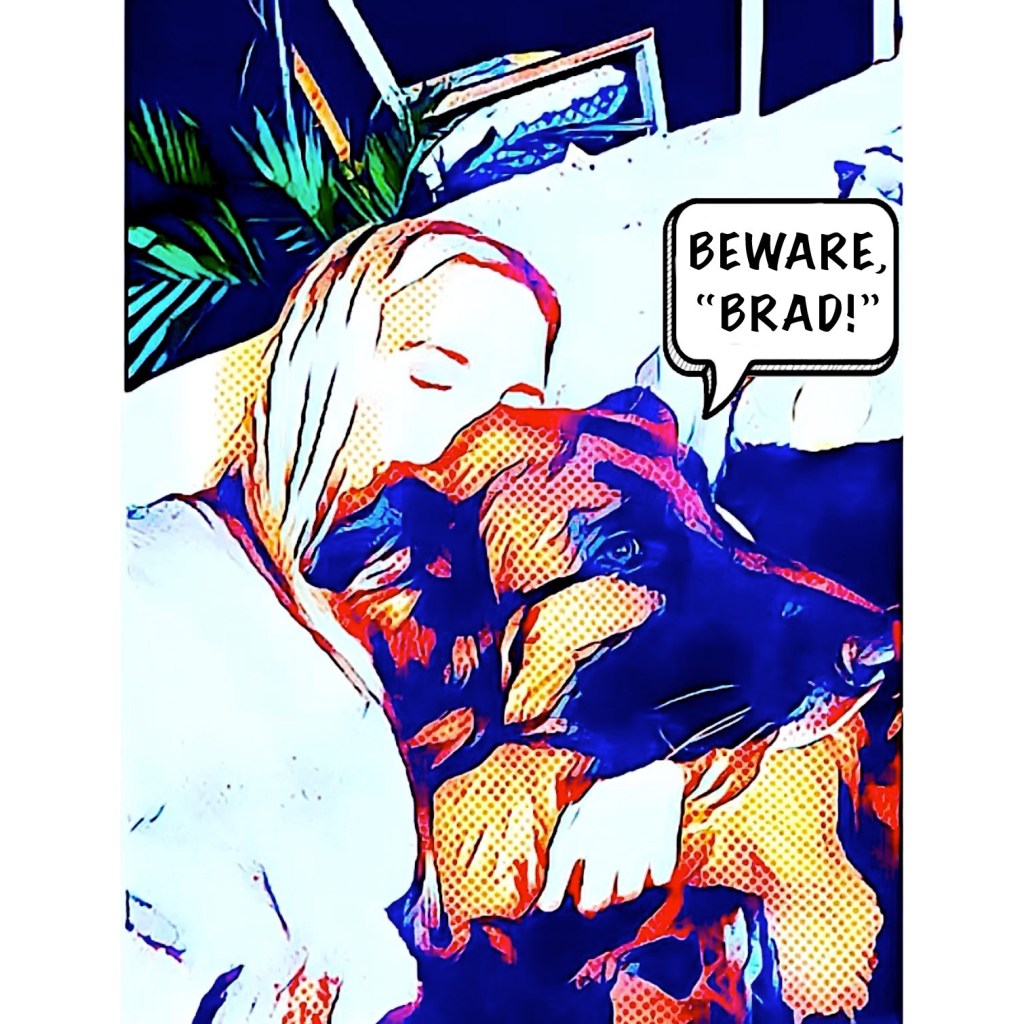
And it was that all-knowing, canine superpower that inspired my original, Roy Lichtenstein-esque, digital representation of the human-animal bond. For those unfamiliar with Lichtenstein’s artistic style, he incorporated the name “Brad” in some of his Pop Art creations. It is important to note that Lichtenstein never referred to this “Brad” with a positive connotation.
For my piece, I emulated Lichtenstein’s use of the name, “Brad,” with the intentions of having “Brad” be any ‘one,’ or any ‘thing,’ that impacts an individual’s physical and/or emotional welfare and security.
Wait, what about that canine cognition connection?
I know, from personal experience, that an individual’s physical and mental strength is restored, and their emotional fortitude reinvigorated, by the unconditional love from their four-legged friend. Dogs have the ability to identify when a “Brad” is lurking in the crevices of their person’s mind, or in the shadows of real-life, and dogs know when, and how, to intervene. The selfless-love of the all-knowing, canine companion, reaffirms a human’s sense of self, and in turn, sends the message to “Brad,” that this human, their human, is strong, confident, and supported.
So, “Beware, ‘Brad’,” for nothing can deter the empowered, especially when a dog is right by their side.





 Empathic Paws