To Love Like Judge

It’s taken me time to write this—maybe because putting it into words means admitting he’s really gone. But grief has a strange way of nudging us forward—through moments of kindness, memory, and unexpected connection.

You see, the other day I received a friendly question from a local gas station attendant. His question opened the door to this reflection, reminding me that Judge’s presence didn’t just change my life—it left a mark on others, too.


I stopped for gas, and the attendant—always kind and jovial—leaned ever so slightly in through the window with a warm smile.

“Where’s your big dog friend?” he asked, looking toward the back seat as if Judge might be curled up, ready to pop his head up—as was the norm.

I felt the weight of the words before I even spoke. But I said them. The attendant’s face shifted—genuine heartbreak in his expression. He wanted to know what happened to my friend, so I told him.

I thanked him for remembering Judge, for asking, for seeing us. He gave me a fist pump, “I’ll be thinking of you.”

The gas station attendant’s words and supportive fist-pump immediately brought me back to a warm summer evening walk a few seasons ago. An older gentleman on his evening stroll passed us and paused, his eyes soft with admiration. “Magnificent,” he said, nodding. “Simply magnificent.”

At the time, I thought he was talking about Judge, and he was, because Judge was magnificent—“magical,” to quote my son. But today, I wonder if the neighborly observation was referring to us—our bond, our rhythm, the strength in how we moved together, how we communicated.

There was something sacred in my connection with Judge, something that didn’t need to be explained—only admired for the authentic love it displayed. It was beautiful.

Intersectionality of Time and Space

The comment at the gas station isn’t so different from the one that summer day. Both came from strangers who saw something beautiful in our everyday. Both moments remind me that Judge’s legacy isn’t just the love he gave me—it’s the way he made people stop and feel something.

People gravitated toward him. Kids, neighbors, delivery drivers, the mailman who kept treats in his pocket just for Judge—they all felt it.

I’ve come to realize that people didn’t just see a beautiful dog when Judge was around—they felt something in his presence. There was a gentleness about him, a knowing. He carried himself with quiet confidence, never asking for attention but always drawing it.

It wasn’t just that he was loyal or smart or handsome or protective, though he was all of those things. It was the way he made people feel seen, safe, and loved—without needing words. He had that rare gift.

Love Like Judge

You know, whenever I posted a picture of Judge to Instagram, it was usually accompanied by the #mustlovejudge hashtag—a playful twist on the early 2000s rom-com Must Love Dogs. It became my unspoken rule, the standard for who I let into my life, into our life: “Must Love Judge.” If you didn’t get Judge or love him, you probably didn’t get me—or love me—either (not to mention our entire pack). Now, after losing him, I see that phrase a little differently.

It’s not enough to have loved Judge. The real challenge, the real calling, is to love like Judge—offering the same quiet comfort walking with people through joy and sorrow, listening without needing to speak, being loyal, steady, and present.

I once heard that grief is just love that has nowhere to go. I’m not sure I’ll ever be over the loss of Judge—and honestly, I don’t think I want to be. But my everlasting love for Judge does have somewhere to go.

The way forward is to carry what he taught me into every space I enter and meet the world with the same unwavering heart and the same quiet grace. This is Judgie’s Yoda-like life lesson I know he wants me to carry forward, reminding me to hold steadfast to my ability to love unconditionally, to always remember that I am deserving of that same unconditional love from the universe, and to encourage others to do the same.

So I choose love—the kind that asks for nothing but gives everything. The kind that lingers, even after goodbye.

I choose to love like Judge.


I want to take a moment to thank everyone who has been so incredibly supportive and kind throughout Judge’s battle—and through everything since. Your calls, texts, DMs, beautiful flowers, cards, handmade drawings, thoughtful gifts, hugs, and check-ins have lifted us all in ways I can’t fully put into words.

Every gesture, no matter how big or small, has been a testament to the love you had for Judge—and for us.

My wish for you is simple but sincere:

May everyone in this world be lucky enough to experience a love like Judge in their lifetime.

And may we all honor that gift by paying it forward—simply by loving like Judge.

Thank you for standing with my pack. Thank you for loving us through our heartbreaking loss.

We love you,

Jess, Jacob, Daisy, Bravo, & Bud

✌️🫶🐾

The Honorable Judge

September 10, 2017 – March 25, 2025

From Wellness Days to Therapy Dogs: Building a Healthier School Culture for the 21st Century

Photo by Karolina Kaboompics on Pexels.com

The concept of a school wellness initiative isn’t new; it has been a growing focus for many years among administrators, faculty, staff, and students as schools increasingly recognize the link between student health and academic success. For instance, in their 1991 article “Schoolsite Health Promotion: Establishing a Wellness Culture in Gwinnett County, Georgia,” David M. Hayes and Leslie F. Lambert discussed creating a wellness culture during a time when health promotion was becoming integrated into educational settings. Hayes and Lambert (1991) highlighted the importance of supporting students’ physical, mental, and emotional health to improve both well-being and academic outcomes. While this was a forward-thinking approach at the time, today’s landscape reveals that the need for such programs are even more urgent, as new challenges further reinforce the importance of comprehensive wellness initiatives in schools.

The Wellness Culture: Then and Now

In Gwinnett County, the health promotion programs aimed to build a comprehensive wellness culture focused on physical fitness, nutrition, and mental health (Hayes and Lambert, 1991). These efforts responded to concerns about childhood obesity, sedentary lifestyles, and rising stress among students (Hayes and Lambert, 1991). The goal was to create an environment where students could thrive physically and academically. While these initiatives successfully addressed student health issues at the time, the challenges highlighted in 1991 have only intensified, emphasizing the need for expanded wellness efforts.

Which brings one to wonder, if a 1991 wellness initiative was effective for the teens of Gwinnett County, wouldn’t a similar program benefit today’s teens? Absolutely! The adolescents of 1991 and 2024 face similar challenges—until they don’t. Today’s students contend with added pressures attached to increased technology use, social media, competitive academic environment, and the ongoing mental health crises exacerbated by the COVID-19 pandemic. It’s safe to conclude that the need for robust wellness initiatives in high schools has never been greater.

There is no harm in acknowledging the heightened need for sustained wellness programs, but to ignore the glaring evidence of its existence is a disservice to 21st-century learners. Students today face traditional adolescent stressors as well as the long-term effects of isolation and disrupted learning environments. Anxiety, depression, and other mental health concerns have surged, and schools must prioritize mental health with the same urgency as academics and athletics.

Expanding Wellness Programs to Meet Current Needs

While the program highlighted in Hayes and Lambert’s (1991) article laid the foundation for integrating physical fitness and mental health initiatives, today’s schools must adopt even more comprehensive approaches. A Wellness Day is an excellent starting point to emphasize emotional health, with the long-term goal of evolving this one-day initiative into ongoing support systems to address the whole students’ needs on the daily.

The Importance of Prioritizing Wellness in High Schools

Schools that prioritize emotional wellness send a powerful message: emotional health is just as important as academic achievement. And for high schools that have yet to implement a Wellness Day, now is the time to consider the lasting positive impact such an initiative can have on the learning environment. A day dedicated to mental health—through activities like meditation, art therapy, nature walks, or interacting with therapy dogs—offers a much-needed break from students’ regular routines.

Here’s some more good news attached to a school’s Wellness Day! A Wellness Day doesn’t have to be a standalone event. A Wellness Day can serve as a gateway to broader, ongoing wellness programs and one such program could be the inclusion of therapy dogs. Beyond the immediate benefits of stress relief and emotional support, a Wellness Day could introduce students to the long-term advantages of a therapy dog program, creating lasting improvements in their well-being.

The Impact of Therapy Dogs on Student Well-Being

The benefits of therapy dogs in schools are well-documented. Numerous studies have shown that providing students with an opportunity to interact with therapy dogs can reduce anxiety, lower stress, and improve overall mood (Maricevic, 2022). This is due in part to the therapy dogs ability to provide a calming presence, helping students feel more at ease in stressful environments, or as they manage invisible traumas (Maricevic, 2022). More good news attached to the presence of therapy dogs in the high school setting! Therapy dogs don’t just help students with specific needs—they offer support to anyone feeling overwhelmed, whether from exams, social difficulties, or other stressors, discretely and in a non-judgmental manner (Maricevic, 2022).

By incorporating therapy dogs into a Wellness Day, schools can introduce students and staff to the positive effects of animal-assisted therapy programs, potentially paving the way for a permanent addition of such support systems in schools.

Moving Toward a Wellness-Focused School Culture

For schools seeking to strengthen their commitment to student well-being, starting with a Wellness Day is a simple yet impactful first step. But it doesn’t have to stop there. By exploring the benefits of therapy dogs during a Wellness Day event, schools can build a wellness-focused culture that extends beyond a single day. A therapy dog program can offer continuous support for students, with therapy dogs available in counseling offices, classrooms, or even libraries, creating a more nurturing environment year-round.

While implementing a therapy dog program requires planning and collaboration, the potential benefits make it well worth the effort. Schools can partner with local therapy dog organizations or work with faculty and staff members who might have extensive training as a certified therapy dog handlers to ensure the program’s success.

The Need Remains

Ultimately, creating space for emotional wellness in high schools is not just a trend—it’s an investment in students’ futures. The article by Hayes and Lambert (1991) reflected a critical moment in the promotion of school wellness, but the need for wellness programs has only grown since the early 1990s. Today’s students face more complex mental health challenges, and schools must continue to prioritize student wellness by expanding programs to include initiatives like therapy dogs and sustained emotional support. The wellness culture envisioned in the 90s must now evolve to meet current needs, ensuring that schools remain spaces where students’ mental, emotional, and physical health are valued as much as academic success. By fostering an innovative wellness culture that prioritizes holistic health, schools can create a supportive environment where high school students are equipped to face both academic and personal challenges with resilience and confidence.

Kudos to those high schools making it happen.

Harmonizing Tails: My Unsuspecting Connection with Peter Frampton

Recently, I enjoyed an exciting post by fellow dog lover, Rocker Dog Podcast, teasing his most recent interview with the legendary singer Peter Frampton. I was elated to learn Frampton shares a deep affection for German Shepherds, just like me. As a dog enthusiast, this connection sparked my interest, but it is a particular image shared by Rocker Dog Podcast that transports me to the past and strikes a chord with a classic tune.

The picture in question features a young Peter Frampton alongside his faithful companion, Rocky.

And immediately I started singing, one of Frampton’s iconic songs, “Show Me the Way.”

The connection between Frampton and his German Shepherd, Rocky, seems to echo the sentiment many have towards dogs and their unique way of showing their people a path in life.

For me, such a connection with dogs goes beyond mere companionship; it’s a source of inspiration and guidance. As a proud owner of a German Shepherd, my Judgie Boy, I know firsthand how these intelligent and loyal animals illuminate the way forward. German Shepherds, like many dogs, demonstrate unwavering loyalty, boundless love, an intuitive understanding, and often act as a guiding light through life’s twists and turns (at least that’s what my Judgie, and all my dogs, have done for me).

Frampton’s photograph with Rocky displays a beautiful symbiosis between a musician and his canine confidant. It makes me reflect on how our dogs become more than just pets; they become our mentors, teaching us about loyalty, resilience, and the joy of living in the present moment.

“Show Me the Way,” a song that touches the hearts of many, now takes on a new layer of meaning for me. It becomes a melody of gratitude for the four-legged friends who, much like Peter Frampton’s Rocky, show me the way in life’s journey.

As Rocker Dog Podcast’s interview with Frampton unfolds, it brings to light the current chapter of Frampton’s canine companionship. The legendary singer shares heartwarming details about his present dog, a Labradoodle— his service dog, Bigsby.

Labradoodles are known for their intelligence and hypoallergenic qualities, and as a service dog highlights a different dimension of the bond between humans and their furry friends. The Labradoodle’s unique combination of friendliness and intelligence aligns seamlessly with Frampton’s lifestyle, showcasing how dogs adapt to their owners’ needs, providing comfort and practical aid. Bigsby is still undergoing training to provide assistance and support to Frampton, and Frampton is very much a part of this training.

During the podcast, Frampton delves into how Bigsby has become an integral part of his daily routine, offering not only companionship but also essential assistance. The revelation about Bigsby adds a contemporary touch to Frampton’s journey with canine companions. It emphasizes the evolving nature of our relationships with dogs, from the iconic Rocky to the modern-day support and friendship provided by Bigsby. It also sheds light on the broader role that dogs play in our lives, not only as loving companions but also as dedicated service animals, enhancing the quality of life for their human counterparts and exemplifies the incredible versatility that dogs bring into our lives.

As a dog lover, hearing about Peter Frampton’s experiences with Bigsby resonates with me. It reinforces the idea that, regardless of fame or status, the connection between humans and dogs transcends boundaries. The Labradoodle’s role as a service dog further underscores the incredible impact dogs can have on our well-being, providing assistance, comfort, and unwavering loyalty.

In the end, Rocker Dog Podcast’s post and interview not only celebrates the enduring love for German Shepherds but also showcases the evolving dynamics of the relationship between Frampton and his canine companions. Bigsby, the Labradoodle service dog, stands as a testament to the adaptability and versatility of our four-legged friends, reminding us of the myriad ways in which dogs continue to enrich and contribute to our lives.

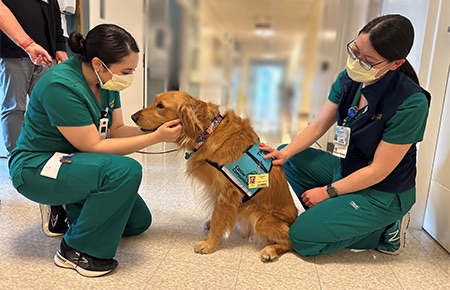
The Key to UC Davis Health’s CARE Project: The Canine Companion

The Impact of Therapy Dogs in the Healthcare Setting

“The newest canine CARE team dog, Landon, is popular not only with patients, but with employees, who enjoy seeing him on the job” (Houser, 2024).

I recently read a social media post by Canine Companions in which the organization highlighted therapy dog Landon and his involvement in the UC Davis Health’s CARE (Creativity, Amenities, Relaxation, Exploration) Project. UC Davis Health takes great pride in the CARE Project, with a focus on treating the whole patient: mind, body, and spirit, its mission goes beyond conventional medical approaches, and recognizes the therapeutic power of what may at first seem to be unconventional—the human-animal bond.

In a healthcare environment, where stress and anxiety can be overwhelming, the introduction of therapy dogs like Landon serves as a beacon of hope and motivation. The partnership between UC Davis Health, Landon and his volunteer handler, Pat Tull, exemplifies the profound impact animals can have on the well-being of individuals facing health challenges. You see, Landon’s supportive role to patients and staff alike, not only highlights the significance of certified therapy dogs but also emphasizes the compassion and comfort they bring to those undergoing hospitalization, and those delivering the medical care.

The CARE Project and UC Davis Health’s commitment to the human-animal bond contributes to patients’ emotional well-being and encourages their active engagement in treatment, which fosters a holistic approach to healthcare. Katie Lorain, the creative arts and recreation therapy manager of the CARE Project, observes patients moved to tears upon encountering a therapy dog, which underscores the transformative nature of these interactions. Lorain’s observations of the patient-therapy dog relationship in the health care setting serves as a testament to the unique and invaluable role that animals can play in enhancing the human experience, especially in challenging circumstances.

The emotional response of patients, often moved to tears at the mere sight of these canine companions, speaks volumes about the profound connection forged in these moments. Let the story of therapy dog Landon and UC Davis Health’s CARE Project remind readers of the healing power embedded in the simplicity of a wagging tail and a comforting presence. Let Landon, and his fellow pawesome therapy dogs, reinforce the idea that, sometimes, love at first sight can come in the form of a furry friend bringing solace and security during moments of vulnerability.

To learn more about Landon and UC Davis Health’s CARE Project, please read Nick Houser’s January 2024 piece, Introducing UC Davis Health’s newest four-legged team member, Landon.

The Canine Advantage: Enhancing Mental Wellness in Professional Sports

Dr. Jessica Maricevic’s 5 Key Advantages of Including Therapy Dogs to Your Professional Sports Organization

In the high-stakes world of professional sports, the physical prowess of athletes often takes center stage, leaving their mental well-being in the shadows. As teams strive for excellence, it’s crucial to recognize the holistic needs of their players.

One innovative approach worth exploring is the inclusion of therapy dogs to support the mental wellness of athletes and foster a healthier organizational environment. Below is an overview of my research-based advantages of including therapy dogs to your professional sports organization (Maricevic, 2022):

1. Stress Reduction and Anxiety Management:
Professional athletes face immense pressure, both on and off the field. Introducing therapy dogs to the team dynamic can provide a natural and effective means of stress reduction. Numerous studies have shown that interacting with dogs can lower cortisol levels and release oxytocin, promoting a sense of calm and reducing anxiety. In high-stakes situations, a therapy dog could be a game-changer in helping athletes manage stress.

2. Team Cohesion and Communication:
A therapy dog can serve as a unifying force within the team, fostering camaraderie and open communication. The presence of a non-judgmental companion can break down barriers, encouraging athletes to connect with each other on a more personal level. Improved team dynamics can translate into better on-field collaboration and synergy.

3. Mental Resilience and Performance Optimization:
Success in professional sports often hinges on mental resilience. Therapy dogs can aid in developing this resilience by providing unconditional support during challenging times. Athletes may find comfort and motivation in the consistent presence of a loyal companion, enhancing their mental fortitude and ultimately contributing to better performance outcomes.

4. Enhancing the Team Environment:
A therapy dog isn’t just beneficial for individual athletes; it can positively impact the entire team environment. A relaxed and supportive atmosphere can contribute to increased job satisfaction, lower burnout rates, and a more positive organizational culture. Teams that prioritize mental wellness are likely to attract top-tier talent and retain experienced athletes.

5. Community Engagement and Brand Image:
Beyond the team’s internal dynamics, incorporating a therapy dog can bolster community engagement and enhance the organization’s public image. Athletes participating in community events alongside therapy dogs can create a positive and relatable image, fostering a deeper connection between the team and its fan base.

While there is no guarantee that the inclusion of a therapy dog will bring the championship at the end of the season, the mere presence of the therapy dog in your professional sports organization represents a progressive step toward prioritizing the mental wellness of athletes and creating a healthier team environment. By recognizing the symbiotic relationship between mental and physical well-being, teams can position themselves at the forefront of athlete care, ultimately contributing to sustained success on and off the field.