To Love Like Judge

It’s taken me time to write this—maybe because putting it into words means admitting he’s really gone. But grief has a strange way of nudging us forward—through moments of kindness, memory, and unexpected connection.

You see, the other day I received a friendly question from a local gas station attendant. His question opened the door to this reflection, reminding me that Judge’s presence didn’t just change my life—it left a mark on others, too.


I stopped for gas, and the attendant—always kind and jovial—leaned ever so slightly in through the window with a warm smile.

“Where’s your big dog friend?” he asked, looking toward the back seat as if Judge might be curled up, ready to pop his head up—as was the norm.

I felt the weight of the words before I even spoke. But I said them. The attendant’s face shifted—genuine heartbreak in his expression. He wanted to know what happened to my friend, so I told him.

I thanked him for remembering Judge, for asking, for seeing us. He gave me a fist pump, “I’ll be thinking of you.”

The gas station attendant’s words and supportive fist-pump immediately brought me back to a warm summer evening walk a few seasons ago. An older gentleman on his evening stroll passed us and paused, his eyes soft with admiration. “Magnificent,” he said, nodding. “Simply magnificent.”

At the time, I thought he was talking about Judge, and he was, because Judge was magnificent—“magical,” to quote my son. But today, I wonder if the neighborly observation was referring to us—our bond, our rhythm, the strength in how we moved together, how we communicated.

There was something sacred in my connection with Judge, something that didn’t need to be explained—only admired for the authentic love it displayed. It was beautiful.

Intersectionality of Time and Space

The comment at the gas station isn’t so different from the one that summer day. Both came from strangers who saw something beautiful in our everyday. Both moments remind me that Judge’s legacy isn’t just the love he gave me—it’s the way he made people stop and feel something.

People gravitated toward him. Kids, neighbors, delivery drivers, the mailman who kept treats in his pocket just for Judge—they all felt it.

I’ve come to realize that people didn’t just see a beautiful dog when Judge was around—they felt something in his presence. There was a gentleness about him, a knowing. He carried himself with quiet confidence, never asking for attention but always drawing it.

It wasn’t just that he was loyal or smart or handsome or protective, though he was all of those things. It was the way he made people feel seen, safe, and loved—without needing words. He had that rare gift.

Love Like Judge

You know, whenever I posted a picture of Judge to Instagram, it was usually accompanied by the #mustlovejudge hashtag—a playful twist on the early 2000s rom-com Must Love Dogs. It became my unspoken rule, the standard for who I let into my life, into our life: “Must Love Judge.” If you didn’t get Judge or love him, you probably didn’t get me—or love me—either (not to mention our entire pack). Now, after losing him, I see that phrase a little differently.

It’s not enough to have loved Judge. The real challenge, the real calling, is to love like Judge—offering the same quiet comfort walking with people through joy and sorrow, listening without needing to speak, being loyal, steady, and present.

I once heard that grief is just love that has nowhere to go. I’m not sure I’ll ever be over the loss of Judge—and honestly, I don’t think I want to be. But my everlasting love for Judge does have somewhere to go.

The way forward is to carry what he taught me into every space I enter and meet the world with the same unwavering heart and the same quiet grace. This is Judgie’s Yoda-like life lesson I know he wants me to carry forward, reminding me to hold steadfast to my ability to love unconditionally, to always remember that I am deserving of that same unconditional love from the universe, and to encourage others to do the same.

So I choose love—the kind that asks for nothing but gives everything. The kind that lingers, even after goodbye.

I choose to love like Judge.


I want to take a moment to thank everyone who has been so incredibly supportive and kind throughout Judge’s battle—and through everything since. Your calls, texts, DMs, beautiful flowers, cards, handmade drawings, thoughtful gifts, hugs, and check-ins have lifted us all in ways I can’t fully put into words.

Every gesture, no matter how big or small, has been a testament to the love you had for Judge—and for us.

My wish for you is simple but sincere:

May everyone in this world be lucky enough to experience a love like Judge in their lifetime.

And may we all honor that gift by paying it forward—simply by loving like Judge.

Thank you for standing with my pack. Thank you for loving us through our heartbreaking loss.

We love you,

Jess, Jacob, Daisy, Bravo, & Bud

✌️🫶🐾

The Honorable Judge

September 10, 2017 – March 25, 2025

A Force for Good at Somers High School: Vader the Therapy Dog

This weekend, the Harrison High School boys varsity football team heads to Somers, New York, for an epic face-off against the Tuskers of Somers High School—a game that is sure to be charged with excitement and school pride. Interestingly enough, even with high-stakes football game merely days away, it’s important to acknowledge that Harrison High School and Somers High School (SHS) are more similar than they are different in many ways, including, but not limited to their shared reputation for excellence, offering outstanding sports programs, extracurricular opportunities for students, and the prestigious International Baccalaureate (IB) programme. But while the Harrison superfans proudly rally behind their mighty Husky mascot, a symbol of strength and loyalty, Somers boasts a different kind of leader in its ranks. Instead of an in-house elephant, as one might expect from the Tusker name, Somers parades an unexpected champion of compassion and well-being: a certified therapy dog named Vader.

Vader is more than just a furry companion; he is a critical part of Somers High School’s commitment to social and emotional wellness. Like many of his therapy dog counterparts across the country, Vader, a certified therapy dog, offers students a source of comfort, helping to ease stress and anxiety in a way that is uniquely effective to meet and quite possibly exceed the needs of students and the larger learning community (Maricevic, 2022). Additionally, given Vader’s placement in an IB secondary school, his role aligns perfectly with the IB philosophy, which emphasizes developing caring, resilient, and well-rounded individuals (IBO, 2024). 

Defying Preconceived Notions

While Harrison boasts the fierce strength of its Husky mascot, Somers leads the charge with implementing an innovative approach to support the needs of the 21st century high school student—proof that sometimes, the best solution to meet the needs of students does not necessarily need to have bells and whistles, or boast a mighty bark, or possess the ability to trumpet trunks; the solution may just be a simple wagging tail.

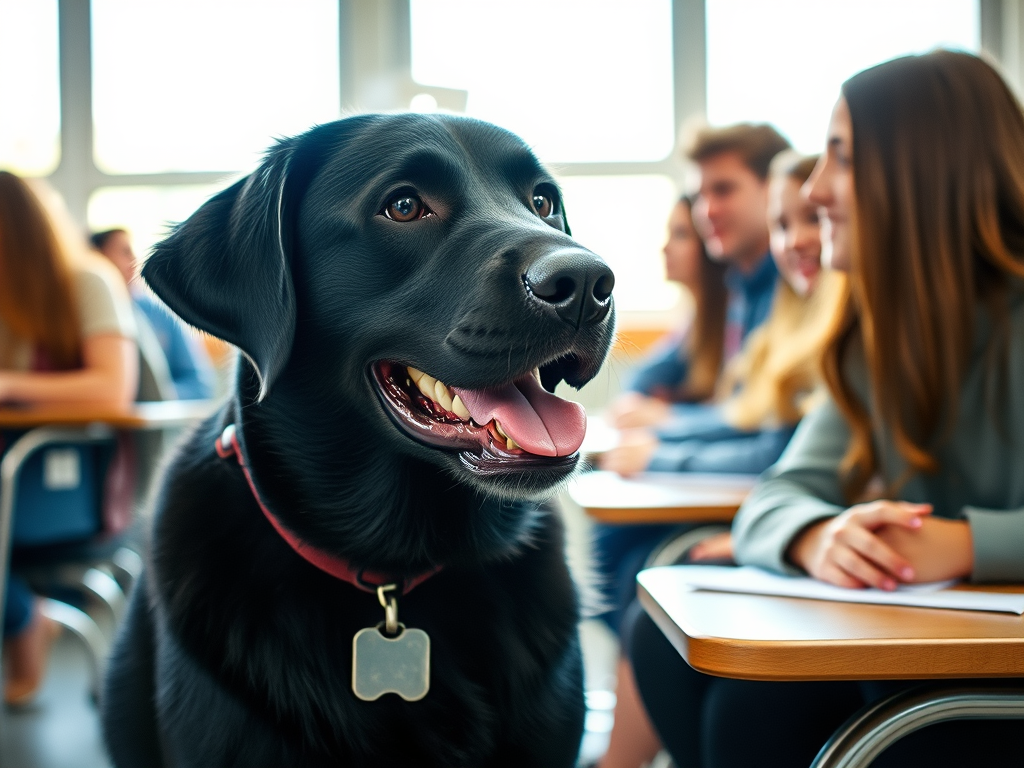
As a Labrador-Shepherd mix, Vader defies preconceived notions about which breeds are worthy of therapy dog certification and designation; he is valued more for his ability to offer comfort and support to students who need it most than for his genetic composition. Handled by Brenda O’Shea, the school’s Student Life Coordinator, Vader is a familiar face in the halls. As an inseparable duo on the days he visits, O’Shea believes Vader is aware of his purpose: to lift spirits and provide emotional support to students. “On the days when I have Vader, I am invisible,” O’Shea remarks, emphasizing the connection students feel with Vader, and indirectly, O’Shea. Vader’s influence on campus is more than just a morale boost; it is a therapeutic outlet that has continued to make a difference for the past three years (Somers Central School District, 2024).

The IB DP & MYP Alignment
Vader exemplifies a unique form of student support that aligns with the values of the IB Diploma Programme (DP) and Middle Years Programme (MYP), in his ability to foster emotional well-being, empathy, and resilience in students. Vader’s impact, highlighted in the article “Therapy Dog Vader is a Force for Good at SHS” showcases the way SHS embraces an innovative approach to promoting social and emotional wellness, directly supporting the IB mission of developing caring, well-rounded individuals.

Vader’s impact is further evident in reports of how he interacts with students, offering comfort and support. Senior Julia Schmidberger fondly recalls, “Vader has been here since my freshman year… The first time he was here, it was so fun to meet him” (Somers Central School District, 2024). Schmidberger’s experience reflects the caring aspect of the IB Learner Profile, as she reports joy and solace in Vader’s companionship (Somers Central School District, 2024). IB learners like Schmidberger are encouraged to be empathetic and supportive, and one can deduce Vader plays a role in modeling these traits by providing emotional comfort to students during challenging times.

In the district’s article, O’Shea continues to underscore Vader’s influence: “If a student is having a tough day, it can be a lot easier to tell a dog what’s going on… If that day is even 2% better for them because they know they are going to see Vader, then we take that as a victory” (Somers Central School District, 2024). O’Shea’s perspective speaks directly to the IB’s whole child approach, which emphasizes not only academic growth but also emotional well-being (Heinonen, 2023). Through O’Shea’s observations, it appears as if Vader’s role in the school helps alleviate stress, making students more balanced and better able to engage in their studies, which is a core goal of the IB programmes.

Vader and the IB Learner Profile
Moreover, based on first-had accounts, Vader’s presence during stressful moments, such as fire drills and lockdowns, highlights his role in promoting resilience among students—a critical trait in the IB Learner Profile (Somers Central School District, 2024). O’Shea notes, “Vader has been here at the school when we have fire and lockdown drills, and he is great. He is a comfort and a distraction for the kids” (Somers Central School District, 2024). O’Shea’s example serves to illuminate Vader’s inclusion in SHS as a reflection of the district’s commitment to emotionally supporting Somers’ students, a commitment that aligns with the IB’s emphasis on self-management skills, particularly in helping students manage stress and maintain focus under pressure.

Vader also plays a significant role in fostering reflection and empathy, qualities that IB students are encouraged to develop as they progress through the MYP and DP years. O’Shea mentions how Vader “does not wander up to any student he does not know” and that “his goal is not to increase anyone’s anxiety,” demonstrating the importance of respecting boundaries and being sensitive to others’ needs—key components of global citizenship in the IB context (Somers Central School District, 2024).

Additionally, Vader’s therapy dog role in easing pre-exam anxiety is yet another way he supports the Approaches to Learning (ATL) skills central to the MYP and DP. O’Shea notes, “You want that last connection with the topics to push the serotonin up and the anxiety down. Vader helps that happen” (Somers Central School District, 2024). By reducing students’ stress, Vader presents the theory that his presence enhances the students’ ability to manage emotions and approach academic challenges with a clearer mind.

Vader’s contribution to SHS aligns perfectly with the IB mission and philosophy, which seeks to develop caring, balanced, and reflective individuals who contribute to their communities (IBO, 2024). His impact is a testament to how high schools, whether holding the IB designation or not, can adopt innovative practices to support the whole child, ensuring that students are not only academically prepared but also emotionally resilient—proving that, in education, sometimes the quietest support systems make the loudest impact.

Vader’s Force
Unlike his intimidating Star Wars namesake, Vader demonstrates how a therapy dog enhances the high school learning environment as the learning community maintains the rigorous academic program expectations, like the IB DP and MYP curricula, for students. The smiling faces of the students is a testament to Vader’s ability to ease anxieties and foster a sense of community, warmth and comfort among students and staff alike. It’s clear that Vader’s presence among the SHS learning community is truly a force unto itself: a force motivated by pure intentions and an uncanny ability to love unconditionally, Vader is truly a force for good.

Outside of school, Vader continues to live the “good life,” complete with hiking adventures and weekend fun. Be sure to follow his adventures on Instagram, @dog_vader_shs.

The Power of Empathy: How Therapy Dogs in High School Can Fill an Empathy Void

Photo by Ivan Babydov on Pexels.com

Empathy is a cornerstone of human connection, fostering relationships and emotional well-being. In an insightful CNN article, Dr. Katie Hurley highlights the contagious nature of empathy and the crucial role parents play in modeling it for their teens. However, what happens when a teen lacks an empathic parent or guardian? How can these adolescents learn to cultivate empathy? One promising solution lies in the unique power of the canine companion.

The Empathy Deficit

Dr. Hurley’s article underscores the importance of parental warmth and emotional support in developing a teen’s empathy. The study Dr. Hurley references demonstrates a clear generational transmission of empathic behaviors from parents to children and beyond. But for teens who do not have access to such nurturing environments, this pathway to empathy can be obstructed, leading to potential emotional and social difficulties.

Benefits of Therapy Dogs

Enter therapy dogs. These specially trained animals offer unconditional love, companionship, and emotional support, which can be incredibly beneficial for teens struggling with empathy development. Therapy dogs have been shown to help individuals, particularly those with emotional and social challenges, to open up and engage in empathic behaviors.

Emotional Support: Therapy dogs provide a non-judgmental and consistent source of emotional support. Their presence can help teens feel understood and valued, which is essential for building self-esteem and emotional resilience (Maricevic, 2022).

Stress Reduction: Interacting with therapy dogs has been proven to reduce stress levels, which can create a more conducive environment for learning and practicing empathy. Lower stress levels allow teens to focus more on others’ feelings and less on their own anxieties (Maricevic, 2022).

Social Skills Improvement: Therapy dogs encourage social interactions. Teens may feel more comfortable practicing empathy and social skills with a dog first, which can then translate to better interactions with peers (Maricevic, 2022).

Modeling Empathy: By caring for and understanding the needs of a therapy dog, teens can learn to recognize and respond to emotions, a skill that is directly transferable to human relationships (Maricevic, 2022).

Real-Life Applications: Therapy Dogs in High School Settings

Several schools and therapy programs have successfully integrated therapy dogs to help students develop empathy and other social skills (Maricevic, 2022). For instance, programs like “Reading to Dogs” in libraries and schools encourage children and teens to read aloud to therapy dogs, improving their reading skills and building a sense of empathy and connection.

While the absence of an empathic parent can pose significant challenges for a teen’s emotional development, therapy dogs offer a viable and effective alternative to cultivate empathy. By providing emotional support, reducing stress, improving social skills, and modeling empathic behaviors, therapy dogs can fill a crucial gap, ensuring that all teens have the opportunity to develop this essential human trait (Maricevic, 2022).

Which is why the integration of therapy dogs in high school settings is an innovative approach that has proven to be highly beneficial in fostering empathy, reducing stress, and enhancing social skills among students (Maricevic, 2022). Here are some specific ways therapy dogs can make a significant impact in high schools:

Stress Relief and Mental Health Support

High school can be an incredibly stressful time for students due to academic pressures, social dynamics, and the challenges of adolescence (Maricevic, 2022). Therapy dogs can provide a calming presence, helping students manage stress and anxiety. Schools that have implemented therapy dog programs often report noticeable improvements in the overall mental health of their students (Maricevic, 2022).

Counseling Sessions: Therapy dogs can be incorporated into school counseling sessions. Their presence helps create a more relaxed environment, making it easier for students to open up and discuss their feelings and issues (Maricevic, 2022). This can be particularly beneficial for students who are reluctant to seek help from a counselor.

Stress-Relief Zones: Some high schools have established designated areas where students can interact with therapy dogs during breaks or free periods (Maricevic, 2022). These stress-relief zones provide a much-needed respite from the pressures of school life and offer a safe space for students to unwind and recharge.

Crisis Intervention: In the aftermath of traumatic events, therapy dogs can be brought in to provide comfort and emotional support to students. Their calming presence can help students feel safer and more secure, aiding in the healing process (Maricevic, 2022).

Enhancing Empathy and Social Skills

Therapy dogs can play a crucial role in teaching students empathy and improving their social skills. Interacting with dogs requires understanding their needs and emotions, which can translate into better interpersonal skills among students (Maricevic, 2022).

Empathy Workshops: Schools can organize workshops where students learn about empathy and emotional intelligence through interactions with therapy dogs. These workshops can include activities such as caring for the dogs, understanding their body language, and practicing gentle and respectful handling. These experiences can help students develop a deeper understanding of empathy, which they can then apply in their interactions with peers (Maricevic, 2022).

Social Skills Groups: Therapy dogs can be used in social skills groups to help students practice and enhance their social interactions. For example, students with social anxiety or autism spectrum disorders can benefit greatly from the presence of a therapy dog, which can act as a social bridge, making it easier for them to engage with others (Maricevic, 2022)

Peer Mediation Programs: Therapy dogs can be integrated into peer mediation programs, where students help resolve conflicts among their peers. The presence of a therapy dog can create a more relaxed atmosphere, making it easier for students to communicate openly and resolve their issues amicably (Maricevic, 2022).

Academic Benefits

The presence of therapy dogs in high schools can also have positive effects on academic performance (Maricevic, 2022). By reducing stress and creating a more supportive and relaxed environment, students may find it easier to focus and perform better academically (Maricevic, 2022).

Reading Programs: Similar to programs in elementary schools, high schools can implement reading programs where students read aloud to therapy dogs. This can be particularly beneficial for students who struggle with reading or have low confidence in their reading abilities. The non-judgmental presence of a dog can help them practice without fear of criticism, improving their skills and confidence over time (Maricevic, 2022).

Attendance and Engagement: Schools that have therapy dog programs often see improvements in student attendance and engagement. The presence of therapy dogs can make school a more welcoming and enjoyable place, encouraging students to attend regularly and participate more actively in their classes (Maricevic, 2022).

Exam Stress Reduction: During exam periods, therapy dogs can be brought in to help students cope with the heightened stress and anxiety. Short interactions with therapy dogs before exams can help calm students and improve their focus and performance (Maricevic, 2022).

Building a Supportive School Community

Therapy dogs can help create a more supportive and inclusive school community by bringing students, teachers, and staff together (Maricevic, 2022).

Community Events: Schools can host events and activities centered around therapy dogs, such as “dog days” where therapy dogs visit the school, or fundraising events for local animal shelters. These events can foster a sense of community and shared purpose among students and staff (Maricevic, 2022).

Teacher and Staff Support: Therapy dogs can also provide support for teachers and staff, who often face high levels of stress. A happier and more relaxed staff can contribute to a more positive school environment, benefiting everyone in the school community (Maricevic, 2022).

Positive School Culture: The presence of therapy dogs can contribute to a more positive school culture by promoting kindness, compassion, and empathy. Students may be more inclined to engage in positive behaviors and support their peers, creating a more inclusive and welcoming environment (Maricevic, 2022).

As schools continue to explore innovative ways to support their students, therapy dog programs stand out as a promising and impactful solution. The presence of therapy dogs in schools not only provides immediate emotional and psychological benefits but also helps in building lifelong skills of empathy and compassion in students. By addressing the emotional needs of teens, especially those lacking empathic parental or guardian support, therapy dogs can help create a generation of more understanding, resilient, and emotionally intelligent individuals.

Empathic Paws: Unleashing the Power of Therapy Dogs in Your High School

As a passionate writer, educator, researcher, and the founder of Empathic Paws, my dedication lies in bringing the incredible benefits of therapy dogs to adolescents in your high school.

My Journey

My educational journey includes a bachelor’s degree in English Literature from Stonehill College, a master’s degree in Curriculum and Teaching from Teachers College, Columbia University, and a Doctorate in Educational Leadership from Manhattanville College. Since 2005, I’ve been committed to the adolescent learner, developing curriculum that nurtures empathy, advocacy, and social responsibility for secondary students. This commitment is what led me to my groundbreaking qualitative research in “Therapy Dogs in Secondary Schools: Implementation Processes & Relationships to Students’ Social-Emotional Competencies,” and equips me in providing invaluable insights to the therapy dog implementation process.

The Power of the Paw

Not only am I a dedicated professional, but I also live with my family, which includes our four dogs, in the dog-friendly Sound Shore region of Westchester County, New York. My commitment to Empathic Paws goes beyond my professional life (I too have benefited from the human-animal bond for close to four decades.), making me the perfect champion for bringing therapy dogs into your school environment.

I firmly believe in the untapped potential of the human-animal bond as a genuine way to address the social-emotional needs of a school community, and beyond. Empathic Paws is dedicated to supporting institutions in incorporating animal-assisted therapies, including therapy dogs, utilizing research-based policy and programmatic protocols to meet and potentially exceed the physical, mental, and emotional needs of all stakeholders.

The Empathic Paws’ Approach

To ensure a smooth and successful integration of a therapy dog program in your school, I will use my original 10 Empathic Steps to Establishing a Therapy Dog Program in Your High School. The 10 Empathic steps to Establishing a Therapy Dog Program in Your High School will assist in implementing, establishing, and maintaining the long-term sustainability of a customized therapy dog program for your specific school and identified area of need, as well as educate, honor and empower stakeholders by:

  • Presenting comprehensive information on animal-assisted therapies and related topics to ensure all stakeholders are well-informed prior to the implementation process.
  • Remaining rooted in collaboration and empowerment, identified stakeholders will be included in the process.
  • Providing empathic guidance and expertise to navigate every step of the implementation process

There is no better thought than knowing your visit to Empathic Paws means you are one step closer to creating a unique therapy dog program that enriches the lives of your students and members of your learning community. Together, let’s harness the transformative power of the human-animal bond and enhance the well-being of all who call your high school home.

Get in touch

Ready to start the process? Don’t hesitate to send a message.

Go back

Your message has been sent

Warning
Warning
Warning
Warning.