Building Trust, One Paw at a Time: Using an Extracurricular Club to Introduce Therapy Dogs in Schools

Many educators and school leaders recognize the benefits of therapy dogs in academic settings but hesitate to implement a full-scale program due to knowledge gaps, logistical challenges, financial constraints, or policy concerns. A Therapy Dog Club offers a structured, low-risk way to introduce animal-assisted therapies, easing leadership apprehensions. In fact, I strongly recommend beginning the therapy dog implementation process in this way to build trust in the program’s effectiveness while addressing concerns in a controlled environment.

So let’s dive in together as I define the concept of a Therapy Dog Club, outline its benefits, and provide a brief guide to getting started.

What is a Therapy Dog Club?

As I define it, a Therapy Dog Club is a student-led, faculty-advised group that brings trained therapy dogs into a school environment on a scheduled basis. The club provides a structured, low-risk way for students and staff to interact with therapy dogs, typically for emotional support, stress relief, and social engagement. It allows students to experience the benefits of animal-assisted interventions without the immediate need for implementing a full-time therapy dog program.

Participation is voluntary, making it an accessible option for a wide range of students. In my view, a Therapy Dog Club operates on a smaller, flexible scale, bringing therapy dogs into the school on specific days rather than having a resident dog on campus daily. Additionally, a Therapy Dog Club may meet after school or during designated extracurricular periods, which can be particularly appealing to school and district leaders.

Benefits of a Therapy Dog Club

Eases Administrative Concerns

Even with strong research supporting the benefits of therapy dogs, one of the biggest barriers to implementation is navigating perceptions, assumptions, and stereotypes. A club helps schools challenge misconceptions and test the waters before committing to a full-time therapy dog program. It also offers:

• Student Autonomy – Participation is voluntary, so students who are uncomfortable around dogs or have allergies can simply opt out. This eliminates concerns about mandatory exposure in classrooms or common areas.

• Waivers for Participants – Schools can require students (and guardians, if necessary) to sign waivers acknowledging participation and understanding any risks. This adds a layer of protection for the school and provides transparency for families.

• Gradual Implementation – Schools can observe how students and staff interact with therapy dogs before considering a larger-scale program. This allows time to refine policies, address concerns, and build community support.

Provides Emotional and Social Benefits for Students

A Therapy Dog Club offers many of the same emotional and mental health benefits as a full program. Interacting with therapy dogs has been shown to reduce stress, improve mood, and boost social interactions—all of which can be particularly helpful for students struggling with anxiety, academic pressure, or social isolation (Maricevic, 2022).

Fosters Student Leadership and Engagement

A Therapy Dog Club empowers students to take on leadership roles by organizing events, coordinating with therapy dog teams, and advocating for expanding the club into a full program. Giving students ownership fosters responsibility, teamwork, and community engagement.

Strengthens Community Partnerships

Starting a club opens the door to collaborations with local therapy dog organizations, shelters, or animal-assisted therapy programs. Schools can invite certified therapy dogs for visits, partner with community groups for educational sessions, or create service-learning opportunities where students volunteer with therapy animals.

Gathers Data to Support a Future Program

If a school is hesitant about implementing a therapy dog program, a club can serve as a pilot initiative to collect data on the impact of animal-assisted therapies. Surveys, testimonials, and anecdotal evidence from students, teachers, parents, and other key stakeholders can provide compelling reasons to expand the club into a permanent program.

How to Start a Therapy Dog Club

Identify a Faculty Advisor – A teacher, counselor, or staff member passionate about student well-being and animal therapy can oversee the club.

Partner with Local Therapy Dog Organizations – Certified therapy dog teams can schedule regular visits to meet with students.

Plan Activities – Meetings can include guest speakers, stress-relief sessions, volunteer opportunities, and advocacy efforts for therapy dog programs.

Involve Students – Let students lead initiatives, create outreach materials, and develop events.

Implement Waivers – Have students (and their guardians, if needed) sign participation waivers to ensure transparency and address liability concerns.

Final Thoughts

A Therapy Dog Club is a low-risk, high-reward way for schools to explore the benefits of therapy dogs before committing to a full program. It fosters a positive school culture, supports student mental health, and builds a foundation for a larger initiative in the future.

If your school is on the fence about a therapy dog program, starting with an extracurricular offering might be the perfect first step. By starting small and scaling thoughtfully, schools can introduce therapy dogs in a way that minimizes risks, maximizes benefits, and paves the way for a sustainable, well-integrated program.

A Force for Good at Somers High School: Vader the Therapy Dog

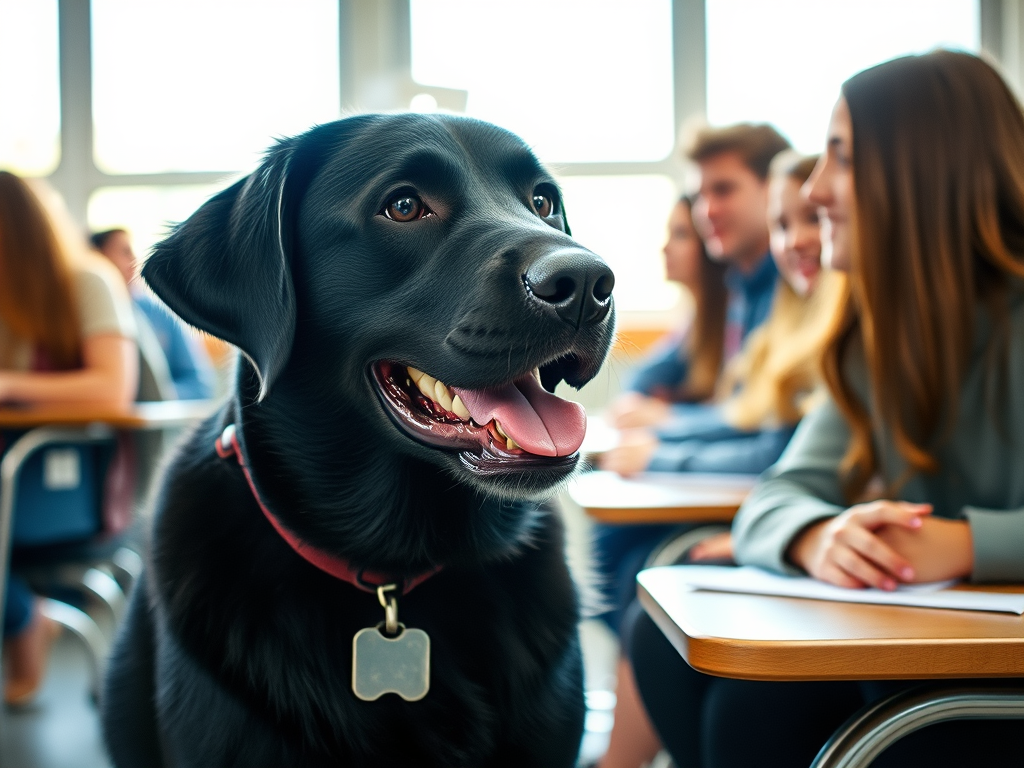
This weekend, the Harrison High School boys varsity football team heads to Somers, New York, for an epic face-off against the Tuskers of Somers High School—a game that is sure to be charged with excitement and school pride. Interestingly enough, even with high-stakes football game merely days away, it’s important to acknowledge that Harrison High School and Somers High School (SHS) are more similar than they are different in many ways, including, but not limited to their shared reputation for excellence, offering outstanding sports programs, extracurricular opportunities for students, and the prestigious International Baccalaureate (IB) programme. But while the Harrison superfans proudly rally behind their mighty Husky mascot, a symbol of strength and loyalty, Somers boasts a different kind of leader in its ranks. Instead of an in-house elephant, as one might expect from the Tusker name, Somers parades an unexpected champion of compassion and well-being: a certified therapy dog named Vader.

Vader is more than just a furry companion; he is a critical part of Somers High School’s commitment to social and emotional wellness. Like many of his therapy dog counterparts across the country, Vader, a certified therapy dog, offers students a source of comfort, helping to ease stress and anxiety in a way that is uniquely effective to meet and quite possibly exceed the needs of students and the larger learning community (Maricevic, 2022). Additionally, given Vader’s placement in an IB secondary school, his role aligns perfectly with the IB philosophy, which emphasizes developing caring, resilient, and well-rounded individuals (IBO, 2024). 

Defying Preconceived Notions

While Harrison boasts the fierce strength of its Husky mascot, Somers leads the charge with implementing an innovative approach to support the needs of the 21st century high school student—proof that sometimes, the best solution to meet the needs of students does not necessarily need to have bells and whistles, or boast a mighty bark, or possess the ability to trumpet trunks; the solution may just be a simple wagging tail.

As a Labrador-Shepherd mix, Vader defies preconceived notions about which breeds are worthy of therapy dog certification and designation; he is valued more for his ability to offer comfort and support to students who need it most than for his genetic composition. Handled by Brenda O’Shea, the school’s Student Life Coordinator, Vader is a familiar face in the halls. As an inseparable duo on the days he visits, O’Shea believes Vader is aware of his purpose: to lift spirits and provide emotional support to students. “On the days when I have Vader, I am invisible,” O’Shea remarks, emphasizing the connection students feel with Vader, and indirectly, O’Shea. Vader’s influence on campus is more than just a morale boost; it is a therapeutic outlet that has continued to make a difference for the past three years (Somers Central School District, 2024).

The IB DP & MYP Alignment
Vader exemplifies a unique form of student support that aligns with the values of the IB Diploma Programme (DP) and Middle Years Programme (MYP), in his ability to foster emotional well-being, empathy, and resilience in students. Vader’s impact, highlighted in the article “Therapy Dog Vader is a Force for Good at SHS” showcases the way SHS embraces an innovative approach to promoting social and emotional wellness, directly supporting the IB mission of developing caring, well-rounded individuals.

Vader’s impact is further evident in reports of how he interacts with students, offering comfort and support. Senior Julia Schmidberger fondly recalls, “Vader has been here since my freshman year… The first time he was here, it was so fun to meet him” (Somers Central School District, 2024). Schmidberger’s experience reflects the caring aspect of the IB Learner Profile, as she reports joy and solace in Vader’s companionship (Somers Central School District, 2024). IB learners like Schmidberger are encouraged to be empathetic and supportive, and one can deduce Vader plays a role in modeling these traits by providing emotional comfort to students during challenging times.

In the district’s article, O’Shea continues to underscore Vader’s influence: “If a student is having a tough day, it can be a lot easier to tell a dog what’s going on… If that day is even 2% better for them because they know they are going to see Vader, then we take that as a victory” (Somers Central School District, 2024). O’Shea’s perspective speaks directly to the IB’s whole child approach, which emphasizes not only academic growth but also emotional well-being (Heinonen, 2023). Through O’Shea’s observations, it appears as if Vader’s role in the school helps alleviate stress, making students more balanced and better able to engage in their studies, which is a core goal of the IB programmes.

Vader and the IB Learner Profile
Moreover, based on first-had accounts, Vader’s presence during stressful moments, such as fire drills and lockdowns, highlights his role in promoting resilience among students—a critical trait in the IB Learner Profile (Somers Central School District, 2024). O’Shea notes, “Vader has been here at the school when we have fire and lockdown drills, and he is great. He is a comfort and a distraction for the kids” (Somers Central School District, 2024). O’Shea’s example serves to illuminate Vader’s inclusion in SHS as a reflection of the district’s commitment to emotionally supporting Somers’ students, a commitment that aligns with the IB’s emphasis on self-management skills, particularly in helping students manage stress and maintain focus under pressure.

Vader also plays a significant role in fostering reflection and empathy, qualities that IB students are encouraged to develop as they progress through the MYP and DP years. O’Shea mentions how Vader “does not wander up to any student he does not know” and that “his goal is not to increase anyone’s anxiety,” demonstrating the importance of respecting boundaries and being sensitive to others’ needs—key components of global citizenship in the IB context (Somers Central School District, 2024).

Additionally, Vader’s therapy dog role in easing pre-exam anxiety is yet another way he supports the Approaches to Learning (ATL) skills central to the MYP and DP. O’Shea notes, “You want that last connection with the topics to push the serotonin up and the anxiety down. Vader helps that happen” (Somers Central School District, 2024). By reducing students’ stress, Vader presents the theory that his presence enhances the students’ ability to manage emotions and approach academic challenges with a clearer mind.

Vader’s contribution to SHS aligns perfectly with the IB mission and philosophy, which seeks to develop caring, balanced, and reflective individuals who contribute to their communities (IBO, 2024). His impact is a testament to how high schools, whether holding the IB designation or not, can adopt innovative practices to support the whole child, ensuring that students are not only academically prepared but also emotionally resilient—proving that, in education, sometimes the quietest support systems make the loudest impact.

Vader’s Force
Unlike his intimidating Star Wars namesake, Vader demonstrates how a therapy dog enhances the high school learning environment as the learning community maintains the rigorous academic program expectations, like the IB DP and MYP curricula, for students. The smiling faces of the students is a testament to Vader’s ability to ease anxieties and foster a sense of community, warmth and comfort among students and staff alike. It’s clear that Vader’s presence among the SHS learning community is truly a force unto itself: a force motivated by pure intentions and an uncanny ability to love unconditionally, Vader is truly a force for good.

Outside of school, Vader continues to live the “good life,” complete with hiking adventures and weekend fun. Be sure to follow his adventures on Instagram, @dog_vader_shs.

Yes, Your IB World High School Needs a Therapy Dog—Here’s Why

Today is World Mental Health Day, a perfect moment to highlight the well-being of students, faculty, and staff, particularly in high-pressure environments like those of International Baccalaureate (IB) World Schools. The IB program, renowned for its rigorous academic standards, challenges students to think critically, act compassionately, and manage complex workloads. However, with this academic intensity comes an ever-growing need to support the emotional and mental health of students who are managing exacerbating feelings resulting from a myriad of factors, one of which being the pandemic (Maricevic, 2022).

As Olli-Pekka Heinonen, Director General of the International Baccalaureate, emphasized in a recent commentary, the IB is re-evaluating education to prioritize well-being in every decision. Therefore, school and district leaders must consider alternative solutions to address the ever-evolving landscape of the 21st-century learner. One such solution is the integration of therapy dogs into the IB high school setting, a decision which not only enhances student well-being but also seamlessly aligns with the IB’s holistic educational approach.

Serving as a unique form of emotional support, therapy dogs in the high school setting transcends traditional methods of student care, fostering empathy, reducing stress, and cultivating a more inclusive school environment (Maricevic, 2022). Their presence encourages students to develop key attributes from the IB Learner Profile, such as being caring, balanced, and reflective, while also promoting emotional resilience. By bridging the gap between academic pressures and personal well-being, therapy dogs help create a learning environment where students can focus, engage, and perform to their fullest potential.

Therapy Dogs: More Than a Comfort, a Core Resource

Therapy dogs offer far more than comfort during stressful times; they play a crucial role in cultivating emotional intelligence and resilience—key components of the IB Learner Profile. Attributes such as being caring, balanced, and reflective are not merely learned from textbooks but are nurtured through lived experiences, often with the guidance of compassionate role models. Therapy dogs provide a unique opportunity for students to develop these traits by offering an empathetic, non-judgmental presence (Maricevic, 2022).

According to Heinonen (2023), well-being is central to learning; without it, students’ minds and bodies become burdened, making academic success increasingly difficult to achieve. Therapy dogs have been shown to alleviate stress, lower anxiety, and increase feelings of belonging—elements crucial for creating a positive learning atmosphere (Maricevic, 2022). By helping students manage academic pressure and emotional strain, therapy dogs directly contribute to the IB’s goal of developing balanced, reflective learners (Maricevic, 2022).

Addressing the Well-Being Crisis

The pandemic has created an undeniable shift in how schools conceptualize well-being. As remote learning became the norm and face-to-face interactions dwindled, students and educators alike experienced heightened levels of stress and uncertainty (Heinonen, 2023). A survey conducted under the #BetterTogether initiative revealed that two in five individuals have faced personal mental health struggles during the pandemic (Heinonen, 2023). Heinonen’s (2023) inclusion of #BetterTogether’s findings reflects the growing concerns voiced by parents and educators worldwide, who are advocating for a more holistic approach to education—one that prioritizes not only academic achievement but also the social and emotional development of students (Maricevic, 2022).

The good news is that the IB Organization appears to recognize these challenges, as it prides itself on a whole-school approach to well-being (Heinonen, 2023). As Heinonen (2023) notes, this approach encompasses every aspect of school life, not merely exam results or curriculum delivery. This is why the inclusion of therapy dogs in IB World Schools aligns perfectly with such a philosophical and pedagogical position, providing a means to support the mental health of students, faculty, staff, and the entire learning community. By fostering a supportive, calming environment, therapy dogs help mitigate the effects of stress, build community, and promote emotional resilience—elements that are key to long-term academic success (Maricevic, 2022).

Mitigating Concerns and Overcoming Barriers

As with any new initiative, the introduction of therapy dogs raises concerns about logistics, allergies, and liability. However, with careful planning and clear policies, these challenges—including allergies, sensitivities, safety, and cultural considerations—can be effectively addressed (Maricevic, 2022). For instance, schools can establish designated dog-free zones for students and staff with allergies or sensitivities, ensuring their comfort while still allowing others to benefit from the therapy dog program (Maricevic, 2022). Another approach is to partner with certified therapy dog organizations to ensure the animals are well-trained for school environments, addressing safety concerns (Maricevic, 2022). Moreover, cultural differences can be respected by making participation voluntary and providing education on the role and benefits of therapy dogs (Maricevic, 2022). With these precautions in place, the program can be smoothly integrated into the school community, offering emotional support without compromising the needs or preferences of others (Maricevic, 2022).

Building a Holistic Educational Experience

Therapy dogs align with the IB’s mission to foster emotional, social, and academic growth, making them a vital addition to IB schools. Heinonen’s (2023) call to redesign education with a focus on well-being underscores the importance of such resources. Therapy dogs serve as more than mere add-ons; they assist students and educators in navigating the pressures of a complex world. By enhancing emotional well-being, therapy dogs enable students to engage more deeply with the curriculum, fostering a growth mindset that encourages them to embrace challenges and learn from mistakes (Maricevic, 2022).

A Call to Action on World Mental Health Day

As we observe World Mental Health Day, there has never been a more urgent time to advocate for innovative solutions that address the well-being of students and educators. Therapy dogs offer a practical, impactful way to enhance emotional resilience, reduce stress, and foster a sense of belonging—qualities that are essential for the success of any educational program, particularly one as demanding as the IB.

Incorporating therapy dogs into secondary IB World Schools is not about diluting academic rigor (Maricevic, 2022). Instead, this programmatic addition represents a commitment to fostering holistic student development—one that recognizes the inseparability of emotional well-being and academic success (Maricevic, 2022). As Heinonen stated, “We know that the time to intervene in the well-being crisis is now” (2023). School and district leadership must act with intentionality, creating environments that prioritize progress over perfection and place student well-being at the heart of learning.

By welcoming therapy dogs into the fold, IB schools can demonstrate their continued commitment to creating a better, more compassionate world—one that nurtures the whole student, mind and heart—one paw at a time.

The Significance of Digital Knowledge Portfolios in the MYP & DP Classrooms: Navigating the IB and Beyond


In an era shaped by technological advancements and evolving educational paradigms, students face an ever-growing need to showcase their skills and accomplishments comprehensively and accessibly. This is where the concept of Digital Knowledge Portfolios becomes a pivotal tool in the academic journey, especially for those pursuing the International Baccalaureate (IB) Middle Years Programme (MYP), Diploma Programme (DP), and beyond.

Digital Knowledge Portfolios serve as dynamic repositories, housing a student’s academic achievements, reflections, and growth over time. Within the context of the IB framework, they play a crucial role in aligning with the program’s core principles and objectives.

Understanding the IB MYP Framework

The MYP emphasizes holistic learning, encouraging students to explore connections between disciplines while fostering critical thinking and communication skills. It’s within this interdisciplinary approach that Digital Knowledge Portfolios find their stride, enabling students to document projects, essays, artistic creations, and other endeavors that exhibit their multifaceted talents.

When transitioning to the DP, these portfolios become even more vital. The program’s rigorous demands necessitate evidence of research, creativity, and reflection – elements that can be effectively showcased through digital portfolios. Students demonstrate their growth, track their academic journey, and exhibit the skills and attributes sought after in the DP curriculum.

The Power of Reflection and Connection

Digital Knowledge Portfolios are not just repositories of work; they are reflective spaces where students can articulate their learning process, challenges faced, and growth achieved. Through this reflective practice, students gain a deeper understanding of their strengths and areas for improvement, aligning with the IB’s emphasis on metacognition and self-awareness.

Moreover, these portfolios bridge the gap between academic endeavors and future aspirations. They serve as tangible evidence of a student’s capabilities, aiding college admissions, scholarship applications, and career pursuits. As the world increasingly values digital literacy and the ability to curate one’s online presence, the Digital Knowledge Portfolios become invaluable assets.

Aligning IB Command Terms within the Digital Knowledge Portfolio

The International Baccalaureate (IB) program is renowned for its rigorous academic standards and precise language used to articulate student expectations. Central to this I IB language are Command Terms – key words that direct students on how to approach their learning.

Integrating Command Terms Strategically

Integrating the IB’s Command Terms within the Digital Knowledge Portfolio is instrumental in showcasing a student’s mastery of these skills as it pertains to the rigors of the IB’s program.

First, students must determine and demonstrate understanding of the terminology.
Within the Digital Knowledge Portfolio, sections are dedicated to honoring the IB’s definition of the Command Term, as well as designated spaces for students to define the Command Terms in their own words. Clearly defining the Command Terms, in their own words, confirms a foundational understanding of the IB’s terminology and students’ ownership of learning.

Then, students strategically align their work to the content specific Command Terms. Students identify an artifact, include an image and/or a direct link to the artifact, and then justify their rationale for the selected artifact.

Hypothetical Artifacts & Justification

In this section, I put forth hypothetical artifacts and justification aligned to some of the Command Terms to showcase how a student might demonstrate engagement in the IB curriculum framework and ownership of learning.

  • Define: The artifact might be an essay or research paper where the student meticulously defines and clarifies key terms within a specific subject area. The justification here would involve highlighting how this artifact serves to establish a foundational understanding of the topic under discussion.
  • Explain: An artifact showcasing an elaborate project presentation or an instructional video might justify its inclusion by emphasizing how it succinctly explains complex concepts or methodologies, showcasing the student’s adeptness in simplifying intricate ideas.
  • Evaluate: If a portfolio entry involves a reflective piece where the student assesses the efficacy of a scientific experiment or a historical analysis, the justification would focus on how this artifact demonstrates the student’s capacity for critical evaluation.
  • Discuss: In the case of a recorded debate or a written dialogue on socio-political issues, the justification would elucidate how this artifact displays the student’s ability to engage in meaningful discussions, considering multiple perspectives.
  • Compare and Contrast: An artifact might feature a project that compares and contrasts different literary works or scientific theories, justifying its inclusion by highlighting how it showcases the student’s understanding of interdisciplinary connections.

Conclusion

By consciously aligning their work to the IB Command Terms within the Digital Knowledge Portfolio, students not only showcase their understanding of these terms but also demonstrate their ability to engage with the academic material at a higher level. This strategic curation enhances the depth of the Digital Knowledge Portfolio, presenting a comprehensive overview of a student’s academic journey while explicitly highlighting their mastery of the IB’s language and expectations.

The Beauty of the Inquiry Conversation

Unearthing School Needs, Listening, and Fostering Hope

We all know the fact that no two schools are alike. Each school has its unique set of strengths and challenges, its own character and culture, its own needs. Which is why the inquiry conversation, like those I have with school districts interested in learning more about what exactly a therapy dog program would look like in their school, is a truly beautiful thing. Let me tell you why.

During these conversations, I listen… a lot. I listen to educators share their experiences and insights. I get an insider’s perspective that no policy document or data report can ever fully capture. I hear the voices of passionate educators, who use their passion and commitment to paint a vivid picture of the real-world challenges faced by students in the day-to-day realities of the 21st century classroom.

Just Listen

Listening to educators during inquiry conversations is not just about absorbing information; it’s about building a bridge of trust and understanding. It’s about acknowledging the educators expertise, valuing their contributions to the organization, and recognizing how their efforts to even initiate an inquiry conversation in the first place is rooted in the best interest of students.

If an educator in your learning organization is passionate about a cause, advocates for their students’ needs, takes time out of their evening to connect with someone, like me, who can provide insight and thoughts for further consideration, that’s a pretty dang good, awesome, educator. Never, ever, let them go.

Hopes 

Inquiry conversations often reveal the hopes and dreams educators hold for their students. These hopes and dreams are deeply rooted in a genuine commitment to fostering the growth, well-being, and success for each learner.

And with each conversation, the voice of the educator carries with it a vision of what they wish for their students. It might be the hope for greater inclusivity with the student body, improved access to resources, or enhanced social-emotional support. 

Step One, Done.

So here’s to those next steps, the ones that take a conversation of hypotheticals to reality. And it will be a journey–a journey that involves dedication, collaboration, and a deep commitment to the well-being of students. I am honored and humbled to be included in step one of your process and cannot wait for step two, and three, and four…. thank you.

It’s Cool to Be Kind

For those of you new to @empathicpaws, I am Dr. Jessica Maricevic, humane-ed reform and animal-assisted therapies advocate, and I am so very glad you’re here.

My most recent original graphic design is inspired by the words of comedian and humane advocate, Ricky Gervais. Let’s further the conversation around the interconnectedness of the human-animal relationship and social-emotional competency development and use Mr. Gervais’s words as a springboard.

©️ J. Maricevic, 2023

The human-animal bond serves as a positive influence upon one’s social-emotional competency development, the sustainability of SECs and subsequent evolution of these traits throughout a person’s lifetime. And with that in mind, more consideration is needed within learning organizations on ways to infuse the human-animal relationship to further the radius of influence upon the social capital within the organization.

Allow Mr. Gervais’s words along with my original visual creation to serve as a conversation starter around the human-animal bond and the need to increase opportunities for such bonding in the high school setting.

Let Me Remind You

An excerpt from my most recent blog, “Dog Save the People: My Conversation with John Bartlett.”

21st century students need more of the tangible, more ways to feel safe, secure, valued and loved, with opportunities to reciprocate those feelings towards another, without judgement (Maricevic, 2022).

Dr. Jessica Maricevic
Why therapy dogs? Why now?

This pseudo post-COVID America has unearthed a tremendous amount of pain, a pain some have tried desperately to suppress, or flat out ignore. Secondary stakeholders who acknowledge the macro reality of the invasive impact of the current geo-political climate are better equipped to consider the micro implications in the high school setting. And to those stakeholders who believe they must personally observe the influence of the macro reality in the micro setting, see with their own eyes presentable evidence of societal stressors, complex anxieties and invisible traumas to adequately address the social and emotional needs of students…

Well, read a little bit more of this post, because today’s high school students are carrying more than a load of books and a laptop with little to no storage.

So say you.

I’ll hold off on the details of my own research and findings for the time being simply to prove you don’t need to read academic journals and peer reviewed articles to establish an understanding of this crisis.

Yet, even with their respective leans, the conscious decision to report on the social and emotional concerns of teens suggests a unified effort to convey the severity of this stark reality.

Dr. Jessica Maricevic

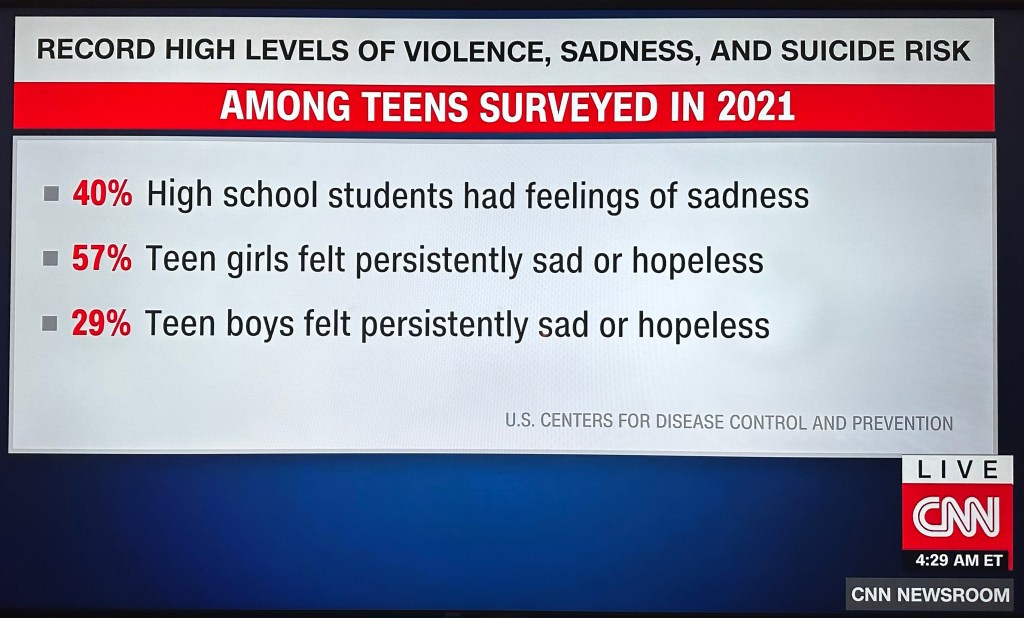
Here are some statistics presented from three national cable news outlets within the last 12 months:

An image I captured from my television during an early morning CNN live broadcast (February 14, 2023).
Read Elizabeth Pritchett’s article in its entirety: Teenage brains aged faster
April 26, 2022 segment from MSNBC’s Morning Joe; guest Harvard University’s John Della Volpe.

Understand, the above sources are a mere snapshot of reporting from three national cable news outlets, and yes I am well aware each source brings with it their own distinct bias. Yet, even with their respective leans, the conscious decision to report on the social and emotional concerns of teens suggests a unified effort to convey the severity of this stark reality.

It is extremely important to note the three news outlets referenced here in this post have observed an increase in viewership during the years of 2016 – 20220 (Pew Research Center, 2023). The research suggests such an increase in viewership is most likely connected to presidential elections, societal conflicts, and the coronavirus pandemic (Pew Research Center, 2023).

Hypothetically, if the Pew Research Center reports either (1) a decrease the numbers of viewers, (2) a plateau of viewership (it remains at its current rate), or (3) a continued upward viewership trend for the period of 2020-2023, millions of Americans would still receive the message loud and clear, teens are hurting, they need something more, and it’s up to the adults in their lives to make it happen.

Back in my day…

As students go from class to class, they carry the weight of the world and the plight of America’s transgressions on their shoulders, they are accompanied by feelings of sadness, hopelessness, feeling down, and depressed. And then, some students hold their breath when a school wide announcement interrupts a class period without warning, flinch upon hearing an unsuspecting sound, and ask what if questions the day after cable news outlets, those very outlets referenced above, consume airwaves with incessant reporting of yet another unthinkable event.

Even with all of this chaos, students aren’t desensitized by their reality. They remain hyper vigilant, in-tune to their emotional responses, and astute to the emotional affect of others in their orbit. But that doesn’t mean they are okay.

The last thing adolescents need is another adult telling them how to manage life as a teenager, or why they need grit and perseverance to get through “these unprecedented times.” Unfortunately, the reality for today’s teens requires more than “Back in my day” talks and harping on trendy jargon (I wish it were that easy). Couple that with the contradictory expectations to prioritize emotional wellbeing and academic performance— students need something more than whatever is provided at the secondary level to meet or exceed their social and emotional needs.

I can hear stakeholders’ “yeah, but…” phrases, ready to launch their counter claims:

Yeah, but their grades are fine.

Yeah, but they’re participating in sports.

Yeah, but they’re not alone in the cafeteria.

Yeah, but they’re taking selfies.

Yeah, but they’re friends with that student; they’re not a bully.

Yeah, but they seem happy.

It’s time to stop assuming. It’s time to stop dismissing the teenage experience. It’s time to start listening, and infuse differentiated support systems that are more real-world centric.

21st century students need more of the tangible, more ways to feel safe, secure, valued and loved, with opportunities to reciprocate those feelings towards another, without judgement (Maricevic, 2022).

Establish a therapy dog program (start today).

Now more than ever, therapy dogs are a viable resource to meet those needs for all high school students— no matter the zip code, regional location or poverty designation of a given school or district.

Yeah, but…

I know, I know! You’re asking yourself, “Yeah, but what about the challenges?” Mitigating challenges, is a totally different blog all together, but believe you me, I’ve got it all covered. I will tell you this, any perceived challenges from fears to allergies can be addressed to ensure the efficacy of board policy and the sustainability of an in-house therapy dog program in your high school (Maricevic, 2022).

This is my original gif which includes slides displaying my research and findings. These slides appeared in my Fall 2022 presentation to members of Association of Professional Humane Educators (and that presentation was an awesome experience).

I’ll also tell you that any stakeholder who flat out says no to an in-house therapy dog program to meet the social and emotional needs of students, is saying no for the sake of saying no (Maricevic, 2022). Don’t forget it.

The student-therapy dog relationship in the high school setting is an indelible, transformative fixture, a relationship with the infinite ability to transcend the four year high school experience. My findings suggest the omnipresence of a therapy dog in the high school setting does more than influence the social-emotional competency development in adolescents (Maricevic, 2022). In fact, the organic development of the student-therapy dog relationship may very well be the antidote to [feel free to fill in the blank to reflect the needs of your students and high school] (Maricevic, 2022).

My study reveals much more about the therapy dog phenomenon, its profound impact on secondary students and the high school setting. I’m proud to say my study also exposes inequities that must be addressed to ensure all students are afforded the opportunity to benefit from the student-therapy dog relationship during their high school years.

The above is a mere snippet of some of the points touched upon during my conversation with John Bartlett, host and founder of Dog Save the People. I encourage you to listen to the podcast in its entirety through any of the following platforms:

And let’s connect! Share your thoughts! Questions! I look forward to it.

Now #Trending…

Collaboration, in any organization, is key— especially when the goal is to create an inclusive environment for all individuals to feel valued and respected. The people within an organization, for the most part, want to experience an enriching workplace. Some may even wish to pay it forward.

Five years ago, a fellow English teacher and myself wanted to do just that, pay it forward. We took it upon ourselves to complete our Google Certification. We taught an in-district summer professional development course. We were selected to present at an annual English Teachers Conference in Albany, New York.

Our vision, The Trendy English Teachers, was coming to fruition, website and all. Unfortunately, the vision was placed on the back-burner, and not entirely from our doing alone.

Once the 2022-2023 school year rolled around, my fellow English teacher (yes, that same fellow English teacher), shared how she wished to somehow participate in my school building leadership internship experience. Like many other educators, my colleague is very much aware of the strengths she has to offer to the organization. Me, being the collaboration, true collaboration, advocate that I am, excitedly said, “Of course!”

So, as we always do, we got to work.

We sat down, made a tentative date and schedule for school-day availability, how we would construct courses based on teacher-driven needs. What would that look like? How would that look? What is required of us, and our participants (faculty and staff), to prepare for, and participate in, meaningful, voluntary, school day professional learning opportunities?

We listed “trendy” articles, “trendy” videos watched on social media, and shared our own “trendy” creations with one another.

We made a list of all the topics to cover, the target audience, the faculty. But there are others to consider, like the staff members of our building. The staff need to be equipped with the technology foundation because students look to them for support and guidance.

Would we include the administration? Yes! Of course! Why not? If the administration suggests technology be used in the 21st century classroom, then they too should have the knowledge of the types of technologies readily available to enhance student learning, performance and progress.

The origin of transformative change rests upon transformative leadership. Highlighting the positive contributions of others within an organization can possibly ruffle some feathers. However, the positives outweigh the negatives. As a future school building leader, I know I must honor the strengths of others within an organization. I must, in some way, make certain the individuals who wish to be directly and indirectly a part of the vision and mission’s sustainability be included, supported, and celebrated for their efforts.

#TrendThePositive

Trending Together with T & J, © J. Maricevic (2022)

Priorities.

My recent post is associated with a school building leadership assignment. Below is the task and my response.

Task: Read the article ‘When It Comes to the Teacher Shortage, Who’s Abandoning Whom?’. How do you see this article as relevant to school leadership? Cite one example.


Humanity-Based vs Business Capital

Nothing speaks more to me as an aspiring school building leader than the concept of enacting transformational change rooted in a “humanity-based model” (Fullan & Rizzotto, 2022). It seems as though the attention given to the “business capital” model (before the pandemic), inspired what now appears, in hindsight, as empty promises— promises to value innovation and creativity, for students and teachers, when things returned to normal. There was hope that maybe a silver lining coming out of this pandemic would be society’s acknowledgement of education as a non-gendered profession, compensate teachers for their years of expertise and degrees, etc. Unfortunately, the swift arrival of phrases like learning loss, constant references to a blanket academic deficit plaguing the intellectual development of America’s children, and the politicizing of education, accompanied fingers pointing in one direction, the classroom teacher.

Interconnected: Teacher-Leader Relationship

Interconnected with a teacher’s post-COVID experience is the role of the school building leader, district leader, and respective leadership teams. Individuals in these leadership positions must counter the destructive noise from outsiders and demonstrate to their faculty and staff that they are seen, valued, and heard (the essence of the Humanity-Based model). If students are deserving of an environment “where ‘belonging, purpose, individual and collective problem solving’ is fostered,” so are teachers. It comes as no surprise that many people will take the stance, teachers are abandoning students! Teachers are leaving the profession not because they forgot why they entered the teaching profession. Teachers are leaving the classroom because they never lost their “why” for entering the teaching profession in the first place, and their “why” is no longer valued.

The System Failed the Teacher

As a parent and educator, I sadly agree with the conclusion presented in the article, “that the old, deeply flawed system has de facto abandoned the teachers, not the other way around” (Fullan & Rizzotto, 2022). The challenges plaguing education, its teachers and students, are systemic, and any systemic challenge should be of great concern for educational leaders. Whether a school building leader or a district leader, those in coveted leadership positions must not only prioritize supporting students in all facets associated with the learning experience. School and district leaders must also prioritize and demonstrate to stakeholders how, and why, they support teachers in all facets of the post-COVID professional demands. A model of appreciation on the part of school and district leaders yields tremendous transformational power, exactly what the profession needs and deserves; nothing less.