To Love Like Judge

It’s taken me time to write this—maybe because putting it into words means admitting he’s really gone. But grief has a strange way of nudging us forward—through moments of kindness, memory, and unexpected connection.

You see, the other day I received a friendly question from a local gas station attendant. His question opened the door to this reflection, reminding me that Judge’s presence didn’t just change my life—it left a mark on others, too.


I stopped for gas, and the attendant—always kind and jovial—leaned ever so slightly in through the window with a warm smile.

“Where’s your big dog friend?” he asked, looking toward the back seat as if Judge might be curled up, ready to pop his head up—as was the norm.

I felt the weight of the words before I even spoke. But I said them. The attendant’s face shifted—genuine heartbreak in his expression. He wanted to know what happened to my friend, so I told him.

I thanked him for remembering Judge, for asking, for seeing us. He gave me a fist pump, “I’ll be thinking of you.”

The gas station attendant’s words and supportive fist-pump immediately brought me back to a warm summer evening walk a few seasons ago. An older gentleman on his evening stroll passed us and paused, his eyes soft with admiration. “Magnificent,” he said, nodding. “Simply magnificent.”

At the time, I thought he was talking about Judge, and he was, because Judge was magnificent—“magical,” to quote my son. But today, I wonder if the neighborly observation was referring to us—our bond, our rhythm, the strength in how we moved together, how we communicated.

There was something sacred in my connection with Judge, something that didn’t need to be explained—only admired for the authentic love it displayed. It was beautiful.

Intersectionality of Time and Space

The comment at the gas station isn’t so different from the one that summer day. Both came from strangers who saw something beautiful in our everyday. Both moments remind me that Judge’s legacy isn’t just the love he gave me—it’s the way he made people stop and feel something.

People gravitated toward him. Kids, neighbors, delivery drivers, the mailman who kept treats in his pocket just for Judge—they all felt it.

I’ve come to realize that people didn’t just see a beautiful dog when Judge was around—they felt something in his presence. There was a gentleness about him, a knowing. He carried himself with quiet confidence, never asking for attention but always drawing it.

It wasn’t just that he was loyal or smart or handsome or protective, though he was all of those things. It was the way he made people feel seen, safe, and loved—without needing words. He had that rare gift.

Love Like Judge

You know, whenever I posted a picture of Judge to Instagram, it was usually accompanied by the #mustlovejudge hashtag—a playful twist on the early 2000s rom-com Must Love Dogs. It became my unspoken rule, the standard for who I let into my life, into our life: “Must Love Judge.” If you didn’t get Judge or love him, you probably didn’t get me—or love me—either (not to mention our entire pack). Now, after losing him, I see that phrase a little differently.

It’s not enough to have loved Judge. The real challenge, the real calling, is to love like Judge—offering the same quiet comfort walking with people through joy and sorrow, listening without needing to speak, being loyal, steady, and present.

I once heard that grief is just love that has nowhere to go. I’m not sure I’ll ever be over the loss of Judge—and honestly, I don’t think I want to be. But my everlasting love for Judge does have somewhere to go.

The way forward is to carry what he taught me into every space I enter and meet the world with the same unwavering heart and the same quiet grace. This is Judgie’s Yoda-like life lesson I know he wants me to carry forward, reminding me to hold steadfast to my ability to love unconditionally, to always remember that I am deserving of that same unconditional love from the universe, and to encourage others to do the same.

So I choose love—the kind that asks for nothing but gives everything. The kind that lingers, even after goodbye.

I choose to love like Judge.


I want to take a moment to thank everyone who has been so incredibly supportive and kind throughout Judge’s battle—and through everything since. Your calls, texts, DMs, beautiful flowers, cards, handmade drawings, thoughtful gifts, hugs, and check-ins have lifted us all in ways I can’t fully put into words.

Every gesture, no matter how big or small, has been a testament to the love you had for Judge—and for us.

My wish for you is simple but sincere:

May everyone in this world be lucky enough to experience a love like Judge in their lifetime.

And may we all honor that gift by paying it forward—simply by loving like Judge.

Thank you for standing with my pack. Thank you for loving us through our heartbreaking loss.

We love you,

Jess, Jacob, Daisy, Bravo, & Bud

✌️🫶🐾

The Honorable Judge

September 10, 2017 – March 25, 2025

A Force for Good at Somers High School: Vader the Therapy Dog

This weekend, the Harrison High School boys varsity football team heads to Somers, New York, for an epic face-off against the Tuskers of Somers High School—a game that is sure to be charged with excitement and school pride. Interestingly enough, even with high-stakes football game merely days away, it’s important to acknowledge that Harrison High School and Somers High School (SHS) are more similar than they are different in many ways, including, but not limited to their shared reputation for excellence, offering outstanding sports programs, extracurricular opportunities for students, and the prestigious International Baccalaureate (IB) programme. But while the Harrison superfans proudly rally behind their mighty Husky mascot, a symbol of strength and loyalty, Somers boasts a different kind of leader in its ranks. Instead of an in-house elephant, as one might expect from the Tusker name, Somers parades an unexpected champion of compassion and well-being: a certified therapy dog named Vader.

Vader is more than just a furry companion; he is a critical part of Somers High School’s commitment to social and emotional wellness. Like many of his therapy dog counterparts across the country, Vader, a certified therapy dog, offers students a source of comfort, helping to ease stress and anxiety in a way that is uniquely effective to meet and quite possibly exceed the needs of students and the larger learning community (Maricevic, 2022). Additionally, given Vader’s placement in an IB secondary school, his role aligns perfectly with the IB philosophy, which emphasizes developing caring, resilient, and well-rounded individuals (IBO, 2024). 

Defying Preconceived Notions

While Harrison boasts the fierce strength of its Husky mascot, Somers leads the charge with implementing an innovative approach to support the needs of the 21st century high school student—proof that sometimes, the best solution to meet the needs of students does not necessarily need to have bells and whistles, or boast a mighty bark, or possess the ability to trumpet trunks; the solution may just be a simple wagging tail.

As a Labrador-Shepherd mix, Vader defies preconceived notions about which breeds are worthy of therapy dog certification and designation; he is valued more for his ability to offer comfort and support to students who need it most than for his genetic composition. Handled by Brenda O’Shea, the school’s Student Life Coordinator, Vader is a familiar face in the halls. As an inseparable duo on the days he visits, O’Shea believes Vader is aware of his purpose: to lift spirits and provide emotional support to students. “On the days when I have Vader, I am invisible,” O’Shea remarks, emphasizing the connection students feel with Vader, and indirectly, O’Shea. Vader’s influence on campus is more than just a morale boost; it is a therapeutic outlet that has continued to make a difference for the past three years (Somers Central School District, 2024).

The IB DP & MYP Alignment
Vader exemplifies a unique form of student support that aligns with the values of the IB Diploma Programme (DP) and Middle Years Programme (MYP), in his ability to foster emotional well-being, empathy, and resilience in students. Vader’s impact, highlighted in the article “Therapy Dog Vader is a Force for Good at SHS” showcases the way SHS embraces an innovative approach to promoting social and emotional wellness, directly supporting the IB mission of developing caring, well-rounded individuals.

Vader’s impact is further evident in reports of how he interacts with students, offering comfort and support. Senior Julia Schmidberger fondly recalls, “Vader has been here since my freshman year… The first time he was here, it was so fun to meet him” (Somers Central School District, 2024). Schmidberger’s experience reflects the caring aspect of the IB Learner Profile, as she reports joy and solace in Vader’s companionship (Somers Central School District, 2024). IB learners like Schmidberger are encouraged to be empathetic and supportive, and one can deduce Vader plays a role in modeling these traits by providing emotional comfort to students during challenging times.

In the district’s article, O’Shea continues to underscore Vader’s influence: “If a student is having a tough day, it can be a lot easier to tell a dog what’s going on… If that day is even 2% better for them because they know they are going to see Vader, then we take that as a victory” (Somers Central School District, 2024). O’Shea’s perspective speaks directly to the IB’s whole child approach, which emphasizes not only academic growth but also emotional well-being (Heinonen, 2023). Through O’Shea’s observations, it appears as if Vader’s role in the school helps alleviate stress, making students more balanced and better able to engage in their studies, which is a core goal of the IB programmes.

Vader and the IB Learner Profile
Moreover, based on first-had accounts, Vader’s presence during stressful moments, such as fire drills and lockdowns, highlights his role in promoting resilience among students—a critical trait in the IB Learner Profile (Somers Central School District, 2024). O’Shea notes, “Vader has been here at the school when we have fire and lockdown drills, and he is great. He is a comfort and a distraction for the kids” (Somers Central School District, 2024). O’Shea’s example serves to illuminate Vader’s inclusion in SHS as a reflection of the district’s commitment to emotionally supporting Somers’ students, a commitment that aligns with the IB’s emphasis on self-management skills, particularly in helping students manage stress and maintain focus under pressure.

Vader also plays a significant role in fostering reflection and empathy, qualities that IB students are encouraged to develop as they progress through the MYP and DP years. O’Shea mentions how Vader “does not wander up to any student he does not know” and that “his goal is not to increase anyone’s anxiety,” demonstrating the importance of respecting boundaries and being sensitive to others’ needs—key components of global citizenship in the IB context (Somers Central School District, 2024).

Additionally, Vader’s therapy dog role in easing pre-exam anxiety is yet another way he supports the Approaches to Learning (ATL) skills central to the MYP and DP. O’Shea notes, “You want that last connection with the topics to push the serotonin up and the anxiety down. Vader helps that happen” (Somers Central School District, 2024). By reducing students’ stress, Vader presents the theory that his presence enhances the students’ ability to manage emotions and approach academic challenges with a clearer mind.

Vader’s contribution to SHS aligns perfectly with the IB mission and philosophy, which seeks to develop caring, balanced, and reflective individuals who contribute to their communities (IBO, 2024). His impact is a testament to how high schools, whether holding the IB designation or not, can adopt innovative practices to support the whole child, ensuring that students are not only academically prepared but also emotionally resilient—proving that, in education, sometimes the quietest support systems make the loudest impact.

Vader’s Force
Unlike his intimidating Star Wars namesake, Vader demonstrates how a therapy dog enhances the high school learning environment as the learning community maintains the rigorous academic program expectations, like the IB DP and MYP curricula, for students. The smiling faces of the students is a testament to Vader’s ability to ease anxieties and foster a sense of community, warmth and comfort among students and staff alike. It’s clear that Vader’s presence among the SHS learning community is truly a force unto itself: a force motivated by pure intentions and an uncanny ability to love unconditionally, Vader is truly a force for good.

Outside of school, Vader continues to live the “good life,” complete with hiking adventures and weekend fun. Be sure to follow his adventures on Instagram, @dog_vader_shs.

Yes, Your IB World High School Needs a Therapy Dog—Here’s Why

Today is World Mental Health Day, a perfect moment to highlight the well-being of students, faculty, and staff, particularly in high-pressure environments like those of International Baccalaureate (IB) World Schools. The IB program, renowned for its rigorous academic standards, challenges students to think critically, act compassionately, and manage complex workloads. However, with this academic intensity comes an ever-growing need to support the emotional and mental health of students who are managing exacerbating feelings resulting from a myriad of factors, one of which being the pandemic (Maricevic, 2022).

As Olli-Pekka Heinonen, Director General of the International Baccalaureate, emphasized in a recent commentary, the IB is re-evaluating education to prioritize well-being in every decision. Therefore, school and district leaders must consider alternative solutions to address the ever-evolving landscape of the 21st-century learner. One such solution is the integration of therapy dogs into the IB high school setting, a decision which not only enhances student well-being but also seamlessly aligns with the IB’s holistic educational approach.

Serving as a unique form of emotional support, therapy dogs in the high school setting transcends traditional methods of student care, fostering empathy, reducing stress, and cultivating a more inclusive school environment (Maricevic, 2022). Their presence encourages students to develop key attributes from the IB Learner Profile, such as being caring, balanced, and reflective, while also promoting emotional resilience. By bridging the gap between academic pressures and personal well-being, therapy dogs help create a learning environment where students can focus, engage, and perform to their fullest potential.

Therapy Dogs: More Than a Comfort, a Core Resource

Therapy dogs offer far more than comfort during stressful times; they play a crucial role in cultivating emotional intelligence and resilience—key components of the IB Learner Profile. Attributes such as being caring, balanced, and reflective are not merely learned from textbooks but are nurtured through lived experiences, often with the guidance of compassionate role models. Therapy dogs provide a unique opportunity for students to develop these traits by offering an empathetic, non-judgmental presence (Maricevic, 2022).

According to Heinonen (2023), well-being is central to learning; without it, students’ minds and bodies become burdened, making academic success increasingly difficult to achieve. Therapy dogs have been shown to alleviate stress, lower anxiety, and increase feelings of belonging—elements crucial for creating a positive learning atmosphere (Maricevic, 2022). By helping students manage academic pressure and emotional strain, therapy dogs directly contribute to the IB’s goal of developing balanced, reflective learners (Maricevic, 2022).

Addressing the Well-Being Crisis

The pandemic has created an undeniable shift in how schools conceptualize well-being. As remote learning became the norm and face-to-face interactions dwindled, students and educators alike experienced heightened levels of stress and uncertainty (Heinonen, 2023). A survey conducted under the #BetterTogether initiative revealed that two in five individuals have faced personal mental health struggles during the pandemic (Heinonen, 2023). Heinonen’s (2023) inclusion of #BetterTogether’s findings reflects the growing concerns voiced by parents and educators worldwide, who are advocating for a more holistic approach to education—one that prioritizes not only academic achievement but also the social and emotional development of students (Maricevic, 2022).

The good news is that the IB Organization appears to recognize these challenges, as it prides itself on a whole-school approach to well-being (Heinonen, 2023). As Heinonen (2023) notes, this approach encompasses every aspect of school life, not merely exam results or curriculum delivery. This is why the inclusion of therapy dogs in IB World Schools aligns perfectly with such a philosophical and pedagogical position, providing a means to support the mental health of students, faculty, staff, and the entire learning community. By fostering a supportive, calming environment, therapy dogs help mitigate the effects of stress, build community, and promote emotional resilience—elements that are key to long-term academic success (Maricevic, 2022).

Mitigating Concerns and Overcoming Barriers

As with any new initiative, the introduction of therapy dogs raises concerns about logistics, allergies, and liability. However, with careful planning and clear policies, these challenges—including allergies, sensitivities, safety, and cultural considerations—can be effectively addressed (Maricevic, 2022). For instance, schools can establish designated dog-free zones for students and staff with allergies or sensitivities, ensuring their comfort while still allowing others to benefit from the therapy dog program (Maricevic, 2022). Another approach is to partner with certified therapy dog organizations to ensure the animals are well-trained for school environments, addressing safety concerns (Maricevic, 2022). Moreover, cultural differences can be respected by making participation voluntary and providing education on the role and benefits of therapy dogs (Maricevic, 2022). With these precautions in place, the program can be smoothly integrated into the school community, offering emotional support without compromising the needs or preferences of others (Maricevic, 2022).

Building a Holistic Educational Experience

Therapy dogs align with the IB’s mission to foster emotional, social, and academic growth, making them a vital addition to IB schools. Heinonen’s (2023) call to redesign education with a focus on well-being underscores the importance of such resources. Therapy dogs serve as more than mere add-ons; they assist students and educators in navigating the pressures of a complex world. By enhancing emotional well-being, therapy dogs enable students to engage more deeply with the curriculum, fostering a growth mindset that encourages them to embrace challenges and learn from mistakes (Maricevic, 2022).

A Call to Action on World Mental Health Day

As we observe World Mental Health Day, there has never been a more urgent time to advocate for innovative solutions that address the well-being of students and educators. Therapy dogs offer a practical, impactful way to enhance emotional resilience, reduce stress, and foster a sense of belonging—qualities that are essential for the success of any educational program, particularly one as demanding as the IB.

Incorporating therapy dogs into secondary IB World Schools is not about diluting academic rigor (Maricevic, 2022). Instead, this programmatic addition represents a commitment to fostering holistic student development—one that recognizes the inseparability of emotional well-being and academic success (Maricevic, 2022). As Heinonen stated, “We know that the time to intervene in the well-being crisis is now” (2023). School and district leadership must act with intentionality, creating environments that prioritize progress over perfection and place student well-being at the heart of learning.

By welcoming therapy dogs into the fold, IB schools can demonstrate their continued commitment to creating a better, more compassionate world—one that nurtures the whole student, mind and heart—one paw at a time.

Restoring Comfort: Advocating for the Return of a Therapy Dog Program

Photo by Helena Lopes on Pexels.com

Just the other day, I received a message from an educator in a current leadership position. In the message, the school leader expressed frustration and confusion over the abrupt discontinuation of a beloved therapy dog program at their school. This decision, a result from a change in district regulations, now prohibits employees from bringing therapy dogs into the school, and many in the learning community are disheartened. It is the educator’s belief that the therapy dog program was a vital source of comfort and emotional support, fostered positive connections and contributed to a supportive school culture for the faculty, staff and student body as a whole.

Which is why I was then brought to wonder about the original policy language prior to the regulatory change for the 2024-2025 school year and why such a change would occur: What explicit language existed in district’ policy regarding therapy dogs before this decision? Was there any formal language at all? Could it be that the therapy dog program was running under an unspoken understanding rather than an official framework?

Policy isn’t necessarily a “bad thing,” for without formal guidelines, such programs can easily grow unchecked, potentially leading to conflicts—especially if there was an increase in the number of dogs coming to school, concerns about certification, or misunderstandings about what constitutes a legitimate therapy dog. The absence of a clear policy on therapy dogs may have allowed the program to grow naturally. However, this lack of structure could have led to unforeseen issues, ultimately contributing to the decision to end the program.

Having said that, while the regulatory change in the educator’s school poses a significant challenge, it doesn’t have to mean the end of the therapy dog program altogether. In the absence of a clear explanation, it’s essential to propose thoughtful solutions to address the concerns of stakeholders while advocating for the reinstatement of the therapy dog program. Below, I outline several considerations for the educator—and others impacted by similar policy shifts—to navigate the current situation with the hopes of reinstating a revised therapy dog program to meet the needs of all stakeholders.

The Role of Unspoken Understandings

When therapy dog programs aren’t codified into official district policy, they may rely on informal arrangements or personal agreements (Maricevic, 2022). In some cases, administrators may allow other school leaders, teachers or staff to bring certified therapy dogs without objection, trusting the intentions of the program (Maricevic, 2022). But without written guidelines, inconsistencies and confusion can arise, which may have contributed to the recent decision to prohibit therapy dogs altogether for the school leader. 

Now, if there were concerns about the number of dogs on campus, questions about certifications, or uncertainty around how to manage liability, any one of these issues—or all of them—could have prompted the district to take a blanket approach and halt the program. In either scenario, the issue comes back to the need for clear policy to ensure the viability of any programmatic addition, with the goal of sustaining a long-term impact on the learning community—especially if that program includes therapy dogs (Maricevic, 2022).

Schools with transparent policies, can foster a supportive environment where therapy dogs, or any programmatic enhancements to the wellness and learning of students, can thrive as valuable resources, ensuring that their benefits are accessible to all students and staff while minimizing potential conflicts or concerns. Without clear, formal guidelines, programs can become vulnerable to misunderstandings and inconsistencies that ultimately jeopardize their effectiveness and long term sustainability within the organization (Maricevic, 2022).

Establishing a comprehensive policy framework would not only provide a solid foundation for the program but also clarify roles, responsibilities, and expectations for all parties involved (Maricevic, 2022). Ultimately, a well-defined policy will help safeguard the educator’s therapy dog program’s integrity and reinforce its positive impact on the school community (Maricevic, 2022). 

Certification Confusion: Therapy Dogs vs. Emotional Support Dogs

Another layer of complexity is the widespread misunderstanding between therapy dogs and emotional support animals (ESAs), particularly when it comes to certification. This confusion can create legal and logistical issues, making it difficult to establish a program that complies with district policies.

First and foremost, it’s important to clarify that there is no formal “certification” for emotional support dogs. ESAs are animals that provide comfort and emotional support to individuals with mental health challenges, but they are not trained to perform specific tasks like service dogs. There’s no official certification for ESAs, and they do not have the same legal rights as service animals.

On the other hand, therapy dogs are specifically trained and certified to provide comfort in settings like schools, hospitals, and nursing homes (Maricevic, 2022). These animals are often part of structured programs, with certification from reputable organizations like Alliance of Therapy Dogs, Pet Partners, and The Good Dog Foundation.

The Problem with Therapy Dog Certifications

Unfortunately, not all organizations that claim to certify therapy dogs are legitimate. Some companies exploit loopholes, offering quick and easy certifications bypassing the necessary training or certification assessment. Such unethical practices can undermine the credibility of therapy dog programs and cause confusion in school districts trying to maintain appropriate standards.

In the case of this educator’s dilemma, if the district encountered concerns about the legitimacy of the certifications held by therapy dogs on campus,such a concern could have triggered the decision to halt the existing therapy dog program. Without clear guidelines or a trusted certification process in place, district leadership may have felt the risks—whether related to liability, safety, or standards—outweighed the benefits. To ensure the program’s legitimacy and effectiveness, schools must establish clear guidelines that require certification only from trusted, reputable organizations, like those presented above (Maricevic, 2022).

Moving Forward: Addressing Policy Gaps and Certification Concerns

To advocate for the reinstatement of the therapy dog program, the educator must first address these potential gaps. Maybe start a conversation with key stakeholders, follow the dialogue with a collaborative review of the district’s policy language (or lack thereof) and discuss additional language to formalize clear guidelines around the use of therapy dogs in schools. Here’s how this educator can approach the current situation:

  1. Review the Old Policy (or Unspoken Understanding): If the program previously operated without formal policy, it’s time to work with district leadership to establish clear guidelines. This would ensure that any future therapy dog program operates within a well-defined framework, preventing misunderstandings or unchecked growth (Maricevic, 2022).
  2. Ensure Proper Certification: Address concerns about certifications by only working with well-established, reputable organizations that train and certify therapy dogs according to recognized standards (Maricevic, 2022). Research and recommend organizations that adhere to the highest levels of training, evaluation, and insurance, helping the district feel more confident in the legitimacy of the program (Maricevic, 2022).
  3. Clarify the Difference Between Therapy Dogs and ESAs: Educate both staff and district leadership on the key distinctions between therapy dogs and emotional support animals. Emphasize that while ESAs provide comfort, they are not part of structured therapy programs, nor do they have certification or training requirements. Therapy dogs, on the other hand, must undergo rigorous training and certification to operate in school settings (Maricevic, 2022).
  4. Propose a Pilot Program with Clear Oversight: If the primary concerns are related to certification and management, propose reinstating the program as a small pilot with stringent guidelines. Start by bringing in one or two certified therapy dogs through reputable organizations during designated times throughout the school year (i.e. Wellness Day, midterms, finals, etc) with clear oversight and documentation. This approach may help ease district concerns while demonstrating the value of the therapy dog in the high school setting.

Bridge the Gap Between Intention and Implementation

The abrupt end of this educator’s therapy dog program highlights the importance of having clear, well-structured policies in place for any school or district initiative’s longterm sustainability. Without them, even well-intentioned programs can become vulnerable to mismanagement, confusion, and abrupt decisions like the one that occurred in this example. By examining the district’s language around therapy dogs, clearing up misunderstandings around certification, and other inconsistencies within the established protocol, this educator, and others who might find themselves in a similar scenario, can build a stronger case for reinstating the program in a way that benefits everyone—students, staff, and dogs alike.

The Power of Empathy: How Therapy Dogs in High School Can Fill an Empathy Void

Photo by Ivan Babydov on Pexels.com

Empathy is a cornerstone of human connection, fostering relationships and emotional well-being. In an insightful CNN article, Dr. Katie Hurley highlights the contagious nature of empathy and the crucial role parents play in modeling it for their teens. However, what happens when a teen lacks an empathic parent or guardian? How can these adolescents learn to cultivate empathy? One promising solution lies in the unique power of the canine companion.

The Empathy Deficit

Dr. Hurley’s article underscores the importance of parental warmth and emotional support in developing a teen’s empathy. The study Dr. Hurley references demonstrates a clear generational transmission of empathic behaviors from parents to children and beyond. But for teens who do not have access to such nurturing environments, this pathway to empathy can be obstructed, leading to potential emotional and social difficulties.

Benefits of Therapy Dogs

Enter therapy dogs. These specially trained animals offer unconditional love, companionship, and emotional support, which can be incredibly beneficial for teens struggling with empathy development. Therapy dogs have been shown to help individuals, particularly those with emotional and social challenges, to open up and engage in empathic behaviors.

Emotional Support: Therapy dogs provide a non-judgmental and consistent source of emotional support. Their presence can help teens feel understood and valued, which is essential for building self-esteem and emotional resilience (Maricevic, 2022).

Stress Reduction: Interacting with therapy dogs has been proven to reduce stress levels, which can create a more conducive environment for learning and practicing empathy. Lower stress levels allow teens to focus more on others’ feelings and less on their own anxieties (Maricevic, 2022).

Social Skills Improvement: Therapy dogs encourage social interactions. Teens may feel more comfortable practicing empathy and social skills with a dog first, which can then translate to better interactions with peers (Maricevic, 2022).

Modeling Empathy: By caring for and understanding the needs of a therapy dog, teens can learn to recognize and respond to emotions, a skill that is directly transferable to human relationships (Maricevic, 2022).

Real-Life Applications: Therapy Dogs in High School Settings

Several schools and therapy programs have successfully integrated therapy dogs to help students develop empathy and other social skills (Maricevic, 2022). For instance, programs like “Reading to Dogs” in libraries and schools encourage children and teens to read aloud to therapy dogs, improving their reading skills and building a sense of empathy and connection.

While the absence of an empathic parent can pose significant challenges for a teen’s emotional development, therapy dogs offer a viable and effective alternative to cultivate empathy. By providing emotional support, reducing stress, improving social skills, and modeling empathic behaviors, therapy dogs can fill a crucial gap, ensuring that all teens have the opportunity to develop this essential human trait (Maricevic, 2022).

Which is why the integration of therapy dogs in high school settings is an innovative approach that has proven to be highly beneficial in fostering empathy, reducing stress, and enhancing social skills among students (Maricevic, 2022). Here are some specific ways therapy dogs can make a significant impact in high schools:

Stress Relief and Mental Health Support

High school can be an incredibly stressful time for students due to academic pressures, social dynamics, and the challenges of adolescence (Maricevic, 2022). Therapy dogs can provide a calming presence, helping students manage stress and anxiety. Schools that have implemented therapy dog programs often report noticeable improvements in the overall mental health of their students (Maricevic, 2022).

Counseling Sessions: Therapy dogs can be incorporated into school counseling sessions. Their presence helps create a more relaxed environment, making it easier for students to open up and discuss their feelings and issues (Maricevic, 2022). This can be particularly beneficial for students who are reluctant to seek help from a counselor.

Stress-Relief Zones: Some high schools have established designated areas where students can interact with therapy dogs during breaks or free periods (Maricevic, 2022). These stress-relief zones provide a much-needed respite from the pressures of school life and offer a safe space for students to unwind and recharge.

Crisis Intervention: In the aftermath of traumatic events, therapy dogs can be brought in to provide comfort and emotional support to students. Their calming presence can help students feel safer and more secure, aiding in the healing process (Maricevic, 2022).

Enhancing Empathy and Social Skills

Therapy dogs can play a crucial role in teaching students empathy and improving their social skills. Interacting with dogs requires understanding their needs and emotions, which can translate into better interpersonal skills among students (Maricevic, 2022).

Empathy Workshops: Schools can organize workshops where students learn about empathy and emotional intelligence through interactions with therapy dogs. These workshops can include activities such as caring for the dogs, understanding their body language, and practicing gentle and respectful handling. These experiences can help students develop a deeper understanding of empathy, which they can then apply in their interactions with peers (Maricevic, 2022).

Social Skills Groups: Therapy dogs can be used in social skills groups to help students practice and enhance their social interactions. For example, students with social anxiety or autism spectrum disorders can benefit greatly from the presence of a therapy dog, which can act as a social bridge, making it easier for them to engage with others (Maricevic, 2022)

Peer Mediation Programs: Therapy dogs can be integrated into peer mediation programs, where students help resolve conflicts among their peers. The presence of a therapy dog can create a more relaxed atmosphere, making it easier for students to communicate openly and resolve their issues amicably (Maricevic, 2022).

Academic Benefits

The presence of therapy dogs in high schools can also have positive effects on academic performance (Maricevic, 2022). By reducing stress and creating a more supportive and relaxed environment, students may find it easier to focus and perform better academically (Maricevic, 2022).

Reading Programs: Similar to programs in elementary schools, high schools can implement reading programs where students read aloud to therapy dogs. This can be particularly beneficial for students who struggle with reading or have low confidence in their reading abilities. The non-judgmental presence of a dog can help them practice without fear of criticism, improving their skills and confidence over time (Maricevic, 2022).

Attendance and Engagement: Schools that have therapy dog programs often see improvements in student attendance and engagement. The presence of therapy dogs can make school a more welcoming and enjoyable place, encouraging students to attend regularly and participate more actively in their classes (Maricevic, 2022).

Exam Stress Reduction: During exam periods, therapy dogs can be brought in to help students cope with the heightened stress and anxiety. Short interactions with therapy dogs before exams can help calm students and improve their focus and performance (Maricevic, 2022).

Building a Supportive School Community

Therapy dogs can help create a more supportive and inclusive school community by bringing students, teachers, and staff together (Maricevic, 2022).

Community Events: Schools can host events and activities centered around therapy dogs, such as “dog days” where therapy dogs visit the school, or fundraising events for local animal shelters. These events can foster a sense of community and shared purpose among students and staff (Maricevic, 2022).

Teacher and Staff Support: Therapy dogs can also provide support for teachers and staff, who often face high levels of stress. A happier and more relaxed staff can contribute to a more positive school environment, benefiting everyone in the school community (Maricevic, 2022).

Positive School Culture: The presence of therapy dogs can contribute to a more positive school culture by promoting kindness, compassion, and empathy. Students may be more inclined to engage in positive behaviors and support their peers, creating a more inclusive and welcoming environment (Maricevic, 2022).

As schools continue to explore innovative ways to support their students, therapy dog programs stand out as a promising and impactful solution. The presence of therapy dogs in schools not only provides immediate emotional and psychological benefits but also helps in building lifelong skills of empathy and compassion in students. By addressing the emotional needs of teens, especially those lacking empathic parental or guardian support, therapy dogs can help create a generation of more understanding, resilient, and emotionally intelligent individuals.

Knicks’ Thibodeau Reflects on Season’s End with Resounding Message for Us All

In a poignant moment during the post-Game 7 conference, Tom Thibodeau, the coach of the valiant 2024 New York Knicks, encapsulated the spirit of a season filled with grit, determination, and unyielding belief. “If you give everything you have, you can live with no regret…this team exceeded everybody’s expectations, except probably our own,” Thibodeau remarked, drawing a definitive line under a remarkable journey.

Thibodeau’s Knicks, a team often underestimated by critics, showcased a season that defied the odds and silenced naysayers. As the coach stood before the press, his words were not just a reflection on the game but a broader commentary on the ethos that propelled the team forward.

Effort and Regret: A Life Lesson

Thibodeau’s assertion, “If you give everything you have, you can live with no regret,” resonates far beyond the confines of the basketball court. It’s a universal principle, applicable to all walks of life. The message is clear: total commitment and effort ensure a life free from the burden of “what ifs.” For the Knicks, this season was a testament to that philosophy. Every player, every game, every practice reflected an unrelenting pursuit of excellence.

Throughout the season, the Knicks faced skepticism and doubt. Analysts, fans, and opponents frequently set low expectations, anticipating a performance that would blend into the mediocrity of past seasons. However, the team’s achievements this year shattered those low ceilings. They played with a tenacity and skill that not only impressed the league but also carved a new identity for themselves. Thibodeau’s reflection that the team “exceeded everybody’s expectations, except probably our own” speaks volumes about their mindset. Internally, the Knicks harbored a quiet confidence, a self-belief that propelled them to strive for greatness. This inner conviction was their driving force, creating a standard of excellence that was inherently higher than what others anticipated.

Embracing a Knicks’ Mindset in the High School Classroom

Of course, the educator in me needs to bring Thibodeau’s words into the the high school classroom. You see, Thibodeau’s reflection on the importance of giving everything you have, to live without regret, and exceeding expectations resonates far beyond the basketball court. This mindset is equally powerful and transformative in the high school classroom. Here’s how:

1. Total Commitment to Effort

Just as the Knicks players gave their all on the court, students can apply this principle to their studies. Whether it’s a challenging math problem, a complex science project, or a demanding essay, putting in maximum effort ensures that students do their best work. This commitment helps students develop resilience and perseverance, knowing that they have done everything possible to succeed.

2. Living Without Regret

By putting forth their best effort in every assignment and exam, students can avoid the regret of wondering what might have been if they had tried harder. This mindset encourages them to take ownership of their education, leading to greater satisfaction and a sense of accomplishment.

3. Exceeding Expectations

The Knicks surpassed what others expected of them by believing in their potential and striving for excellence. Similarly, students can set high personal goals and work towards surpassing them. This approach fosters a growth mindset, where students see challenges as opportunities to improve rather than obstacles to fear.

4. Building Self-Belief

The Knicks’ internal confidence drove their success. In the classroom, students who believe in their abilities are more likely to take risks, participate actively, and embrace difficult tasks. Teachers can nurture this self-belief by providing encouragement, recognizing effort, and celebrating progress.

5. Creating a Supportive Environment

A key factor in the Knicks’ success was their team spirit and mutual support. In a high school setting, fostering a collaborative and supportive classroom environment can help students thrive. Group projects, peer tutoring, and open discussions encourage students to support each other’s learning, enhancing overall performance.

6. Resilience in the Face of Failure

The Knicks’ journey wasn’t without setbacks, yet their unwavering effort allowed them to bounce back stronger. Similarly, students can learn to view failures not as endpoints but as valuable learning experiences. This resilience builds character and prepares them for future challenges.

7. Setting Personal Benchmarks

Students can take inspiration from the Knicks by setting personal benchmarks for success. These benchmarks might be improving grades, mastering a particular subject, or developing better study habits. Achieving these goals can boost confidence and motivate further progress.

Applying the Knicks’ mindset to the high school classroom cultivates a culture of effort, self-belief, and continuous improvement. By striving to give their all and exceed their own expectations, students can achieve academic success and personal growth. This approach not only prepares them for higher education and careers but also instills life-long values of perseverance, resilience, and self-confidence.

A Season to Remember

As the Knicks wrap up this season, their journey serves as a powerful narrative of overcoming doubt and surpassing limitations. The coach’s words will likely linger in the minds of players and fans alike, a reminder of what can be achieved with relentless effort and self-belief. In reflecting on this season, the Knicks have not just played basketball; they’ve crafted a story of resilience and ambition. They’ve demonstrated that with the right attitude and determination, exceeding expectations becomes not just a possibility, but a reality.

Looking ahead, the foundation laid this season paves the way for even greater aspirations. The team’s performance has set a new benchmark, one that will undoubtedly shape their future endeavors. As the city of New York reflects on this memorable season, it’s clear that the Knicks have redefined their narrative. They’ve proven that with heart and hustle, they can not only meet the expectations of their most ardent supporters but also inspire a broader audience with their commitment to excellence.

Coach Thibodeau and the 2024 New York Knicks, you are an inspiration to us all.

Let Me Remind You

An excerpt from my most recent blog, “Dog Save the People: My Conversation with John Bartlett.”

21st century students need more of the tangible, more ways to feel safe, secure, valued and loved, with opportunities to reciprocate those feelings towards another, without judgement (Maricevic, 2022).

Dr. Jessica Maricevic
Why therapy dogs? Why now?

This pseudo post-COVID America has unearthed a tremendous amount of pain, a pain some have tried desperately to suppress, or flat out ignore. Secondary stakeholders who acknowledge the macro reality of the invasive impact of the current geo-political climate are better equipped to consider the micro implications in the high school setting. And to those stakeholders who believe they must personally observe the influence of the macro reality in the micro setting, see with their own eyes presentable evidence of societal stressors, complex anxieties and invisible traumas to adequately address the social and emotional needs of students…

Well, read a little bit more of this post, because today’s high school students are carrying more than a load of books and a laptop with little to no storage.

So say you.

I’ll hold off on the details of my own research and findings for the time being simply to prove you don’t need to read academic journals and peer reviewed articles to establish an understanding of this crisis.

Yet, even with their respective leans, the conscious decision to report on the social and emotional concerns of teens suggests a unified effort to convey the severity of this stark reality.

Dr. Jessica Maricevic

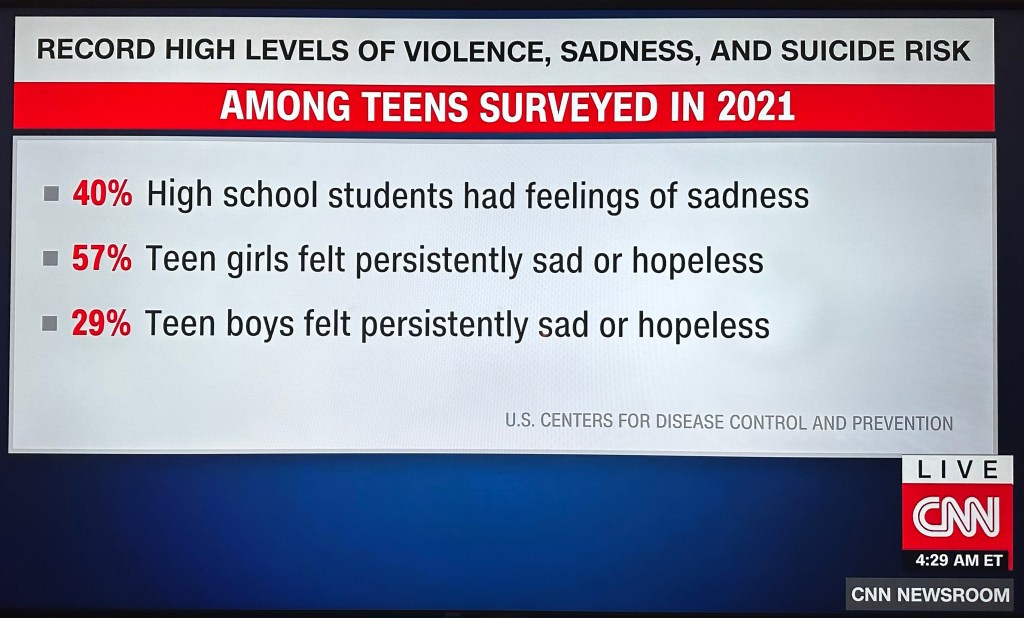
Here are some statistics presented from three national cable news outlets within the last 12 months:

An image I captured from my television during an early morning CNN live broadcast (February 14, 2023).
Read Elizabeth Pritchett’s article in its entirety: Teenage brains aged faster
April 26, 2022 segment from MSNBC’s Morning Joe; guest Harvard University’s John Della Volpe.

Understand, the above sources are a mere snapshot of reporting from three national cable news outlets, and yes I am well aware each source brings with it their own distinct bias. Yet, even with their respective leans, the conscious decision to report on the social and emotional concerns of teens suggests a unified effort to convey the severity of this stark reality.

It is extremely important to note the three news outlets referenced here in this post have observed an increase in viewership during the years of 2016 – 20220 (Pew Research Center, 2023). The research suggests such an increase in viewership is most likely connected to presidential elections, societal conflicts, and the coronavirus pandemic (Pew Research Center, 2023).

Hypothetically, if the Pew Research Center reports either (1) a decrease the numbers of viewers, (2) a plateau of viewership (it remains at its current rate), or (3) a continued upward viewership trend for the period of 2020-2023, millions of Americans would still receive the message loud and clear, teens are hurting, they need something more, and it’s up to the adults in their lives to make it happen.

Back in my day…

As students go from class to class, they carry the weight of the world and the plight of America’s transgressions on their shoulders, they are accompanied by feelings of sadness, hopelessness, feeling down, and depressed. And then, some students hold their breath when a school wide announcement interrupts a class period without warning, flinch upon hearing an unsuspecting sound, and ask what if questions the day after cable news outlets, those very outlets referenced above, consume airwaves with incessant reporting of yet another unthinkable event.

Even with all of this chaos, students aren’t desensitized by their reality. They remain hyper vigilant, in-tune to their emotional responses, and astute to the emotional affect of others in their orbit. But that doesn’t mean they are okay.

The last thing adolescents need is another adult telling them how to manage life as a teenager, or why they need grit and perseverance to get through “these unprecedented times.” Unfortunately, the reality for today’s teens requires more than “Back in my day” talks and harping on trendy jargon (I wish it were that easy). Couple that with the contradictory expectations to prioritize emotional wellbeing and academic performance— students need something more than whatever is provided at the secondary level to meet or exceed their social and emotional needs.

I can hear stakeholders’ “yeah, but…” phrases, ready to launch their counter claims:

Yeah, but their grades are fine.

Yeah, but they’re participating in sports.

Yeah, but they’re not alone in the cafeteria.

Yeah, but they’re taking selfies.

Yeah, but they’re friends with that student; they’re not a bully.

Yeah, but they seem happy.

It’s time to stop assuming. It’s time to stop dismissing the teenage experience. It’s time to start listening, and infuse differentiated support systems that are more real-world centric.

21st century students need more of the tangible, more ways to feel safe, secure, valued and loved, with opportunities to reciprocate those feelings towards another, without judgement (Maricevic, 2022).

Establish a therapy dog program (start today).

Now more than ever, therapy dogs are a viable resource to meet those needs for all high school students— no matter the zip code, regional location or poverty designation of a given school or district.

Yeah, but…

I know, I know! You’re asking yourself, “Yeah, but what about the challenges?” Mitigating challenges, is a totally different blog all together, but believe you me, I’ve got it all covered. I will tell you this, any perceived challenges from fears to allergies can be addressed to ensure the efficacy of board policy and the sustainability of an in-house therapy dog program in your high school (Maricevic, 2022).

This is my original gif which includes slides displaying my research and findings. These slides appeared in my Fall 2022 presentation to members of Association of Professional Humane Educators (and that presentation was an awesome experience).

I’ll also tell you that any stakeholder who flat out says no to an in-house therapy dog program to meet the social and emotional needs of students, is saying no for the sake of saying no (Maricevic, 2022). Don’t forget it.

The student-therapy dog relationship in the high school setting is an indelible, transformative fixture, a relationship with the infinite ability to transcend the four year high school experience. My findings suggest the omnipresence of a therapy dog in the high school setting does more than influence the social-emotional competency development in adolescents (Maricevic, 2022). In fact, the organic development of the student-therapy dog relationship may very well be the antidote to [feel free to fill in the blank to reflect the needs of your students and high school] (Maricevic, 2022).

My study reveals much more about the therapy dog phenomenon, its profound impact on secondary students and the high school setting. I’m proud to say my study also exposes inequities that must be addressed to ensure all students are afforded the opportunity to benefit from the student-therapy dog relationship during their high school years.

The above is a mere snippet of some of the points touched upon during my conversation with John Bartlett, host and founder of Dog Save the People. I encourage you to listen to the podcast in its entirety through any of the following platforms:

And let’s connect! Share your thoughts! Questions! I look forward to it.

Dog Save the People: My Conversation with John Bartlett

Me & Judge: Dog Save the People.

In the fall of 2022, I received an email from the amazing production team behind John Bartlett’s podcast, Dog Save the People. John and his team stumbled upon my website, were intrigued by the novel nature of my qualitative study, impressed by my steadfast research-based mission to dispel misconceptions around therapy dogs in high schools, desire to educate stakeholders on why therapy dogs are needed, and how to implement a therapy dog program with efficacy.

Dog Save the People have welcomed some unbelievable guests. Writers, professors, even Nobel Prize recipients, and now, to be added to this list, Dr. Jessica Maricevic— I’m humbled.

So here I am, and yeah, I know, I was always “here,” but I am forever grateful for Dog Save the People’s equally steadfast position to illuminate the voices of others (which in this episode, happens to be my voice).

Thank you John Bartlett, for providing a platform for my research, honoring my commitment to secondary education, the student-therapy dog relationship, and helping me educate others on how a vital relationship like the one between a high school student and a therapy dog needs to be an equitable norm for all high school students across America.

I welcome you to listen to the episode in its entirety (click here) and to explore some additional thoughts below.


Why therapy dogs? Why now?

This pseudo post-COVID America has unearthed a tremendous amount of pain, a pain some have tried desperately to suppress, or flat out ignore. Secondary stakeholders who acknowledge the macro reality of the invasive impact of the current geo-political climate are better equipped to consider the micro implications in the high school setting. And to those stakeholders who believe they must personally observe the influence of the macro reality in the micro setting, see with their own eyes presentable evidence of societal stressors, complex anxieties and invisible traumas to adequately address the social and emotional needs of students… well, read a little bit more of this post, because today’s high school students are carrying more than a load of books and a laptop with little to no storage.

So say you.

I’ll hold off on the details of my own research and findings for the time being simply to prove you don’t need to read academic journals and peer reviewed articles to establish an understanding of this crisis. Here are some statistics presented from three national cable news outlets within the last 12 months:

An image I captured from my television during an early morning CNN live broadcast (February 14, 2023).
Read Elizabeth Pritchett’s article in its entirety: Teenage brains aged faster
April 26, 2022 segment from MSNBC’s Morning Joe; guest Harvard University’s John Della Volpe.

Understand, the above sources are a mere snapshot of reporting from three national cable news outlets, and yes I am well aware each source brings with it their own distinct bias. Yet, even with their respective leans, the conscious decision to report on the social and emotional concerns of teens suggests a unified effort to convey a stark reality to their audiences.

It is extremely important to note the three news outlets referenced here in this post have observed an increase in viewership during the years of 2016 – 20220 (Pew Research Center, 2023). The research suggests such an increase in viewership is most likely connected to presidential elections, societal conflicts, and the coronavirus pandemic (Pew Research Center, 2023).

Hypothetically, if the Pew Research Center reports either (1) a decrease the numbers of viewers, (2) a plateau of viewership (it remains at its current rate), or (3) a continued upward viewership trend for the period of 2020-2023, millions of Americans would still receive the message loud and clear, teens are hurting, they need something more, and it’s up to the adults in their lives to make it happen.

Back in my day…

As students go from class to class, carry the weight of the world and the plight of America’s transgressions on their shoulders, they are accompanied by feelings of sadness, hopelessness, feeling down, and depressed. And then, some students hold their breath when a school wide announcement interrupts a class period without warning, flinch upon hearing an unsuspecting sound, and ask what if questions the day after cable news outlets, those very outlets referenced above, consume airwaves with incessant reporting of yet another unthinkable event.

Even with all of this chaos, students aren’t desensitized by their reality. They remain hyper vigilant, in-tune to their emotional responses, and astute to the emotional affect of others in their orbit. But that doesn’t mean they are okay.

The last thing adolescents need is another adult telling them how to manage life as a teenager, or why they need grit and perseverance to get through “these unprecedented times.” Unfortunately, the reality for today’s teens requires more than “Back in my day” talks and harping on trendy jargon (I wish it were that easy). Couple that with the contradictory expectations to prioritize emotional wellbeing and academic performance— students need something more than whatever is provided at the secondary level to meet or exceed their social and emotional needs.

I can hear stakeholders’ “yeah, but…” phrases, ready to launch their counter claims:

Yeah, but their grades are fine.

Yeah, but they’re participating in sports.

Yeah, but they’re not alone in the cafeteria.

Yeah, but they’re taking selfies.

Yeah, but they’re friends with that student; they’re not a bully.

Yeah, but they seem happy.

It’s time to stop assuming. It’s time to stop dismissing the teenage experience. It’s time to start listening, and infuse differentiated support systems that are more real-world centric.

21st century students need more of the tangible, more ways to feel safe, secure, valued and loved, with opportunities to reciprocate those feelings towards another, without judgement (Maricevic, 2022).

Establish a therapy dog program (start today).

Now more than ever, therapy dogs are a viable resource to meet those needs for all high school students— no matter the zip code, regional location or poverty designation of a given school or district.

Yeah, but…

I know, I know! You’re asking yourself, “Yeah, but what about the challenges?” Mitigating challenges, is a totally different blog all together, but believe you me, I’ve got it all covered. I will tell you this, any perceived challenges from fears to allergies can be addressed to ensure the efficacy of board policy and the sustainability of an in-house therapy dog program in your high school (Maricevic, 2022).

This is my original gif which includes slides displaying my research and findings. These slides appeared in my Fall 2022 presentation to members of Association of Professional Humane Educators (and that presentation was an awesome experience).

I’ll also tell you that any stakeholder who flat out says no to an in-house therapy dog program to meet the social and emotional needs of students, is saying no for the sake of saying no (Maricevic, 2022). Don’t forget it.

The student-therapy dog relationship in the high school setting is an indelible, transformative fixture, a relationship with the infinite ability to transcend the four year high school experience. My findings suggest the omnipresence of a therapy dog in the high school setting does more than influence the social-emotional competency development in adolescents (Maricevic, 2022). In fact, the organic development of the student-therapy dog relationship may very well be the antidote to [feel free to fill in the blank to reflect the needs of your students and high school] (Maricevic, 2022).

My study reveals much more about the therapy dog phenomenon, its profound impact on secondary students and the high school setting. I’m proud to say my study also exposes inequities that must be addressed to ensure all students are afforded the opportunity to benefit from the student-therapy dog relationship during their high school years.

The above is a mere snippet of some of the points touched upon during my conversation with John Bartlett, host and founder of Dog Save the People. I encourage you to listen to the podcast in its entirety through any of the following platforms:

And let’s connect! Share your thoughts! Questions! I look forward to it.