Building Trust, One Paw at a Time: Using an Extracurricular Club to Introduce Therapy Dogs in Schools

Many educators and school leaders recognize the benefits of therapy dogs in academic settings but hesitate to implement a full-scale program due to knowledge gaps, logistical challenges, financial constraints, or policy concerns. A Therapy Dog Club offers a structured, low-risk way to introduce animal-assisted therapies, easing leadership apprehensions. In fact, I strongly recommend beginning the therapy dog implementation process in this way to build trust in the program’s effectiveness while addressing concerns in a controlled environment.

So let’s dive in together as I define the concept of a Therapy Dog Club, outline its benefits, and provide a brief guide to getting started.

What is a Therapy Dog Club?

As I define it, a Therapy Dog Club is a student-led, faculty-advised group that brings trained therapy dogs into a school environment on a scheduled basis. The club provides a structured, low-risk way for students and staff to interact with therapy dogs, typically for emotional support, stress relief, and social engagement. It allows students to experience the benefits of animal-assisted interventions without the immediate need for implementing a full-time therapy dog program.

Participation is voluntary, making it an accessible option for a wide range of students. In my view, a Therapy Dog Club operates on a smaller, flexible scale, bringing therapy dogs into the school on specific days rather than having a resident dog on campus daily. Additionally, a Therapy Dog Club may meet after school or during designated extracurricular periods, which can be particularly appealing to school and district leaders.

Benefits of a Therapy Dog Club

Eases Administrative Concerns

Even with strong research supporting the benefits of therapy dogs, one of the biggest barriers to implementation is navigating perceptions, assumptions, and stereotypes. A club helps schools challenge misconceptions and test the waters before committing to a full-time therapy dog program. It also offers:

• Student Autonomy – Participation is voluntary, so students who are uncomfortable around dogs or have allergies can simply opt out. This eliminates concerns about mandatory exposure in classrooms or common areas.

• Waivers for Participants – Schools can require students (and guardians, if necessary) to sign waivers acknowledging participation and understanding any risks. This adds a layer of protection for the school and provides transparency for families.

• Gradual Implementation – Schools can observe how students and staff interact with therapy dogs before considering a larger-scale program. This allows time to refine policies, address concerns, and build community support.

Provides Emotional and Social Benefits for Students

A Therapy Dog Club offers many of the same emotional and mental health benefits as a full program. Interacting with therapy dogs has been shown to reduce stress, improve mood, and boost social interactions—all of which can be particularly helpful for students struggling with anxiety, academic pressure, or social isolation (Maricevic, 2022).

Fosters Student Leadership and Engagement

A Therapy Dog Club empowers students to take on leadership roles by organizing events, coordinating with therapy dog teams, and advocating for expanding the club into a full program. Giving students ownership fosters responsibility, teamwork, and community engagement.

Strengthens Community Partnerships

Starting a club opens the door to collaborations with local therapy dog organizations, shelters, or animal-assisted therapy programs. Schools can invite certified therapy dogs for visits, partner with community groups for educational sessions, or create service-learning opportunities where students volunteer with therapy animals.

Gathers Data to Support a Future Program

If a school is hesitant about implementing a therapy dog program, a club can serve as a pilot initiative to collect data on the impact of animal-assisted therapies. Surveys, testimonials, and anecdotal evidence from students, teachers, parents, and other key stakeholders can provide compelling reasons to expand the club into a permanent program.

How to Start a Therapy Dog Club

Identify a Faculty Advisor – A teacher, counselor, or staff member passionate about student well-being and animal therapy can oversee the club.

Partner with Local Therapy Dog Organizations – Certified therapy dog teams can schedule regular visits to meet with students.

Plan Activities – Meetings can include guest speakers, stress-relief sessions, volunteer opportunities, and advocacy efforts for therapy dog programs.

Involve Students – Let students lead initiatives, create outreach materials, and develop events.

Implement Waivers – Have students (and their guardians, if needed) sign participation waivers to ensure transparency and address liability concerns.

Final Thoughts

A Therapy Dog Club is a low-risk, high-reward way for schools to explore the benefits of therapy dogs before committing to a full program. It fosters a positive school culture, supports student mental health, and builds a foundation for a larger initiative in the future.

If your school is on the fence about a therapy dog program, starting with an extracurricular offering might be the perfect first step. By starting small and scaling thoughtfully, schools can introduce therapy dogs in a way that minimizes risks, maximizes benefits, and paves the way for a sustainable, well-integrated program.
Never Gonna Give You Up: What Dogs and Rick Astley Teach Us About Loyalty and Human Connection

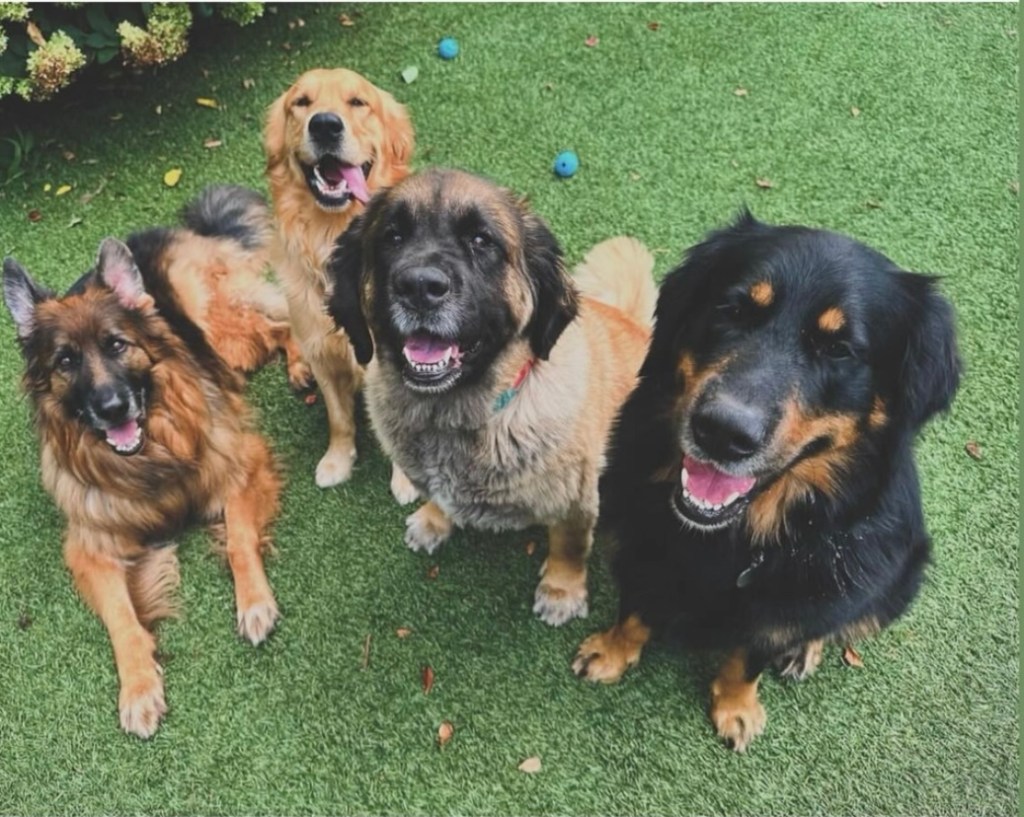
Judge, Bud, Daisy, & Bravo | National Dog Day • August 26th, 2024

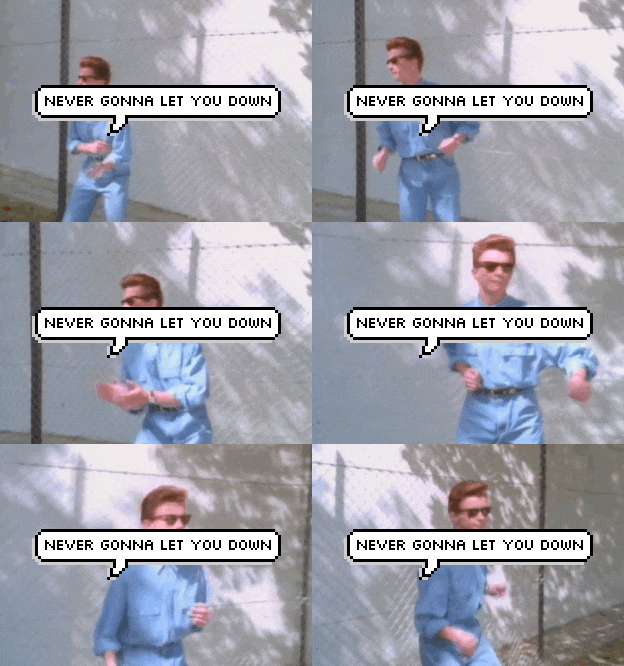
Loyalty is a rare and invaluable trait—a kind of dedication we often seek in our human relationships but one that is lived out daily by our four-legged companions. When I captured the above smiling faces of Judge, Daisy, Bravo, and Bud, they immediately offered a powerful reminder of what true loyalty looks like and what we, as humans, can learn from our furry friends. It was in that moment that Rick Astley’s iconic song Never Gonna Give You Up began playing in my mind, its lyrics perfectly mirroring my pack’s unwavering commitment—a promise to never let me or our family down.

Dogs and the Art of Commitment

Astley’s song became an anthem of 1980s pop music not only for its catchy beat but also because it speaks to a timeless truth: genuine loyalty doesn’t falter. It’s safe to say dogs understand this truth instinctively because they:

  • Aren’t driven by obligation or social expectation; they are loyal because they choose to be.
  • Show up every day, no matter what.
  • Greet you at the door, excited to see you, even if you’ve had a bad day.
  • Remain unwavering in their loyalty.

For dogs, there are no conditions to which their commitment is contingent—it’s a steadfast bond rooted in love and trust that remains unshakeable, no matter the circumstances. In contrast, human relationships often hinge on conditions. Friendships, partnerships, and even family bonds can strain when circumstances change. But a dog’s commitment doesn’t work that way; they remain present. Just as Astley promises, “Never gonna let you down,” dogs demonstrate a loyalty that doesn’t just weather storms—they stare down the turbulence, remaining steadfast by your side.

Learning from a Dog’s Loyalty: What If?

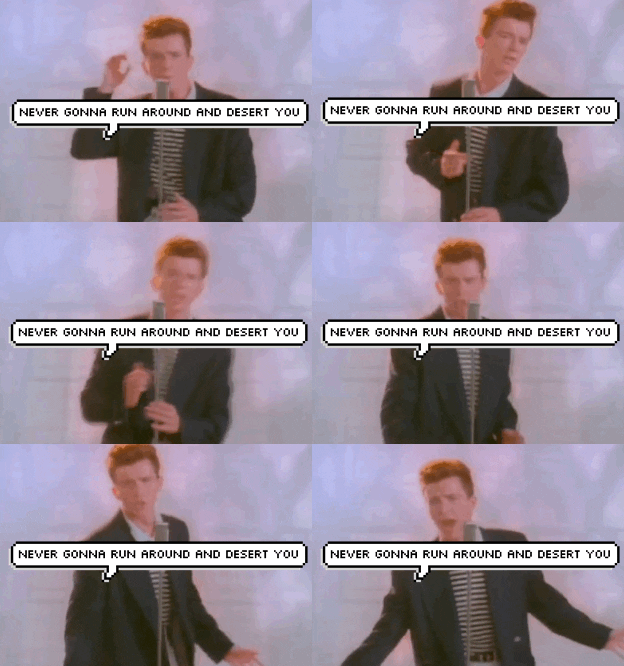
Too often, human relationships falter because we set conditions for our loyalty. We withdraw when things get hard or when someone doesn’t meet our expectations. Dogs, on the other hand, don’t play by those rules. They are all in, every day, whether it’s a good one or not. Dogs live by example, and their example is a lesson in showing up, even when life isn’t perfect—especially when it isn’t. Take Astley’s line, “Never gonna run around and desert you.” Those words aren’t just a promise; they’re a commitment to show up, regardless of the challenges.

What if we approached our human relationships with the same kind of loyalty that dogs demonstrate on our best days, worst days, and every day in between? If we were as consistent in our support, our affection, and our willingness to be there for each other, we could deepen those connections. Dogs don’t wait for the perfect moment to offer love—they do it without hesitation, so why can’t we?

The Power of Consistency

Consistency is another hallmark of a dog’s loyalty. Dogs don’t just offer love in the big moments; they show love in the everyday, in the simple moments of routine, and they love hard. Whether it’s sitting by your feet as you work away at the computer (like Judge is doing right at this very moment as I type) or greeting you with excitement every morning like clockwork (cough, cough—BUD), their presence is constant, genuine, and motivated by love.

In Astley’s song, the repeated refrain drives home the importance of consistency: “Never gonna give you up, never gonna let you down.” These aren’t just words; they represent a commitment to consistency, much like the loyalty dogs provide us every day. It’s in that consistency that trust and depth in relationships grow. Dogs are there for you, even when you may not feel like you deserve such unconditional love—but believe me, you do. The human-animal relationship, along with Astley’s lyrics, provides a humbling lesson: to offer loyalty and love consistently—not just when it’s easy or convenient—and to recognize that you deserve such unconditional treatment, whether it comes from a dog or another human.

Dogs Don’t Give Up—Neither Should We

When I look at this image, or any image, of Judge, Daisy, Bravo, and Bud, I see such happy dogs and a powerful reflection of loyalty in action. Dogs live out the core message of Never Gonna Give You Up without even trying, teaching us that loyalty isn’t just about grand gestures; it’s about being present through the everyday ups and downs.

You see, dogs don’t give up on their people, no matter what. It’s often the people who give up on dogs and on each other, and it’s time for that to change. This is why humans have much to learn from our canine companions. We could:

  • Strengthen our relationships—whether romantic, familial, or platonic—by showing the same level of devotion.
  • Stay the course—just as dogs do, day after day, with nothing more than a wagging tail and the quiet assurance that they will always be there.

So, the next time you listen to Rick Astley’s Never Gonna Give You Up, think beyond the music. Then, reflect on the lessons from those unconventional teachers—dogs—and the invaluable lessons they teach us every day about loyalty. It’s a reminder to show up, stay consistent, and offer our support and love, unconditionally.

Just like Judge, Daisy, Bravo, and Bud, we all have the capacity to live out that promise, and if this motley crew can do it, so can you. There’s no better time than the present to simply follow their lead.

A Case of the Mondays

After a relaxing weekend with our dogs, Monday morning hits hard. The easygoing days replaced by the usual work routine, and it’s clear the pack feels the shift too. Judge, Daisy, Bud, and Bravo all know when it’s time for me to head out the door. Their eyes reflect a shared disappointment. Yup, somebody’s got a case of the Mondays and it’s not just me.

But there’s a silver lining embedded within the dreaded Monday. After hours apart, walking through the door to the pack’s excitement makes life feel lighter. No matter how long the day was, that afternoon greeting, tails wagging as if no time has passed, immediately erases the stress and brings a smile to my face.

Need proof? Take this photo from Monday evening. Here, Bravo is affectionately letting me know how happy he is to be together again. He may not use words, but Bravo’s expression of love says it all. Sharing a moment like this after a long day is a reminder that despite the weekday grind, our bond remains strong. Reuniting isn’t just about making up for lost time—it’s about resetting the connection. Just like in any relationship, whether with family or friends, reconnecting after time apart strengthens the bond.

Bravo, Bud, Daisy, and Judge; their love reminds me that, even after a busy day, the simple act of coming home to a house filled with love is always the best part of every day—and the perfect remedy for any case of the Mondays.

Embracing Unconditional Love: Lessons from Our Dogs

Photo by Laura Stanley on Pexels.com

Earlier today, I stumbled upon an Instagram post from @moderndogco that read, “Imagine if we loved each other the way our dogs love us.” Of course this post immediately struck a chord with me, as it undoubtedly has with many others. “Imagine if we loved each other the way our dogs love us” is a sentiment that, on the surface, seems straightforward, but carries with it a deep and transformative message about love, compassion, and humanity.


The Unconditional Love of Dogs

Dogs are often described as a person’s best friend, and for good reason. A dog’s love is pure, unconditional, and unwavering. Whether the human in a dog’s life had a bad day, made mistakes, or are feeling down, it is always the dog there to offer a wagging tail, the dog who is willing to do anything to elicit a smile from their person. A dog’s love doesn’t depend on their human’s actions, socio-economic status, or fluctuating moods. A dog’s love is an inherent part of who they are.

The Underlying Message

“Imagine if we loved each other the way our dogs love us,” invites us to imagine a world where we love each other with the same boundless generosity that our dogs demonstrate on-the-daily. You see, love is about embracing each other’s imperfections and offering support and kindness, no matter the circumstances. In essence, “Imagine if we loved each other the way our dogs love us,” is a call to elevate our capacity for empathy and understanding in our daily interactions, to love without conditions, judgments, or expectations.

Our Responsibility as Readers

“Imagine if we loved each other the way our dogs love us,” are more than just words to inspire a fleeting moment of inspiration; it’s a call to action. Here are 5 possible ways to bring these simple words to fruition in an impactful way:

  • Practice Empathy: Strive to understand others’ perspectives and feelings. Just as dogs sense our emotions and offer comfort, we can be more attuned to the needs and emotions of those around us.
  • Forgive Freely: Dogs don’t hold grudges. They forgive quickly and move on. Let’s adopt this attitude by letting go of past grievances and focusing on building positive relationships.
  • Show Consistent Kindness: Small acts of kindness can make a significant impact. Whether it’s a smile, a kind word, or a helping hand, these gestures can brighten someone’s day and create a ripple effect of goodwill.
  • Be Present: Dogs are masters of living in the moment. They don’t dwell on the past or worry about the future. By being present, we can fully engage with those around us and appreciate the beauty of each moment.
  • Love Unconditionally: This is perhaps the most challenging, yet most rewarding aspect. Unconditional love means accepting others as they are, flaws and all. It means offering love without expecting anything in return.

The Transformative Power of Love

Imagine the profound impact on our communities, workplaces, and families if we all loved a little more like our dogs love their humans. Relationships would be stronger, conflicts fewer, and the world a kinder place. Each of us has the power to contribute to this vision by embracing these principles in our daily lives.

“Imagine if we loved each other the way our dogs love us,” serves as a gentle yet powerful reminder of the transformative power of love. By taking this message to heart and integrating its essence into our lives, we can create a more compassionate and connected world.

The Silent Echo of a Promise: How Dogs Quietly Shape Our Understanding of Relationships

Life’s most profound lessons often come from unexpected sources. One such source is the stoic presence of a dog in our lives. Another is a timeless song that speaks to the heart: “The Promise” by the 1980s pop group When in Rome. So what happens when you combine the two, the narrative of one family dog + When in Rome’s The Promise? Through the lens of the human-animal bond and one particular 80s classic, I delve into our family dog Bravo’s steadfast presence and the way in which it helps reveal profound life lessons on unconditional love and loyalty.

When In Rome – The Promise (Official Music Video)

Bravo’s Early Days

Bravo’s story begins far from our doorstep but is forever etched in the chronicles of his Alaskan journey. His early days were marked by a true “it can only happen in New York” debut, highlighting the loving kindness of a local woman who fought tirelessly to keep Bravo, his siblings, and their mother alive. One woman’s compassion and dedication set the stage for Bravo’s miraculous survival and eventual arrival in our lives. That’s why when I read on a local social media page about a little guy with big paws who needed a place to call home, I knew our hearts were big enough to welcome him with open arms.

Those who meet Bravo immediately recognize he is far from an ordinary dog. Bravo is a stunning blend of Golden Retriever, German Shepherd, and Bernese Mountain Dog, with a splash of Super Mutt. This unique combination gives Bravo a majestic appearance—a regal stance of a German Shepherd, the golden warmth of a retriever, and the gentle giant presence of a Bernese. His soulful eyes, framed by his thick, multi-colored coat, reflect a depth of experience and emotion that words often fail to capture.

Cue “The Promise” by When in Rome

“The Promise” by When in Rome is one of my favorite 80s songs to sing during a round of living room karaoke, in part because it seems to resonate deeply with anyone who loves 80s music, has experienced the transformative power of unconditional love, loyalty, and companionship; oh and loves the 2004 movie Napoleon Dynamite.

Napoleon Dynamite (2004)

But more importantly, the lyrics of this poppy-80s song speak of unwavering support and the assurance that, no matter what, someone will always be there for you—and that someone might just be a four-legged friend:

That’s why when I recently heard “The Promise” on the radio, its thematic message reverberated within me. Later that same day, I happened to capture a beautiful image of Bravo’s soulful eyes. Immediately, I put the two together. It was as if the speaker of the song was narrating Bravo’s silent vow to stand by me, stand by our family, through thick and thin.

You see, unlike humans, dogs communicate their loyalty and love through actions rather than words, underscoring the connection of the silent promise that dogs make to their human companions. “The Promise” intertwines melody and lyrics to evoke a person’s universal longing for comfort, reassurance, and security, mirroring the steadfast presence that a loyal dog offers day in and day out.

Bravo’s Unspoken Promise

From the moment Bravo entered our lives to this very moment in which I write this piece, he shared, and continues to share, an unspoken promise to be there for me, for our family in his every action.

Dogs, with their intuitive nature, grasp the very essence of human emotions. They sense when we are happy and join in our joy with wagging tails and playful antics. They also detect our sadness and respond with gentle nudges and soulful eyes that seem to say, “I’m here.” The unspoken promise between humans and dogs parallels the beautifully encapsulated motif in “The Promise.”

Bravo’s presence serves as a reminder of the silent promises that bind us. He stands by us during difficult times, offering comfort without words. His watchful eyes and gentle demeanor provide a sense of security and calm, illustrating that simply being there for those we care about can be just enough to guide one through life’s ups, downs, and in-betweens.

Lessons in Loyalty and Presence

The human-animal bond is unique in its purity and depth. Dogs like Bravo teach us invaluable life lessons through their unwavering loyalty and presence. They show us that love does not always need to be expressed through grand gestures or spoken words. Sometimes, the act of being there is enough, and why the subsequent line from “The Promise” captures the struggle to articulate emotions that are often felt more deeply than words can convey:

Bravo’s presence teaches us that it’s okay to not always have the right words, and that sometimes, the most meaningful connections are communicated through loving looks or silent understandings of respect and empathy. Whether it’s a gentle nuzzle or a wagging tail, Bravo demonstrates that genuine affection and support doesn’t require elaborate expressions. In his quiet, steadfast way, he reminds us that being there for one another, through good times and bad, is the true essence of love and loyalty.

The Human-Animal Bond

Relationships are built on trust, mutual respect, and unconditional love. While the bond between humans and animals transcends ordinary relationships, it shares similarities with human connections. Bravo’s journey with us, marked by the echoes of “The Promise,” highlights the transformative power of the human-animal bond and its positive influence on human relationships.

The above lyrics encapsulate what Bravo does for us every day. His steadfast presence is a promise fulfilled, a constant reminder of the strength of the human-animal bond. Bravo teaches us patience, compassion, the beauty of silent companionship, and how to be steadfastly loyal and protective of those we love the most, with or without audible words. This profound bond with Bravo positively influences our human relationships by demonstrating the importance of being present and attentive.

In observing Bravo’s loyalty and protective instincts, we learn to prioritize the well-being of our loved ones, ensuring that they feel safe and becomes a model for us to emulate in our relationships, whether they be familial, platonic, or romantic. Bravo’s presence, therefore, not only enriches our lives with his love but also enhances our ability to build and maintain meaningful, loving relationships with those around us.

The Power of the Silent Promise

As I reflect on my love for Bravo and play “The Promise” throughout the house, I am reminded of the profound impact the human-animal bond has on one’s overall well-being. The lessons imparted by Bravo and the timeless words of When in Rome demonstrate that life’s greatest joys often come from the simplest acts of being there for one another. Bravo’s role in our family and “The Promise” illustrate how some promises really are forever, even if they aren’t audible to the ears, they are felt with the heart.

So, if you ever find yourself in doubt, look to the silent companionship of a loyal friend, whether they be near or far, have two legs or four, and remember: the greatest promises are kept not in words, but in actions and presence. In the end, these silent promises, these unspoken bonds of love, serve as a powerful testament that the simplest acts of being there, literally or figuratively, for another are what truly make life beautiful.

Napoleon Dynamite (2004)

Harmonizing Tails: My Unsuspecting Connection with Peter Frampton

Recently, I enjoyed an exciting post by fellow dog lover, Rocker Dog Podcast, teasing his most recent interview with the legendary singer Peter Frampton. I was elated to learn Frampton shares a deep affection for German Shepherds, just like me. As a dog enthusiast, this connection sparked my interest, but it is a particular image shared by Rocker Dog Podcast that transports me to the past and strikes a chord with a classic tune.

The picture in question features a young Peter Frampton alongside his faithful companion, Rocky.

And immediately I started singing, one of Frampton’s iconic songs, “Show Me the Way.”

The connection between Frampton and his German Shepherd, Rocky, seems to echo the sentiment many have towards dogs and their unique way of showing their people a path in life.

For me, such a connection with dogs goes beyond mere companionship; it’s a source of inspiration and guidance. As a proud owner of a German Shepherd, my Judgie Boy, I know firsthand how these intelligent and loyal animals illuminate the way forward. German Shepherds, like many dogs, demonstrate unwavering loyalty, boundless love, an intuitive understanding, and often act as a guiding light through life’s twists and turns (at least that’s what my Judgie, and all my dogs, have done for me).

Frampton’s photograph with Rocky displays a beautiful symbiosis between a musician and his canine confidant. It makes me reflect on how our dogs become more than just pets; they become our mentors, teaching us about loyalty, resilience, and the joy of living in the present moment.

“Show Me the Way,” a song that touches the hearts of many, now takes on a new layer of meaning for me. It becomes a melody of gratitude for the four-legged friends who, much like Peter Frampton’s Rocky, show me the way in life’s journey.

As Rocker Dog Podcast’s interview with Frampton unfolds, it brings to light the current chapter of Frampton’s canine companionship. The legendary singer shares heartwarming details about his present dog, a Labradoodle— his service dog, Bigsby.

Labradoodles are known for their intelligence and hypoallergenic qualities, and as a service dog highlights a different dimension of the bond between humans and their furry friends. The Labradoodle’s unique combination of friendliness and intelligence aligns seamlessly with Frampton’s lifestyle, showcasing how dogs adapt to their owners’ needs, providing comfort and practical aid. Bigsby is still undergoing training to provide assistance and support to Frampton, and Frampton is very much a part of this training.

During the podcast, Frampton delves into how Bigsby has become an integral part of his daily routine, offering not only companionship but also essential assistance. The revelation about Bigsby adds a contemporary touch to Frampton’s journey with canine companions. It emphasizes the evolving nature of our relationships with dogs, from the iconic Rocky to the modern-day support and friendship provided by Bigsby. It also sheds light on the broader role that dogs play in our lives, not only as loving companions but also as dedicated service animals, enhancing the quality of life for their human counterparts and exemplifies the incredible versatility that dogs bring into our lives.

As a dog lover, hearing about Peter Frampton’s experiences with Bigsby resonates with me. It reinforces the idea that, regardless of fame or status, the connection between humans and dogs transcends boundaries. The Labradoodle’s role as a service dog further underscores the incredible impact dogs can have on our well-being, providing assistance, comfort, and unwavering loyalty.

In the end, Rocker Dog Podcast’s post and interview not only celebrates the enduring love for German Shepherds but also showcases the evolving dynamics of the relationship between Frampton and his canine companions. Bigsby, the Labradoodle service dog, stands as a testament to the adaptability and versatility of our four-legged friends, reminding us of the myriad ways in which dogs continue to enrich and contribute to our lives.

The Key to UC Davis Health’s CARE Project: The Canine Companion

The Impact of Therapy Dogs in the Healthcare Setting

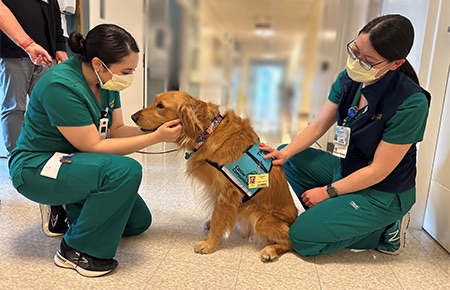
“The newest canine CARE team dog, Landon, is popular not only with patients, but with employees, who enjoy seeing him on the job” (Houser, 2024).

I recently read a social media post by Canine Companions in which the organization highlighted therapy dog Landon and his involvement in the UC Davis Health’s CARE (Creativity, Amenities, Relaxation, Exploration) Project. UC Davis Health takes great pride in the CARE Project, with a focus on treating the whole patient: mind, body, and spirit, its mission goes beyond conventional medical approaches, and recognizes the therapeutic power of what may at first seem to be unconventional—the human-animal bond.

In a healthcare environment, where stress and anxiety can be overwhelming, the introduction of therapy dogs like Landon serves as a beacon of hope and motivation. The partnership between UC Davis Health, Landon and his volunteer handler, Pat Tull, exemplifies the profound impact animals can have on the well-being of individuals facing health challenges. You see, Landon’s supportive role to patients and staff alike, not only highlights the significance of certified therapy dogs but also emphasizes the compassion and comfort they bring to those undergoing hospitalization, and those delivering the medical care.

The CARE Project and UC Davis Health’s commitment to the human-animal bond contributes to patients’ emotional well-being and encourages their active engagement in treatment, which fosters a holistic approach to healthcare. Katie Lorain, the creative arts and recreation therapy manager of the CARE Project, observes patients moved to tears upon encountering a therapy dog, which underscores the transformative nature of these interactions. Lorain’s observations of the patient-therapy dog relationship in the health care setting serves as a testament to the unique and invaluable role that animals can play in enhancing the human experience, especially in challenging circumstances.

The emotional response of patients, often moved to tears at the mere sight of these canine companions, speaks volumes about the profound connection forged in these moments. Let the story of therapy dog Landon and UC Davis Health’s CARE Project remind readers of the healing power embedded in the simplicity of a wagging tail and a comforting presence. Let Landon, and his fellow pawesome therapy dogs, reinforce the idea that, sometimes, love at first sight can come in the form of a furry friend bringing solace and security during moments of vulnerability.

To learn more about Landon and UC Davis Health’s CARE Project, please read Nick Houser’s January 2024 piece, Introducing UC Davis Health’s newest four-legged team member, Landon.

Celebrating Black History Month: Honoring Tina Turner


In honor of Black History Month, each week I will delve into the heartwarming bond between Black voices and their cherished canine companions.

For my final post, I pay tribute to the remarkable life of the iconic Tina Turner, a music legend who reshaped the rock ‘n’ roll landscape and is forever immortalized as the #Queen of Rock ‘n’ Roll. Tina’s electrifying performances, soulful voice, and resilient spirit made her a music icon and one of my favorite artists to karaoke!

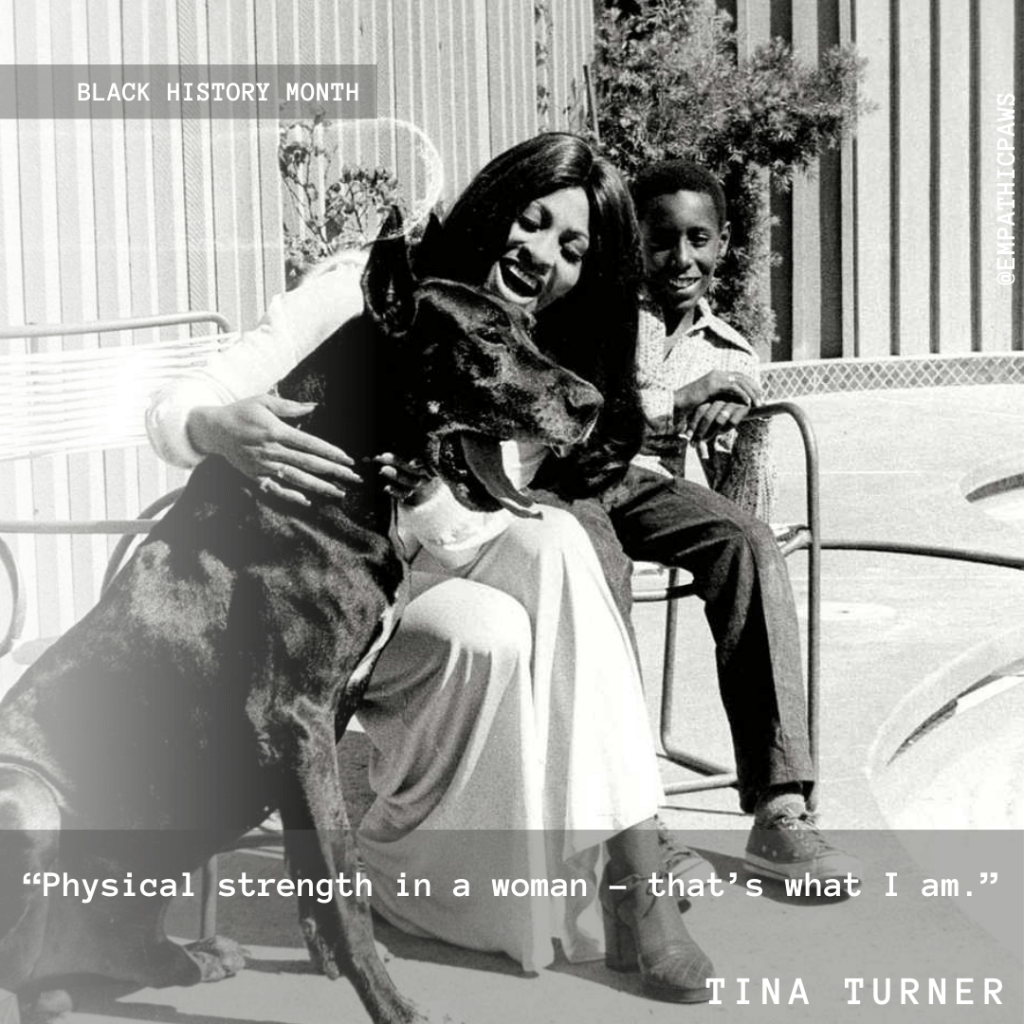
I personally found myself even more inspired by Tina after learning about this 1971 image depicting Tina, her son Ronnie, and their majestic Great Dane, Onyx. You see, this image encapsulates the dynamic energy of the rock legend and the serene strength of a canine companion, solidifying the position held by many, other than myself, that dogs are not just pets; they are steadfast companions, offering a unique and irreplaceable bond, one that transcends barriers imposed by others and the society in which they live.

Additionally, the image suggests Onyx exemplified the quintessential #GreatDane attributes, loyalty and a gentle demeanor, not because of his regal posture, but more so by the body language of Onyx’s humans—Tina’s loving embrace of Onyx, the position of her arm and her beaming smile, not to mention her son’s joyous expression. In this moment, the trio appear to share simultaneous happiness.

I’m left to wonder about the myriad of ways Onyx may have offered Tina unwavering reinforcements through the highs and lows of the early days of her illustrious career, including her personal hardships and quest for true love. In the whirlwind of a demanding career, one may consider that the presence of a loyal canine friend, like Onyx, served as a grounding force, for dogs, with their intuitive understanding and unconditional love, fulfill an area of need within their person.

Tina and Onyx, another beautiful example of the human-animal bond to further substantiate my personal belief that standing alongside every great woman is a stoic canine companion (or four). At the end of the day, dogs really are “Simply the Best.”

Please consider a visit to my Instagram to view posts honoring the incomparable Black voices of Billie Holiday, Oprah, Pauli Murray, and their respective love of dogs.

Dog Save the People: My Conversation with John Bartlett

Me & Judge: Dog Save the People.

In the fall of 2022, I received an email from the amazing production team behind John Bartlett’s podcast, Dog Save the People. John and his team stumbled upon my website, were intrigued by the novel nature of my qualitative study, impressed by my steadfast research-based mission to dispel misconceptions around therapy dogs in high schools, desire to educate stakeholders on why therapy dogs are needed, and how to implement a therapy dog program with efficacy.

Dog Save the People have welcomed some unbelievable guests. Writers, professors, even Nobel Prize recipients, and now, to be added to this list, Dr. Jessica Maricevic— I’m humbled.

So here I am, and yeah, I know, I was always “here,” but I am forever grateful for Dog Save the People’s equally steadfast position to illuminate the voices of others (which in this episode, happens to be my voice).

Thank you John Bartlett, for providing a platform for my research, honoring my commitment to secondary education, the student-therapy dog relationship, and helping me educate others on how a vital relationship like the one between a high school student and a therapy dog needs to be an equitable norm for all high school students across America.

I welcome you to listen to the episode in its entirety (click here) and to explore some additional thoughts below.


Why therapy dogs? Why now?

This pseudo post-COVID America has unearthed a tremendous amount of pain, a pain some have tried desperately to suppress, or flat out ignore. Secondary stakeholders who acknowledge the macro reality of the invasive impact of the current geo-political climate are better equipped to consider the micro implications in the high school setting. And to those stakeholders who believe they must personally observe the influence of the macro reality in the micro setting, see with their own eyes presentable evidence of societal stressors, complex anxieties and invisible traumas to adequately address the social and emotional needs of students… well, read a little bit more of this post, because today’s high school students are carrying more than a load of books and a laptop with little to no storage.

So say you.

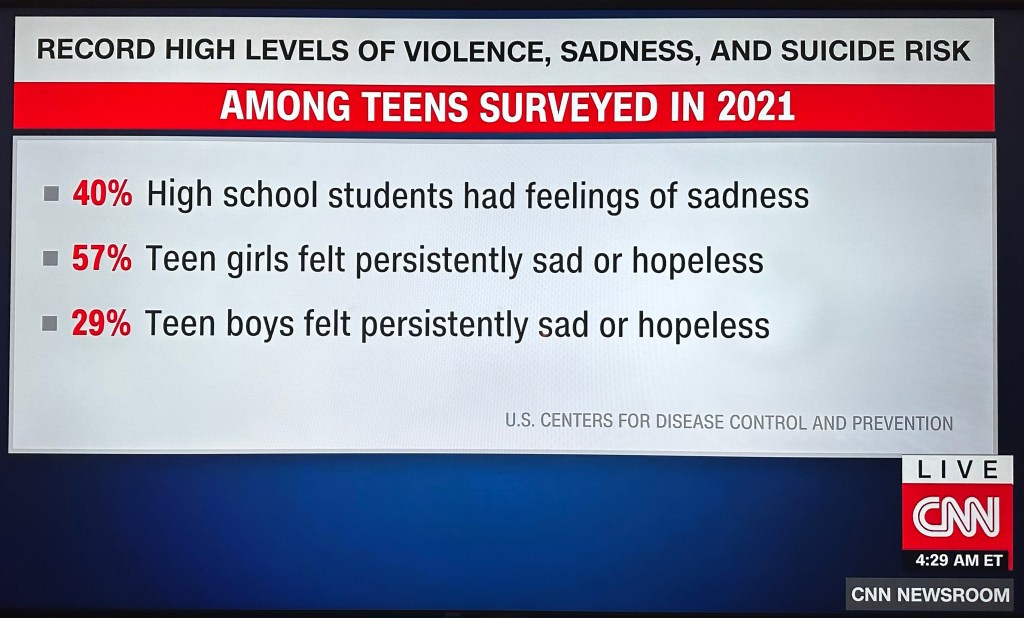
I’ll hold off on the details of my own research and findings for the time being simply to prove you don’t need to read academic journals and peer reviewed articles to establish an understanding of this crisis. Here are some statistics presented from three national cable news outlets within the last 12 months:

An image I captured from my television during an early morning CNN live broadcast (February 14, 2023).
Read Elizabeth Pritchett’s article in its entirety: Teenage brains aged faster
April 26, 2022 segment from MSNBC’s Morning Joe; guest Harvard University’s John Della Volpe.

Understand, the above sources are a mere snapshot of reporting from three national cable news outlets, and yes I am well aware each source brings with it their own distinct bias. Yet, even with their respective leans, the conscious decision to report on the social and emotional concerns of teens suggests a unified effort to convey a stark reality to their audiences.

It is extremely important to note the three news outlets referenced here in this post have observed an increase in viewership during the years of 2016 – 20220 (Pew Research Center, 2023). The research suggests such an increase in viewership is most likely connected to presidential elections, societal conflicts, and the coronavirus pandemic (Pew Research Center, 2023).

Hypothetically, if the Pew Research Center reports either (1) a decrease the numbers of viewers, (2) a plateau of viewership (it remains at its current rate), or (3) a continued upward viewership trend for the period of 2020-2023, millions of Americans would still receive the message loud and clear, teens are hurting, they need something more, and it’s up to the adults in their lives to make it happen.

Back in my day…

As students go from class to class, carry the weight of the world and the plight of America’s transgressions on their shoulders, they are accompanied by feelings of sadness, hopelessness, feeling down, and depressed. And then, some students hold their breath when a school wide announcement interrupts a class period without warning, flinch upon hearing an unsuspecting sound, and ask what if questions the day after cable news outlets, those very outlets referenced above, consume airwaves with incessant reporting of yet another unthinkable event.

Even with all of this chaos, students aren’t desensitized by their reality. They remain hyper vigilant, in-tune to their emotional responses, and astute to the emotional affect of others in their orbit. But that doesn’t mean they are okay.

The last thing adolescents need is another adult telling them how to manage life as a teenager, or why they need grit and perseverance to get through “these unprecedented times.” Unfortunately, the reality for today’s teens requires more than “Back in my day” talks and harping on trendy jargon (I wish it were that easy). Couple that with the contradictory expectations to prioritize emotional wellbeing and academic performance— students need something more than whatever is provided at the secondary level to meet or exceed their social and emotional needs.

I can hear stakeholders’ “yeah, but…” phrases, ready to launch their counter claims:

Yeah, but their grades are fine.

Yeah, but they’re participating in sports.

Yeah, but they’re not alone in the cafeteria.

Yeah, but they’re taking selfies.

Yeah, but they’re friends with that student; they’re not a bully.

Yeah, but they seem happy.

It’s time to stop assuming. It’s time to stop dismissing the teenage experience. It’s time to start listening, and infuse differentiated support systems that are more real-world centric.

21st century students need more of the tangible, more ways to feel safe, secure, valued and loved, with opportunities to reciprocate those feelings towards another, without judgement (Maricevic, 2022).

Establish a therapy dog program (start today).

Now more than ever, therapy dogs are a viable resource to meet those needs for all high school students— no matter the zip code, regional location or poverty designation of a given school or district.

Yeah, but…

I know, I know! You’re asking yourself, “Yeah, but what about the challenges?” Mitigating challenges, is a totally different blog all together, but believe you me, I’ve got it all covered. I will tell you this, any perceived challenges from fears to allergies can be addressed to ensure the efficacy of board policy and the sustainability of an in-house therapy dog program in your high school (Maricevic, 2022).

This is my original gif which includes slides displaying my research and findings. These slides appeared in my Fall 2022 presentation to members of Association of Professional Humane Educators (and that presentation was an awesome experience).

I’ll also tell you that any stakeholder who flat out says no to an in-house therapy dog program to meet the social and emotional needs of students, is saying no for the sake of saying no (Maricevic, 2022). Don’t forget it.

The student-therapy dog relationship in the high school setting is an indelible, transformative fixture, a relationship with the infinite ability to transcend the four year high school experience. My findings suggest the omnipresence of a therapy dog in the high school setting does more than influence the social-emotional competency development in adolescents (Maricevic, 2022). In fact, the organic development of the student-therapy dog relationship may very well be the antidote to [feel free to fill in the blank to reflect the needs of your students and high school] (Maricevic, 2022).

My study reveals much more about the therapy dog phenomenon, its profound impact on secondary students and the high school setting. I’m proud to say my study also exposes inequities that must be addressed to ensure all students are afforded the opportunity to benefit from the student-therapy dog relationship during their high school years.

The above is a mere snippet of some of the points touched upon during my conversation with John Bartlett, host and founder of Dog Save the People. I encourage you to listen to the podcast in its entirety through any of the following platforms:

And let’s connect! Share your thoughts! Questions! I look forward to it.