Promoting and equitably assisting organizations in the integration of animal-assisted therapies for the physical, mental, and emotional benefit of individuals in public and private settings, one paw at a time.
Recently, I enjoyed an exciting post by fellow dog lover, Rocker Dog Podcast, teasing his most recent interview with the legendary singer Peter Frampton. I was elated to learn Frampton shares a deep affection for German Shepherds, just like me. As a dog enthusiast, this connection sparked my interest, but it is a particular image shared by Rocker Dog Podcast that transports me to the past and strikes a chord with a classic tune.
And immediately I started singing, one of Frampton’s iconic songs, “Show Me the Way.”
The connection between Frampton and his German Shepherd, Rocky, seems to echo the sentiment many have towards dogs and their unique way of showing their people a path in life.
For me, such a connection with dogs goes beyond mere companionship; it’s a source of inspiration and guidance. As a proud owner of a German Shepherd, my Judgie Boy, I know firsthand how these intelligent and loyal animals illuminate the way forward. German Shepherds, like many dogs, demonstrate unwavering loyalty, boundless love, an intuitive understanding, and often act as a guiding light through life’s twists and turns (at least that’s what my Judgie, and all my dogs, have done for me).
Frampton’s photograph with Rocky displays a beautiful symbiosis between a musician and his canine confidant. It makes me reflect on how our dogs become more than just pets; they become our mentors, teaching us about loyalty, resilience, and the joy of living in the present moment.
“Show Me the Way,” a song that touches the hearts of many, now takes on a new layer of meaning for me. It becomes a melody of gratitude for the four-legged friends who, much like Peter Frampton’s Rocky, show me the way in life’s journey.
As Rocker Dog Podcast’s interview with Frampton unfolds, it brings to light the current chapter of Frampton’s canine companionship. The legendary singer shares heartwarming details about his present dog, a Labradoodle— his service dog, Bigsby.
Labradoodles are known for their intelligence and hypoallergenic qualities, and as a service dog highlights a different dimension of the bond between humans and their furry friends. The Labradoodle’s unique combination of friendliness and intelligence aligns seamlessly with Frampton’s lifestyle, showcasing how dogs adapt to their owners’ needs, providing comfort and practical aid. Bigsby is still undergoing training to provide assistance and support to Frampton, and Frampton is very much a part of this training.
During the podcast, Frampton delves into how Bigsby has become an integral part of his daily routine, offering not only companionship but also essential assistance. The revelation about Bigsby adds a contemporary touch to Frampton’s journey with canine companions. It emphasizes the evolving nature of our relationships with dogs, from the iconic Rocky to the modern-day support and friendship provided by Bigsby. It also sheds light on the broader role that dogs play in our lives, not only as loving companions but also as dedicated service animals, enhancing the quality of life for their human counterparts and exemplifies the incredible versatility that dogs bring into our lives.
As a dog lover, hearing about Peter Frampton’s experiences with Bigsby resonates with me. It reinforces the idea that, regardless of fame or status, the connection between humans and dogs transcends boundaries. The Labradoodle’s role as a service dog further underscores the incredible impact dogs can have on our well-being, providing assistance, comfort, and unwavering loyalty.
In the end, Rocker Dog Podcast’s post and interview not only celebrates the enduring love for German Shepherds but also showcases the evolving dynamics of the relationship between Frampton and his canine companions. Bigsby, the Labradoodle service dog, stands as a testament to the adaptability and versatility of our four-legged friends, reminding us of the myriad ways in which dogs continue to enrich and contribute to our lives.
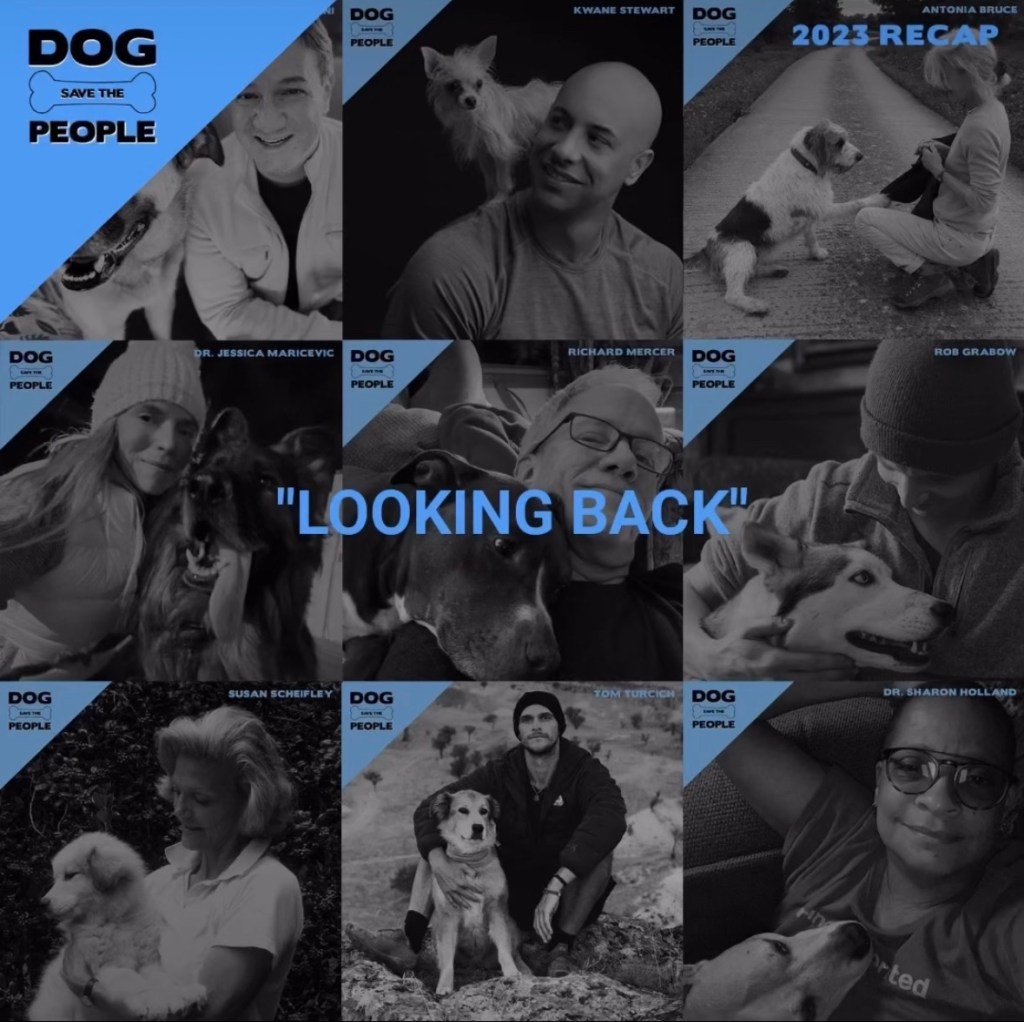
As 2023 comes to an end, I am reminded of an extraordinary privilege afforded to me this year—being featured alongside incredible human-animal bond advocates in the 2023 podcast series, Dog Save the People. In a world filled with remarkable voices dedicated to uplifting humanity, there are those who stand out, inspiring change and progress. To find myself nestled amidst luminaries—a Nobel Prize winner and CNN’s #2023HeroOfTheYear, well, to say it was a surreal experience would be an understatement.
The honor was not just a personal triumph. Dog Save the People’s decision to devote an entire episode to my research and to unpack the why behind the need for therapy dogs in high school settings, gave credence to my research, the human-animal bond (specifically the one between teenagers and therapy dogs), and so much more. But here’s the best part, I’m not the only person to hold such convictions.
Dog Save the People’s dedication to nurturing meaningful discussions, with a focus on the profound bond between humans and animals, is truly commendable. Each episode’s authentic portrayal and reverence for diverse perspectives reflects an unwavering commitment to fostering impactful dialogue for the greater good.
And then there’s my voice.
The inclusion of my voice alongside this esteemed 2023 group of guests serves as a reminder of the collective strength found in passionate advocacy. It’s a testament to the transformative potential of shared conversations and the ripple effect they create.
To those who stood by EmpathicPaws, supported my ventures, and rallied for the advocacy work addressing the human-animal bond across public and private sectors, and continue to do so, I extend my deepest gratitude.
And as I glance at the time, the minutes tick closer to 2024. It’s exciting to affirm my empathic journey is one that is far from over. Here’s to carrying forth the torch of empathy and advocacy into the new year. Together, let our collective voices resonate louder, ushering in positive change—one paw at a time.
In the fall of 2022, I received an email from the amazing production team behind John Bartlett’s podcast, Dog Save the People. John and his team stumbled upon my website, were intrigued by the novel nature of my qualitative study, impressed by my steadfast research-based mission to dispel misconceptions around therapy dogs in high schools, desire to educate stakeholders on why therapy dogs are needed, and how to implement a therapy dog program with efficacy.
Dog Save the People have welcomed some unbelievable guests. Writers, professors, even Nobel Prize recipients, and now, to be added to this list, Dr. Jessica Maricevic— I’m humbled.
So here I am, and yeah, I know, I was always “here,” but I am forever grateful for Dog Save the People’s equally steadfast position to illuminate the voices of others (which in this episode, happens to be my voice).
Thank you John Bartlett, for providing a platform for my research, honoring my commitment to secondary education, the student-therapy dog relationship, and helping me educate others on how a vital relationship like the one between a high school student and a therapy dog needs to be an equitable norm for all high school students across America.
I welcome you to listen to the episode in its entirety (click here) and to explore some additional thoughts below.
Why therapy dogs? Why now?
This pseudo post-COVID America has unearthed a tremendous amount of pain, a pain some have tried desperately to suppress, or flat out ignore. Secondary stakeholders who acknowledge the macro reality of the invasive impact of the current geo-political climate are better equipped to consider the micro implications in the high school setting. And to those stakeholders who believe they must personally observe the influence of the macro reality in the micro setting, see with their own eyes presentable evidence of societal stressors, complex anxieties and invisible traumas to adequately address the social and emotional needs of students… well, read a little bit more of this post, because today’s high school students are carrying more than a load of books and a laptop with little to no storage.
So say you.
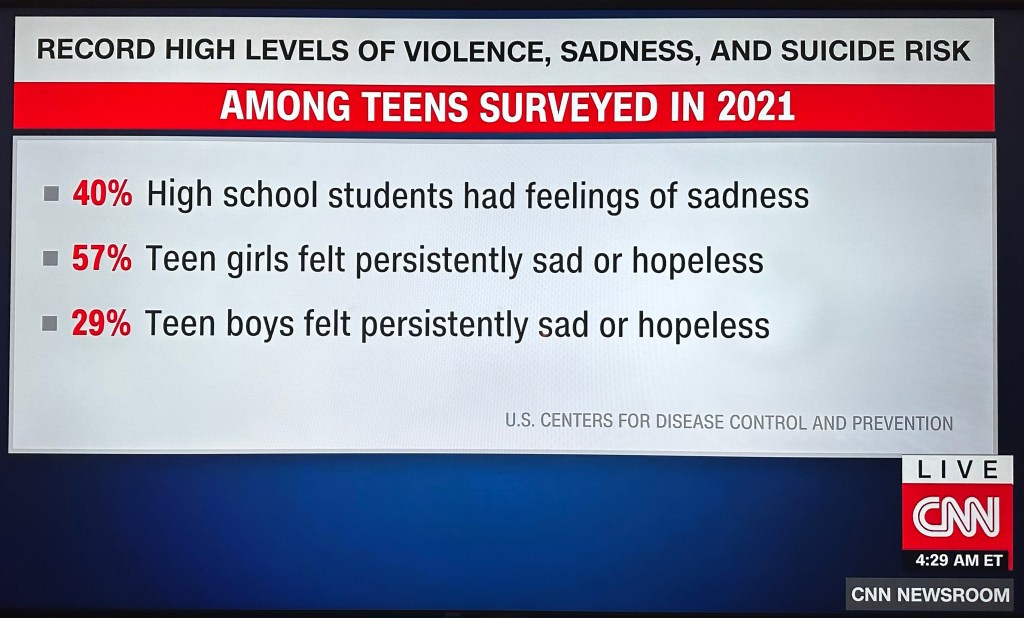
I’ll hold off on the details of my own research and findings for the time being simply to prove you don’t need to read academic journals and peer reviewed articles to establish an understanding of this crisis. Here are some statistics presented from three national cable news outlets within the last 12 months:
An image I captured from my television during an early morning CNN live broadcast (February 14, 2023).Read Elizabeth Pritchett’s article in its entirety: Teenage brains aged faster…
April 26, 2022 segment from MSNBC’s Morning Joe; guest Harvard University’s John Della Volpe.
Understand, the above sources are a mere snapshot of reporting from three national cable news outlets, and yes I am well aware each source brings with it their own distinct bias. Yet, even with their respective leans, the conscious decision to report on the social and emotional concerns of teens suggests a unified effort to convey a stark reality to their audiences.
It is extremely important to note the three news outlets referenced here in this post have observed an increase in viewership during the years of 2016 – 20220 (Pew Research Center, 2023). The research suggests such an increase in viewership is most likely connected to presidential elections, societal conflicts, and the coronavirus pandemic (Pew Research Center, 2023).
Hypothetically, if the Pew Research Center reports either (1) a decrease the numbers of viewers, (2) a plateau of viewership (it remains at its current rate), or (3) a continued upward viewership trend for the period of 2020-2023, millions of Americans would still receive the message loud and clear, teens are hurting, they need something more, and it’s up to the adults in their lives to make it happen.
As students go from class to class, carry the weight of the world and the plight of America’s transgressions on their shoulders, they are accompanied by feelings of sadness, hopelessness, feeling down, and depressed. And then, some students hold their breath when a school wide announcement interrupts a class period without warning, flinch upon hearing an unsuspecting sound, and ask what if questions the day after cable news outlets, those very outlets referenced above, consume airwaves with incessant reporting of yet another unthinkable event.
Even with all of this chaos, students aren’t desensitized by their reality. They remain hyper vigilant, in-tune to their emotional responses, and astute to the emotional affect of others in their orbit. But that doesn’t mean they are okay.
The last thing adolescents need is another adult telling them how to manage life as a teenager, or why they need grit and perseverance to get through “these unprecedented times.” Unfortunately, the reality for today’s teens requires more than “Back in my day” talks and harping on trendy jargon (I wish it were that easy). Couple that with the contradictory expectations to prioritize emotional wellbeing and academic performance— students need something more than whatever is provided at the secondary level to meet or exceed their social and emotional needs.
I can hear stakeholders’ “yeah, but…” phrases, ready to launch their counter claims:
Yeah, but their grades are fine.
Yeah, but they’re participating in sports.
Yeah, but they’re not alone in the cafeteria.
Yeah, but they’re taking selfies.
Yeah, but they’re friends with that student; they’re not a bully.
Yeah, but they seem happy.
It’s time to stop assuming. It’s time to stop dismissing the teenage experience. It’s time to start listening, and infuse differentiated support systems that are more real-world centric.
21st century students need more of the tangible, more ways to feel safe, secure, valued and loved, with opportunities to reciprocate those feelings towards another, without judgement (Maricevic, 2022).
Establish a therapy dog program (start today).
Now more than ever, therapy dogs are a viable resourceto meet those needs for all high school students— no matter the zip code, regional location or poverty designation of a given school or district.
Yeah, but…
I know, I know! You’re asking yourself, “Yeah, but what about the challenges?” Mitigating challenges, is a totally different blog all together, but believe you me, I’ve got it all covered. I will tell you this, any perceived challenges from fears to allergies can be addressed to ensure the efficacy of board policy and the sustainability of an in-house therapy dog program in your high school (Maricevic, 2022).
This is my original gif which includes slides displaying my research and findings. These slides appeared in my Fall 2022 presentation to members of Association of Professional Humane Educators (and that presentation was an awesome experience).
I’ll also tell you that any stakeholder who flat out says no to an in-house therapy dog program to meet the social and emotional needs of students, is saying no for the sake of saying no (Maricevic, 2022). Don’t forget it.
The student-therapy dog relationship in the high school setting is an indelible, transformative fixture, a relationship with the infinite ability to transcend the four year high school experience. My findings suggest the omnipresence of a therapy dog in the high school setting does more than influence the social-emotional competency development in adolescents (Maricevic, 2022). In fact, the organic development of the student-therapy dog relationship may very well be the antidote to [feel free to fill in the blank to reflect the needs of your students and high school] (Maricevic, 2022).
My study reveals much more about the therapy dog phenomenon, its profound impact on secondary students and the high school setting. I’m proud to say my study also exposes inequities that must be addressed to ensure all students are afforded the opportunity to benefit from the student-therapy dog relationship during their high school years.
The above is a mere snippet of some of the points touched upon during my conversation with John Bartlett, host and founder of Dog Save the People. I encourage you to listen to the podcast in its entirety through any of the following platforms:




 Empathic Paws