The Key to UC Davis Health’s CARE Project: The Canine Companion

The Impact of Therapy Dogs in the Healthcare Setting
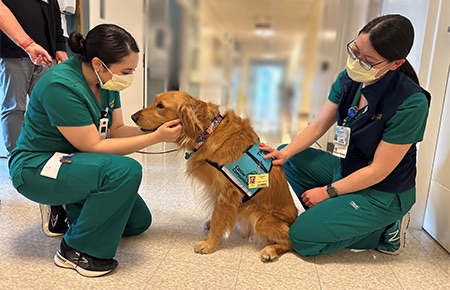
“The newest canine CARE team dog, Landon, is popular not only with patients, but with employees, who enjoy seeing him on the job” (Houser, 2024).

I recently read a social media post by Canine Companions in which the organization highlighted therapy dog Landon and his involvement in the UC Davis Health’s CARE (Creativity, Amenities, Relaxation, Exploration) Project. UC Davis Health takes great pride in the CARE Project, with a focus on treating the whole patient: mind, body, and spirit, its mission goes beyond conventional medical approaches, and recognizes the therapeutic power of what may at first seem to be unconventional—the human-animal bond.

In a healthcare environment, where stress and anxiety can be overwhelming, the introduction of therapy dogs like Landon serves as a beacon of hope and motivation. The partnership between UC Davis Health, Landon and his volunteer handler, Pat Tull, exemplifies the profound impact animals can have on the well-being of individuals facing health challenges. You see, Landon’s supportive role to patients and staff alike, not only highlights the significance of certified therapy dogs but also emphasizes the compassion and comfort they bring to those undergoing hospitalization, and those delivering the medical care.

The CARE Project and UC Davis Health’s commitment to the human-animal bond contributes to patients’ emotional well-being and encourages their active engagement in treatment, which fosters a holistic approach to healthcare. Katie Lorain, the creative arts and recreation therapy manager of the CARE Project, observes patients moved to tears upon encountering a therapy dog, which underscores the transformative nature of these interactions. Lorain’s observations of the patient-therapy dog relationship in the health care setting serves as a testament to the unique and invaluable role that animals can play in enhancing the human experience, especially in challenging circumstances.

The emotional response of patients, often moved to tears at the mere sight of these canine companions, speaks volumes about the profound connection forged in these moments. Let the story of therapy dog Landon and UC Davis Health’s CARE Project remind readers of the healing power embedded in the simplicity of a wagging tail and a comforting presence. Let Landon, and his fellow pawesome therapy dogs, reinforce the idea that, sometimes, love at first sight can come in the form of a furry friend bringing solace and security during moments of vulnerability.

To learn more about Landon and UC Davis Health’s CARE Project, please read Nick Houser’s January 2024 piece, Introducing UC Davis Health’s newest four-legged team member, Landon.

The Human Resource

My recent post is associated with a school building leadership assignment. Below is the prompt and my response.

Prompt: During your internship, has anything occurred that was unanticipated or surprising? Is there anything you encountered that was unexpected? If so, what was your major takeaway? If nothing was unexpected or surprising, why do you think that is the case? After the class session, post a reply to this inquiry on the discussion board and respond to at least one other classmates post.

This is the second semester of my school building leader internship.  Interestingly enough, I find myself much more astute at identifying areas of need, at both the building and district level. Additionally, I find myself considering those within the organization, other than individuals appointed to leadership positions, equipped to address those identified areas of need.

I’m aware that there are resources, human resources, readily available to assist those in the designated leadership position, human resources who may in fact be more equipped to address the identified area need than the person in the designated leadership position to typically address those needs. But for leadership to truly benefit from the human capital within the organization, it requires a transformative mindset, or at least a mindset working towards a full transformative overhaul and cognizant of the need to be open minded, as well as a fortified ego, ready to withstand some of the most daunting moments of self-doubt.

I often find myself thinking, if I were in a current leadership position, how I would incorporate these outstanding educators, to honor their strengths and their desire to be a part of the larger systematic plan of improvement? If students want to be seen, heard, and valued by their teachers, wouldn’t teachers want to be seen, heard, and valued by their leadership team? At the end of the day, people are people.

I always tell my colleagues how proud I am to work alongside them, wish for more time for collaboration, to learn from one another– my colleagues know they are seen, heard, and valued, but it’s me that’s doing the seeing, and hearing and valuing.  As one colleague said during a recent conversation, “You’re going to make a great principal one day….” I brush those comments to the side and change the subject, not because it doesn’t feel good to hear, but because of what their comment really says about how they feel, and how their words that followed directly reflected an area of need: school culture the teacher’s perspective on their value and worth, and the degree to which the teacher perspective was aligned with the leaderships’ perspective.

How does one address an identified area of need specific to the school culture from the perspective of the teacher, when it is assumed by some (not all) in leadership positions that there isn’t a problem at all? When does an identified area of need become an identified area of need?  Is it in the eye of the beholder, or the one in a leadership position? And if the role of the leader is integral to addressing the need, is the need only a need worthy of attention when it directly impacts the transactional leader? More questions than answers.

I’ll continue to lift my colleagues, and contemplate all the possibilities to address the embedded needs in questions like those above. In all honesty, I would be disappointed if the only thing to come out of this reflective response is further confirmation for how I want to lead as school building leader, but it just might be all that a response like this is destined to reaffirm.