To Love Like Judge

It’s taken me time to write this—maybe because putting it into words means admitting he’s really gone. But grief has a strange way of nudging us forward—through moments of kindness, memory, and unexpected connection.

You see, the other day I received a friendly question from a local gas station attendant. His question opened the door to this reflection, reminding me that Judge’s presence didn’t just change my life—it left a mark on others, too.


I stopped for gas, and the attendant—always kind and jovial—leaned ever so slightly in through the window with a warm smile.

“Where’s your big dog friend?” he asked, looking toward the back seat as if Judge might be curled up, ready to pop his head up—as was the norm.

I felt the weight of the words before I even spoke. But I said them. The attendant’s face shifted—genuine heartbreak in his expression. He wanted to know what happened to my friend, so I told him.

I thanked him for remembering Judge, for asking, for seeing us. He gave me a fist pump, “I’ll be thinking of you.”

The gas station attendant’s words and supportive fist-pump immediately brought me back to a warm summer evening walk a few seasons ago. An older gentleman on his evening stroll passed us and paused, his eyes soft with admiration. “Magnificent,” he said, nodding. “Simply magnificent.”

At the time, I thought he was talking about Judge, and he was, because Judge was magnificent—“magical,” to quote my son. But today, I wonder if the neighborly observation was referring to us—our bond, our rhythm, the strength in how we moved together, how we communicated.

There was something sacred in my connection with Judge, something that didn’t need to be explained—only admired for the authentic love it displayed. It was beautiful.

Intersectionality of Time and Space

The comment at the gas station isn’t so different from the one that summer day. Both came from strangers who saw something beautiful in our everyday. Both moments remind me that Judge’s legacy isn’t just the love he gave me—it’s the way he made people stop and feel something.

People gravitated toward him. Kids, neighbors, delivery drivers, the mailman who kept treats in his pocket just for Judge—they all felt it.

I’ve come to realize that people didn’t just see a beautiful dog when Judge was around—they felt something in his presence. There was a gentleness about him, a knowing. He carried himself with quiet confidence, never asking for attention but always drawing it.

It wasn’t just that he was loyal or smart or handsome or protective, though he was all of those things. It was the way he made people feel seen, safe, and loved—without needing words. He had that rare gift.

Love Like Judge

You know, whenever I posted a picture of Judge to Instagram, it was usually accompanied by the #mustlovejudge hashtag—a playful twist on the early 2000s rom-com Must Love Dogs. It became my unspoken rule, the standard for who I let into my life, into our life: “Must Love Judge.” If you didn’t get Judge or love him, you probably didn’t get me—or love me—either (not to mention our entire pack). Now, after losing him, I see that phrase a little differently.

It’s not enough to have loved Judge. The real challenge, the real calling, is to love like Judge—offering the same quiet comfort walking with people through joy and sorrow, listening without needing to speak, being loyal, steady, and present.

I once heard that grief is just love that has nowhere to go. I’m not sure I’ll ever be over the loss of Judge—and honestly, I don’t think I want to be. But my everlasting love for Judge does have somewhere to go.

The way forward is to carry what he taught me into every space I enter and meet the world with the same unwavering heart and the same quiet grace. This is Judgie’s Yoda-like life lesson I know he wants me to carry forward, reminding me to hold steadfast to my ability to love unconditionally, to always remember that I am deserving of that same unconditional love from the universe, and to encourage others to do the same.

So I choose love—the kind that asks for nothing but gives everything. The kind that lingers, even after goodbye.

I choose to love like Judge.


I want to take a moment to thank everyone who has been so incredibly supportive and kind throughout Judge’s battle—and through everything since. Your calls, texts, DMs, beautiful flowers, cards, handmade drawings, thoughtful gifts, hugs, and check-ins have lifted us all in ways I can’t fully put into words.

Every gesture, no matter how big or small, has been a testament to the love you had for Judge—and for us.

My wish for you is simple but sincere:

May everyone in this world be lucky enough to experience a love like Judge in their lifetime.

And may we all honor that gift by paying it forward—simply by loving like Judge.

Thank you for standing with my pack. Thank you for loving us through our heartbreaking loss.

We love you,

Jess, Jacob, Daisy, Bravo, & Bud

✌️🫶🐾

The Honorable Judge
September 10, 2017 – March 25, 2025

The Privilege of a Second Chance

Reunited with Judge • February 16th, 2025

I was given two options: immediate surgery or I needed to say goodbye. The surgery wasn’t guaranteed, the risks were high, and there was no promise of a miracle. But when I looked into Judge’s eyes, I knew it wasn’t time for us to part.

You see, his eyes told me everything—full of life, determination, and an unbreakable spirit that’s always defined him. And in those eyes, I saw a Rolodex of memories and moments in which Judge never gave up on me. Not once. Through every high and low, he’s been there, my constant, my protector, my best friend. How could I possibly give up on him now?

The doctors were honest. They told me the risks, the during and post-operative possibilities. But they also told me Judge was strong with an excellent heart—minus a bum spleen, Judge was a relatively healthy German Shepherd. It was all I needed to hear.

But making that choice was a privilege.

Emergency surgery isn’t just a matter of love and loyalty—it’s a matter of resources. It requires financial stability, access to specialized care, and the ability to take time away from life’s other responsibilities to be fully present for recovery. Not everyone has that choice. For many, the cost of life-saving surgery for a pet is simply out of reach. For others, the lack of nearby medical facilities or the inability to take time off work becomes the deciding factor.

When I stood at that crossroads, I was painfully aware of this privilege. I had a support system that rallied around me, offering love, prayers, and help with life’s other demands. I had access to my own veterinarian, the Veterinary Emergency Group, and Cornell’s exceptional veterinary team which carried out the life saving surgery. Without any one of those things, the outcome could have been heartbreakingly different.

This awareness weighed heavily on me because I know so many people face the same gut-wrenching decision without the resources to choose hope. I was able to fight for Judge because I had the privilege to do so. But others have to make the hardest choice of all—not because they don’t love their pets just as fiercely, but because life’s realities leave them no other option.

Judge isn’t just a dog. He’s my family, my guardian, my heart. He’s watched over my son, protected our home, and shown me a love so pure it’s changed me for the better. He is the reason why I started my entire dissertation over and focused on the adolescent-animal bond in secondary settings. In Judge, I saw the power of connection, the depth of loyalty, and the healing power that only a dog’s love can bring. His impact on my life was profound enough to shape my career, my research, and my purpose.

Today, the doctors are hopeful. Even with three liters of blood in his abdomen, the surgery was clean, a successful splenectomy, and Judge is home healing. He’s eating like the picky king of the castle that he is, back to reigning over his Mötley crew, his spirit as unbreakable as ever. Watching Judge return to himself, sneaking back to his spot on the couch, seeing that familiar spark in his eyes cataloging another memory together—it’s nothing short of a miracle.

Judge’s road to recovery won’t be easy, but he’s here, alive, because he never gave up and because I had the privilege to fight for him—just as he’s always fought for me. But for those who aren’t given that choice, my heart aches.

I will never take for granted the opportunity I had to fight for Judge and will advocate for solutions to ensure all pet parents can make balanced choices for the well-being of their furry family member—without having to choose between love and necessity. It’s my hope that one day, every pet parent will have the freedom to choose what’s best for their pet, without limitations.


I want to sincerely thank the veterinary teams at White Plains Animal Hospital, Veterinary Emergency Group of White Plains, and Cornell University Veterinary Specialists of Stamford. Your expertise, compassion, and dedication have meant everything to our family and Judge. You’ve given us more than just a second chance—you’ve given us hope. I am forever grateful for all you’ve done to give us back our Judgie Boy.

Never Gonna Give You Up: What Dogs and Rick Astley Teach Us About Loyalty and Human Connection

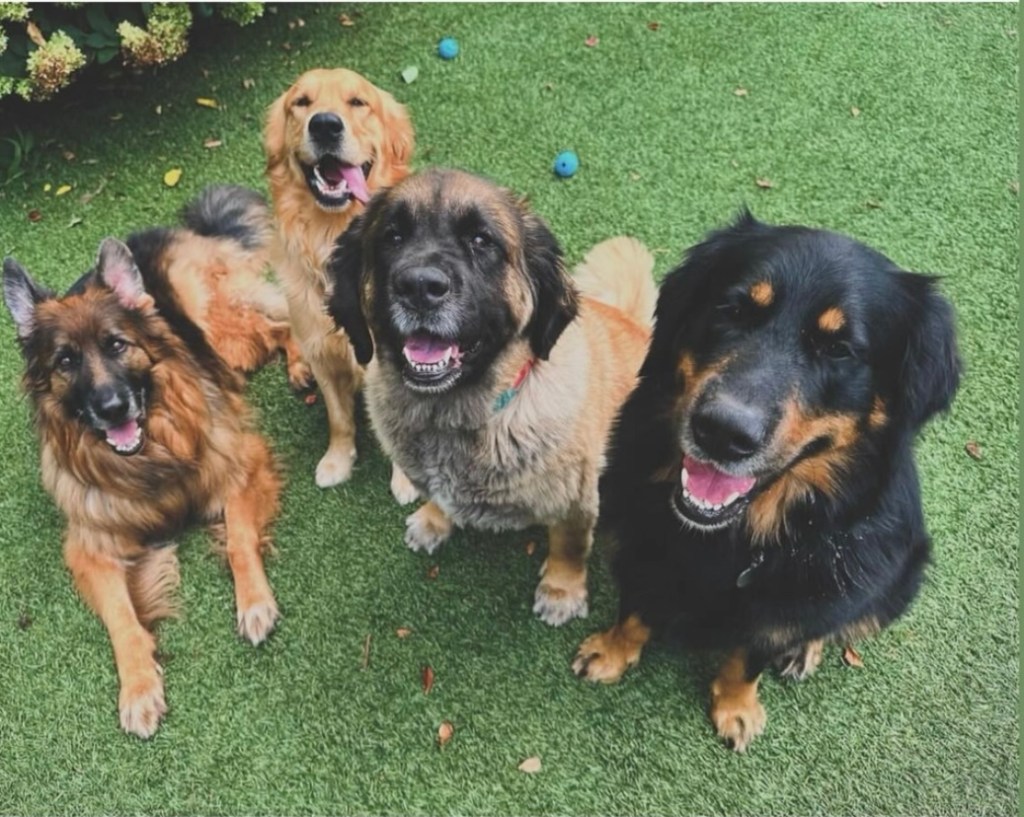
Judge, Bud, Daisy, & Bravo | National Dog Day • August 26th, 2024

Loyalty is a rare and invaluable trait—a kind of dedication we often seek in our human relationships but one that is lived out daily by our four-legged companions. When I captured the above smiling faces of Judge, Daisy, Bravo, and Bud, they immediately offered a powerful reminder of what true loyalty looks like and what we, as humans, can learn from our furry friends. It was in that moment that Rick Astley’s iconic song Never Gonna Give You Up began playing in my mind, its lyrics perfectly mirroring my pack’s unwavering commitment—a promise to never let me or our family down.

Dogs and the Art of Commitment

Astley’s song became an anthem of 1980s pop music not only for its catchy beat but also because it speaks to a timeless truth: genuine loyalty doesn’t falter. It’s safe to say dogs understand this truth instinctively because they:

  • Aren’t driven by obligation or social expectation; they are loyal because they choose to be.
  • Show up every day, no matter what.
  • Greet you at the door, excited to see you, even if you’ve had a bad day.
  • Remain unwavering in their loyalty.

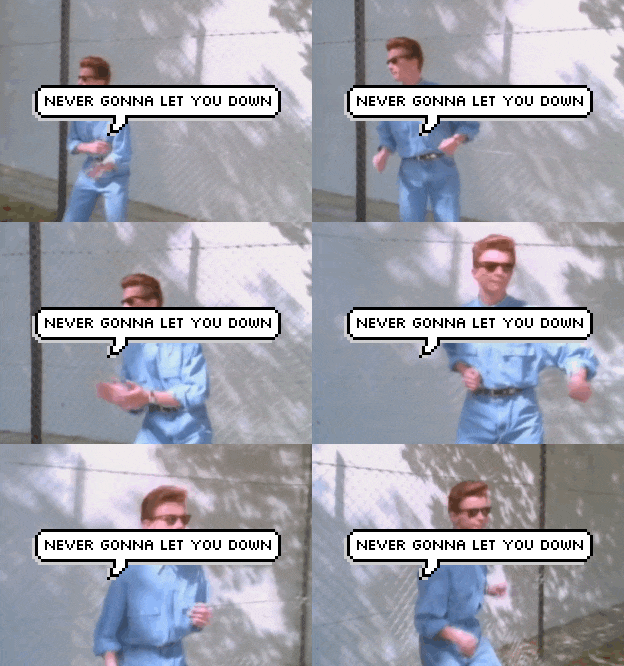
For dogs, there are no conditions to which their commitment is contingent—it’s a steadfast bond rooted in love and trust that remains unshakeable, no matter the circumstances. In contrast, human relationships often hinge on conditions. Friendships, partnerships, and even family bonds can strain when circumstances change. But a dog’s commitment doesn’t work that way; they remain present. Just as Astley promises, “Never gonna let you down,” dogs demonstrate a loyalty that doesn’t just weather storms—they stare down the turbulence, remaining steadfast by your side.

Learning from a Dog’s Loyalty: What If?

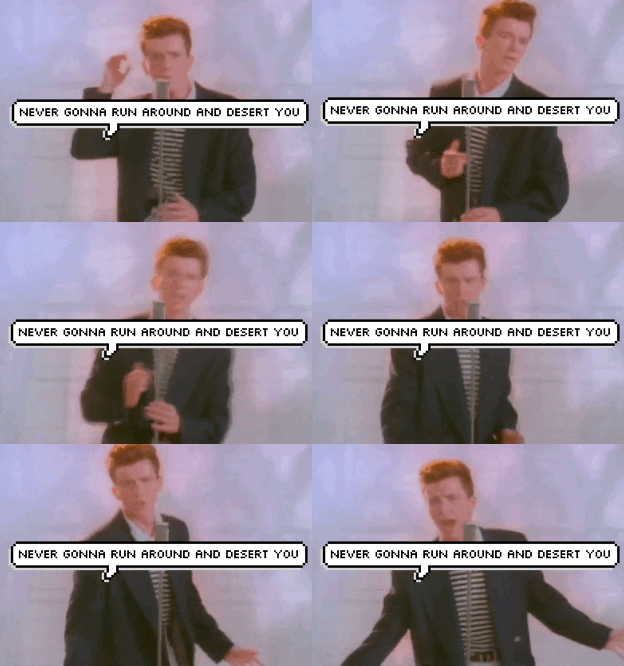
Too often, human relationships falter because we set conditions for our loyalty. We withdraw when things get hard or when someone doesn’t meet our expectations. Dogs, on the other hand, don’t play by those rules. They are all in, every day, whether it’s a good one or not. Dogs live by example, and their example is a lesson in showing up, even when life isn’t perfect—especially when it isn’t. Take Astley’s line, “Never gonna run around and desert you.” Those words aren’t just a promise; they’re a commitment to show up, regardless of the challenges.

What if we approached our human relationships with the same kind of loyalty that dogs demonstrate on our best days, worst days, and every day in between? If we were as consistent in our support, our affection, and our willingness to be there for each other, we could deepen those connections. Dogs don’t wait for the perfect moment to offer love—they do it without hesitation, so why can’t we?

The Power of Consistency

Consistency is another hallmark of a dog’s loyalty. Dogs don’t just offer love in the big moments; they show love in the everyday, in the simple moments of routine, and they love hard. Whether it’s sitting by your feet as you work away at the computer (like Judge is doing right at this very moment as I type) or greeting you with excitement every morning like clockwork (cough, cough—BUD), their presence is constant, genuine, and motivated by love.

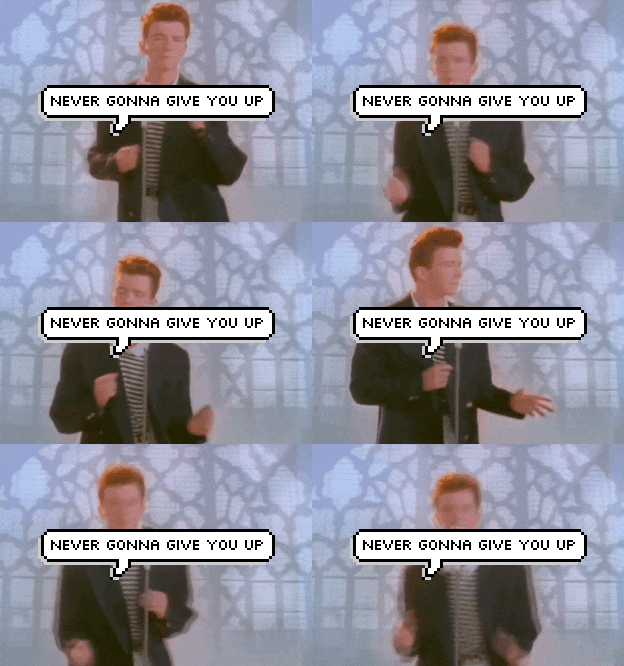
In Astley’s song, the repeated refrain drives home the importance of consistency: “Never gonna give you up, never gonna let you down.” These aren’t just words; they represent a commitment to consistency, much like the loyalty dogs provide us every day. It’s in that consistency that trust and depth in relationships grow. Dogs are there for you, even when you may not feel like you deserve such unconditional love—but believe me, you do. The human-animal relationship, along with Astley’s lyrics, provides a humbling lesson: to offer loyalty and love consistently—not just when it’s easy or convenient—and to recognize that you deserve such unconditional treatment, whether it comes from a dog or another human.

Dogs Don’t Give Up—Neither Should We

When I look at this image, or any image, of Judge, Daisy, Bravo, and Bud, I see such happy dogs and a powerful reflection of loyalty in action. Dogs live out the core message of Never Gonna Give You Up without even trying, teaching us that loyalty isn’t just about grand gestures; it’s about being present through the everyday ups and downs.

You see, dogs don’t give up on their people, no matter what. It’s often the people who give up on dogs and on each other, and it’s time for that to change. This is why humans have much to learn from our canine companions. We could:

  • Strengthen our relationships—whether romantic, familial, or platonic—by showing the same level of devotion.
  • Stay the course—just as dogs do, day after day, with nothing more than a wagging tail and the quiet assurance that they will always be there.

So, the next time you listen to Rick Astley’s Never Gonna Give You Up, think beyond the music. Then, reflect on the lessons from those unconventional teachers—dogs—and the invaluable lessons they teach us every day about loyalty. It’s a reminder to show up, stay consistent, and offer our support and love, unconditionally.

Just like Judge, Daisy, Bravo, and Bud, we all have the capacity to live out that promise, and if this motley crew can do it, so can you. There’s no better time than the present to simply follow their lead.

The Beauty of the Inquiry Conversation

Unearthing School Needs, Listening, and Fostering Hope

We all know the fact that no two schools are alike. Each school has its unique set of strengths and challenges, its own character and culture, its own needs. Which is why the inquiry conversation, like those I have with school districts interested in learning more about what exactly a therapy dog program would look like in their school, is a truly beautiful thing. Let me tell you why.

During these conversations, I listen… a lot. I listen to educators share their experiences and insights. I get an insider’s perspective that no policy document or data report can ever fully capture. I hear the voices of passionate educators, who use their passion and commitment to paint a vivid picture of the real-world challenges faced by students in the day-to-day realities of the 21st century classroom.

Just Listen

Listening to educators during inquiry conversations is not just about absorbing information; it’s about building a bridge of trust and understanding. It’s about acknowledging the educators expertise, valuing their contributions to the organization, and recognizing how their efforts to even initiate an inquiry conversation in the first place is rooted in the best interest of students.

If an educator in your learning organization is passionate about a cause, advocates for their students’ needs, takes time out of their evening to connect with someone, like me, who can provide insight and thoughts for further consideration, that’s a pretty dang good, awesome, educator. Never, ever, let them go.

Hopes 

Inquiry conversations often reveal the hopes and dreams educators hold for their students. These hopes and dreams are deeply rooted in a genuine commitment to fostering the growth, well-being, and success for each learner.

And with each conversation, the voice of the educator carries with it a vision of what they wish for their students. It might be the hope for greater inclusivity with the student body, improved access to resources, or enhanced social-emotional support. 

Step One, Done.

So here’s to those next steps, the ones that take a conversation of hypotheticals to reality. And it will be a journey–a journey that involves dedication, collaboration, and a deep commitment to the well-being of students. I am honored and humbled to be included in step one of your process and cannot wait for step two, and three, and four…. thank you.