Data! Data! Data!

During my most recent school building leadership internship course, students were to read one of five articles and provide a response. Below you will find my original thoughts inspired by the reading and analysis of Larry Ferlazzo’s the March 7, 2022 EducationWeek article, entitled, “It’s Time to Debunk the Myths About Standardized Tests.” I had fun writing this piece and hope you enjoy the read.


Standardized tests. Okay, fine. To appease the quantitative data driven mind reading this response, I will give you the token line you know I am programmed to say. Yes, the data produced from standardized tests provides insight into the abilities and deficiencies of students, areas in need of improvement, yada yada. Can you pick up on the sarcasm? Well, it’s there, along with a dramatic eye roll.

Please do not confuse my position around the quantitative data put forth by standardized assessments with my position on data as a whole. I actually love data. Data! Data! Data! I love data. I think that might make for a good bumper sticker, maybe a t-shirt. No, I really do.

Data is evidence.

Data is what I need to prove my point, to validate my position, because my position is never enough to stand on its own, it needs some support.

For example, I can’t rely on a singular data set when it comes to making a statement like the New York Yankees are the best team in baseball (we all know they are the best team in baseball, but still). And that singular data set cannot be my own opinion. Sound the bias alarms.

Following this line of thinking, why should one type of data set, say the data from standardized tests, trump all other data collected specific to evaluating a student’s performance? There is still the need for multiple data points for triangulation purposes, a system of checks and balances, etc, to ensure the findings reflect the data, the data-driven findings are reliable and sound, otherwise, nullify the recommendations.

Data does have a place, but only when that data is well-rounded data and truly meaningful to reflect and act upon. Data becomes meaningful when it reveals evidence, from multiple sources, to support or negate a school or district’s current curricular pathway, or the degree in which teaching practices/protocols established within that school or district effectively meet, or exceed, district, state, national, and at times external learning standards and benchmarks.

The data of value, the data I’m talking about, is the data the standardized test fails to produce.

The data of value, the data I’m talking about is the data society has deemed as a less valuable marker.

You see, data most definitely has value, but that data is “no good,” especially when it suggests there are inequities at play.

That data is “no good,” when it takes a stand-alone moment in time, and gives that moment such tremendous power, quite possibly the power to determine the trajectory of one’s academic career, maybe even their life.

That data is “no good,” when it stems from an assessment catered to the student with just the right amount of socio-economic clout. Clout that, in turn, provides a cushion of support for almost guaranteed success, but does not guarantee the success of their classmate because of that impenetrable socio-economic stratosphere.

Any data produced from an assessment that reveals society’s interference and influence on determining who deserves an opportunity and who does not, is of no value. And it is society, government, the hierarchy established by the macro, and carried out by the micro, that continues to perpetuate this vicious cycle. What does all this “no good” data really try to remedy, or prevent from happening, anyway?

[and then there was silence]

Exactly.

There is no better time than now to make the academic playing field an equitable one, not one determined by the perfunctory toss of a scantron and test booklet– one to the student the system wishes to promote, and one to the student the system wishes to leave behind.
The Human Resource

My recent post is associated with a school building leadership assignment. Below is the prompt and my response.

Prompt: During your internship, has anything occurred that was unanticipated or surprising? Is there anything you encountered that was unexpected? If so, what was your major takeaway? If nothing was unexpected or surprising, why do you think that is the case? After the class session, post a reply to this inquiry on the discussion board and respond to at least one other classmates post.

This is the second semester of my school building leader internship.  Interestingly enough, I find myself much more astute at identifying areas of need, at both the building and district level. Additionally, I find myself considering those within the organization, other than individuals appointed to leadership positions, equipped to address those identified areas of need.

I’m aware that there are resources, human resources, readily available to assist those in the designated leadership position, human resources who may in fact be more equipped to address the identified area need than the person in the designated leadership position to typically address those needs. But for leadership to truly benefit from the human capital within the organization, it requires a transformative mindset, or at least a mindset working towards a full transformative overhaul and cognizant of the need to be open minded, as well as a fortified ego, ready to withstand some of the most daunting moments of self-doubt.

I often find myself thinking, if I were in a current leadership position, how I would incorporate these outstanding educators, to honor their strengths and their desire to be a part of the larger systematic plan of improvement? If students want to be seen, heard, and valued by their teachers, wouldn’t teachers want to be seen, heard, and valued by their leadership team? At the end of the day, people are people.

I always tell my colleagues how proud I am to work alongside them, wish for more time for collaboration, to learn from one another– my colleagues know they are seen, heard, and valued, but it’s me that’s doing the seeing, and hearing and valuing.  As one colleague said during a recent conversation, “You’re going to make a great principal one day….” I brush those comments to the side and change the subject, not because it doesn’t feel good to hear, but because of what their comment really says about how they feel, and how their words that followed directly reflected an area of need: school culture the teacher’s perspective on their value and worth, and the degree to which the teacher perspective was aligned with the leaderships’ perspective.

How does one address an identified area of need specific to the school culture from the perspective of the teacher, when it is assumed by some (not all) in leadership positions that there isn’t a problem at all? When does an identified area of need become an identified area of need?  Is it in the eye of the beholder, or the one in a leadership position? And if the role of the leader is integral to addressing the need, is the need only a need worthy of attention when it directly impacts the transactional leader? More questions than answers.

I’ll continue to lift my colleagues, and contemplate all the possibilities to address the embedded needs in questions like those above. In all honesty, I would be disappointed if the only thing to come out of this reflective response is further confirmation for how I want to lead as school building leader, but it just might be all that a response like this is destined to reaffirm.

Let Me Remind You

An excerpt from my most recent blog, “Dog Save the People: My Conversation with John Bartlett.”

21st century students need more of the tangible, more ways to feel safe, secure, valued and loved, with opportunities to reciprocate those feelings towards another, without judgement (Maricevic, 2022).

Dr. Jessica Maricevic
Why therapy dogs? Why now?

This pseudo post-COVID America has unearthed a tremendous amount of pain, a pain some have tried desperately to suppress, or flat out ignore. Secondary stakeholders who acknowledge the macro reality of the invasive impact of the current geo-political climate are better equipped to consider the micro implications in the high school setting. And to those stakeholders who believe they must personally observe the influence of the macro reality in the micro setting, see with their own eyes presentable evidence of societal stressors, complex anxieties and invisible traumas to adequately address the social and emotional needs of students…

Well, read a little bit more of this post, because today’s high school students are carrying more than a load of books and a laptop with little to no storage.

So say you.

I’ll hold off on the details of my own research and findings for the time being simply to prove you don’t need to read academic journals and peer reviewed articles to establish an understanding of this crisis.

Yet, even with their respective leans, the conscious decision to report on the social and emotional concerns of teens suggests a unified effort to convey the severity of this stark reality.

Dr. Jessica Maricevic

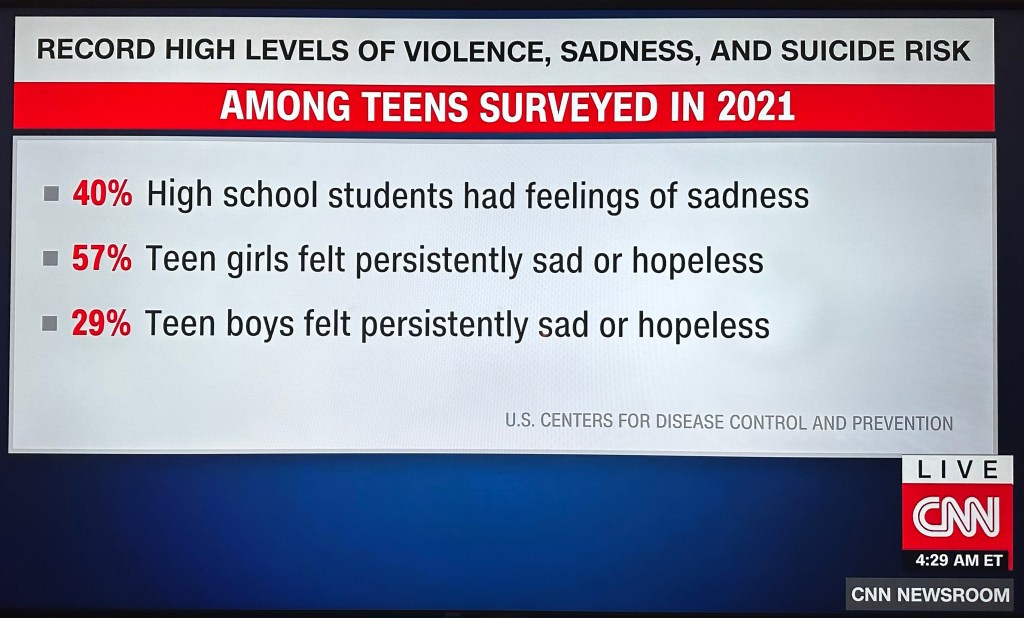
Here are some statistics presented from three national cable news outlets within the last 12 months:

An image I captured from my television during an early morning CNN live broadcast (February 14, 2023).
Read Elizabeth Pritchett’s article in its entirety: Teenage brains aged faster
April 26, 2022 segment from MSNBC’s Morning Joe; guest Harvard University’s John Della Volpe.

Understand, the above sources are a mere snapshot of reporting from three national cable news outlets, and yes I am well aware each source brings with it their own distinct bias. Yet, even with their respective leans, the conscious decision to report on the social and emotional concerns of teens suggests a unified effort to convey the severity of this stark reality.

It is extremely important to note the three news outlets referenced here in this post have observed an increase in viewership during the years of 2016 – 20220 (Pew Research Center, 2023). The research suggests such an increase in viewership is most likely connected to presidential elections, societal conflicts, and the coronavirus pandemic (Pew Research Center, 2023).

Hypothetically, if the Pew Research Center reports either (1) a decrease the numbers of viewers, (2) a plateau of viewership (it remains at its current rate), or (3) a continued upward viewership trend for the period of 2020-2023, millions of Americans would still receive the message loud and clear, teens are hurting, they need something more, and it’s up to the adults in their lives to make it happen.

Back in my day…

As students go from class to class, they carry the weight of the world and the plight of America’s transgressions on their shoulders, they are accompanied by feelings of sadness, hopelessness, feeling down, and depressed. And then, some students hold their breath when a school wide announcement interrupts a class period without warning, flinch upon hearing an unsuspecting sound, and ask what if questions the day after cable news outlets, those very outlets referenced above, consume airwaves with incessant reporting of yet another unthinkable event.

Even with all of this chaos, students aren’t desensitized by their reality. They remain hyper vigilant, in-tune to their emotional responses, and astute to the emotional affect of others in their orbit. But that doesn’t mean they are okay.

The last thing adolescents need is another adult telling them how to manage life as a teenager, or why they need grit and perseverance to get through “these unprecedented times.” Unfortunately, the reality for today’s teens requires more than “Back in my day” talks and harping on trendy jargon (I wish it were that easy). Couple that with the contradictory expectations to prioritize emotional wellbeing and academic performance— students need something more than whatever is provided at the secondary level to meet or exceed their social and emotional needs.

I can hear stakeholders’ “yeah, but…” phrases, ready to launch their counter claims:

Yeah, but their grades are fine.

Yeah, but they’re participating in sports.

Yeah, but they’re not alone in the cafeteria.

Yeah, but they’re taking selfies.

Yeah, but they’re friends with that student; they’re not a bully.

Yeah, but they seem happy.

It’s time to stop assuming. It’s time to stop dismissing the teenage experience. It’s time to start listening, and infuse differentiated support systems that are more real-world centric.

21st century students need more of the tangible, more ways to feel safe, secure, valued and loved, with opportunities to reciprocate those feelings towards another, without judgement (Maricevic, 2022).

Establish a therapy dog program (start today).

Now more than ever, therapy dogs are a viable resource to meet those needs for all high school students— no matter the zip code, regional location or poverty designation of a given school or district.

Yeah, but…

I know, I know! You’re asking yourself, “Yeah, but what about the challenges?” Mitigating challenges, is a totally different blog all together, but believe you me, I’ve got it all covered. I will tell you this, any perceived challenges from fears to allergies can be addressed to ensure the efficacy of board policy and the sustainability of an in-house therapy dog program in your high school (Maricevic, 2022).

This is my original gif which includes slides displaying my research and findings. These slides appeared in my Fall 2022 presentation to members of Association of Professional Humane Educators (and that presentation was an awesome experience).

I’ll also tell you that any stakeholder who flat out says no to an in-house therapy dog program to meet the social and emotional needs of students, is saying no for the sake of saying no (Maricevic, 2022). Don’t forget it.

The student-therapy dog relationship in the high school setting is an indelible, transformative fixture, a relationship with the infinite ability to transcend the four year high school experience. My findings suggest the omnipresence of a therapy dog in the high school setting does more than influence the social-emotional competency development in adolescents (Maricevic, 2022). In fact, the organic development of the student-therapy dog relationship may very well be the antidote to [feel free to fill in the blank to reflect the needs of your students and high school] (Maricevic, 2022).

My study reveals much more about the therapy dog phenomenon, its profound impact on secondary students and the high school setting. I’m proud to say my study also exposes inequities that must be addressed to ensure all students are afforded the opportunity to benefit from the student-therapy dog relationship during their high school years.

The above is a mere snippet of some of the points touched upon during my conversation with John Bartlett, host and founder of Dog Save the People. I encourage you to listen to the podcast in its entirety through any of the following platforms:

And let’s connect! Share your thoughts! Questions! I look forward to it.