Building Trust, One Paw at a Time: Using an Extracurricular Club to Introduce Therapy Dogs in Schools

Many educators and school leaders recognize the benefits of therapy dogs in academic settings but hesitate to implement a full-scale program due to knowledge gaps, logistical challenges, financial constraints, or policy concerns. A Therapy Dog Club offers a structured, low-risk way to introduce animal-assisted therapies, easing leadership apprehensions. In fact, I strongly recommend beginning the therapy dog implementation process in this way to build trust in the program’s effectiveness while addressing concerns in a controlled environment.

So let’s dive in together as I define the concept of a Therapy Dog Club, outline its benefits, and provide a brief guide to getting started.

What is a Therapy Dog Club?

As I define it, a Therapy Dog Club is a student-led, faculty-advised group that brings trained therapy dogs into a school environment on a scheduled basis. The club provides a structured, low-risk way for students and staff to interact with therapy dogs, typically for emotional support, stress relief, and social engagement. It allows students to experience the benefits of animal-assisted interventions without the immediate need for implementing a full-time therapy dog program.

Participation is voluntary, making it an accessible option for a wide range of students. In my view, a Therapy Dog Club operates on a smaller, flexible scale, bringing therapy dogs into the school on specific days rather than having a resident dog on campus daily. Additionally, a Therapy Dog Club may meet after school or during designated extracurricular periods, which can be particularly appealing to school and district leaders.

Benefits of a Therapy Dog Club

Eases Administrative Concerns

Even with strong research supporting the benefits of therapy dogs, one of the biggest barriers to implementation is navigating perceptions, assumptions, and stereotypes. A club helps schools challenge misconceptions and test the waters before committing to a full-time therapy dog program. It also offers:

• Student Autonomy – Participation is voluntary, so students who are uncomfortable around dogs or have allergies can simply opt out. This eliminates concerns about mandatory exposure in classrooms or common areas.

• Waivers for Participants – Schools can require students (and guardians, if necessary) to sign waivers acknowledging participation and understanding any risks. This adds a layer of protection for the school and provides transparency for families.

• Gradual Implementation – Schools can observe how students and staff interact with therapy dogs before considering a larger-scale program. This allows time to refine policies, address concerns, and build community support.

Provides Emotional and Social Benefits for Students

A Therapy Dog Club offers many of the same emotional and mental health benefits as a full program. Interacting with therapy dogs has been shown to reduce stress, improve mood, and boost social interactions—all of which can be particularly helpful for students struggling with anxiety, academic pressure, or social isolation (Maricevic, 2022).

Fosters Student Leadership and Engagement

A Therapy Dog Club empowers students to take on leadership roles by organizing events, coordinating with therapy dog teams, and advocating for expanding the club into a full program. Giving students ownership fosters responsibility, teamwork, and community engagement.

Strengthens Community Partnerships

Starting a club opens the door to collaborations with local therapy dog organizations, shelters, or animal-assisted therapy programs. Schools can invite certified therapy dogs for visits, partner with community groups for educational sessions, or create service-learning opportunities where students volunteer with therapy animals.

Gathers Data to Support a Future Program

If a school is hesitant about implementing a therapy dog program, a club can serve as a pilot initiative to collect data on the impact of animal-assisted therapies. Surveys, testimonials, and anecdotal evidence from students, teachers, parents, and other key stakeholders can provide compelling reasons to expand the club into a permanent program.

How to Start a Therapy Dog Club

Identify a Faculty Advisor – A teacher, counselor, or staff member passionate about student well-being and animal therapy can oversee the club.

Partner with Local Therapy Dog Organizations – Certified therapy dog teams can schedule regular visits to meet with students.

Plan Activities – Meetings can include guest speakers, stress-relief sessions, volunteer opportunities, and advocacy efforts for therapy dog programs.

Involve Students – Let students lead initiatives, create outreach materials, and develop events.

Implement Waivers – Have students (and their guardians, if needed) sign participation waivers to ensure transparency and address liability concerns.

Final Thoughts

A Therapy Dog Club is a low-risk, high-reward way for schools to explore the benefits of therapy dogs before committing to a full program. It fosters a positive school culture, supports student mental health, and builds a foundation for a larger initiative in the future.

If your school is on the fence about a therapy dog program, starting with an extracurricular offering might be the perfect first step. By starting small and scaling thoughtfully, schools can introduce therapy dogs in a way that minimizes risks, maximizes benefits, and paves the way for a sustainable, well-integrated program.

Celebrating Black History Month: Honoring Tina Turner


In honor of Black History Month, each week I will delve into the heartwarming bond between Black voices and their cherished canine companions.

For my final post, I pay tribute to the remarkable life of the iconic Tina Turner, a music legend who reshaped the rock ‘n’ roll landscape and is forever immortalized as the #Queen of Rock ‘n’ Roll. Tina’s electrifying performances, soulful voice, and resilient spirit made her a music icon and one of my favorite artists to karaoke!

I personally found myself even more inspired by Tina after learning about this 1971 image depicting Tina, her son Ronnie, and their majestic Great Dane, Onyx. You see, this image encapsulates the dynamic energy of the rock legend and the serene strength of a canine companion, solidifying the position held by many, other than myself, that dogs are not just pets; they are steadfast companions, offering a unique and irreplaceable bond, one that transcends barriers imposed by others and the society in which they live.

Additionally, the image suggests Onyx exemplified the quintessential #GreatDane attributes, loyalty and a gentle demeanor, not because of his regal posture, but more so by the body language of Onyx’s humans—Tina’s loving embrace of Onyx, the position of her arm and her beaming smile, not to mention her son’s joyous expression. In this moment, the trio appear to share simultaneous happiness.

I’m left to wonder about the myriad of ways Onyx may have offered Tina unwavering reinforcements through the highs and lows of the early days of her illustrious career, including her personal hardships and quest for true love. In the whirlwind of a demanding career, one may consider that the presence of a loyal canine friend, like Onyx, served as a grounding force, for dogs, with their intuitive understanding and unconditional love, fulfill an area of need within their person.

Tina and Onyx, another beautiful example of the human-animal bond to further substantiate my personal belief that standing alongside every great woman is a stoic canine companion (or four). At the end of the day, dogs really are “Simply the Best.”

Please consider a visit to my Instagram to view posts honoring the incomparable Black voices of Billie Holiday, Oprah, Pauli Murray, and their respective love of dogs.

Celebrating Black History Month: Honoring Pauli Murray

👩🏼‍💻: @empathicpaws
📸: Robert D. Farber archives

In honor of Black History Month, each week, I will delve into the heartwarming bond between Black voices and their cherished canine companions. This week, I honor the trailblazing Pauli Murray – a civil rights activist, legal scholar, and champion for equality.

Along with Pauli’s immense contributions to life as we know it today, Pauli was a steadfast dog lover and it is Pauli’s enduring love for dogs that is beautifully captured in this moment. Pictured here you will find an image of Pauli and cherished companion, “Doc” – officially known as “Black and White We Rise Together,” on the lawn of Benedict College (Farber Archives, 1967).

Throughout Pauli’s remarkable life, dogs transcended the role of mere pets; they were steadfast allies, bearing witness to Pauli’s tireless advocacy for justice, equality, and ideals.

Accompanying their groundbreaking contributions, Pauli’s connection with their canine companions is a testament to the enduring strength found in companionship and the human-animal bond. “Doc” stands as one of the many loyal dogs integral to Pauli’s story, quite possibly offering solace, understanding, and unconditional love.

I am inspired by the thought of Pauli Murray making these profound contributions, accomplishing monumental feats all the while having a loyal canine companion equally steadfast by their side—a symbol of companionship, unwavering support, and a unique kind of partnership, but the most true form of love.

Imagine the comfort of having a faithful friend, witnessing tireless advocacy, celebrating triumphs, and offering solace during challenges. This bond may very well have evoked feelings of determination, resilience, and reaffirmed Pauli’s commitment to making a difference.

Pauli and “Doc,” a testament to the extraordinary impact that the companionship of a beloved dog can have on one’s life, the role they play in the narrative of accomplishments, and the inspiration to continue on my own advocacy journey, with gratitude and love for the pack that remains by my side.

Please consider a visit to my Instagram to view posts honoring the incomparable Black voices of Billie Holiday and Oprah, and their respective love of dogs.

The Significance of Digital Knowledge Portfolios in the MYP & DP Classrooms: Navigating the IB and Beyond


In an era shaped by technological advancements and evolving educational paradigms, students face an ever-growing need to showcase their skills and accomplishments comprehensively and accessibly. This is where the concept of Digital Knowledge Portfolios becomes a pivotal tool in the academic journey, especially for those pursuing the International Baccalaureate (IB) Middle Years Programme (MYP), Diploma Programme (DP), and beyond.

Digital Knowledge Portfolios serve as dynamic repositories, housing a student’s academic achievements, reflections, and growth over time. Within the context of the IB framework, they play a crucial role in aligning with the program’s core principles and objectives.

Understanding the IB MYP Framework

The MYP emphasizes holistic learning, encouraging students to explore connections between disciplines while fostering critical thinking and communication skills. It’s within this interdisciplinary approach that Digital Knowledge Portfolios find their stride, enabling students to document projects, essays, artistic creations, and other endeavors that exhibit their multifaceted talents.

When transitioning to the DP, these portfolios become even more vital. The program’s rigorous demands necessitate evidence of research, creativity, and reflection – elements that can be effectively showcased through digital portfolios. Students demonstrate their growth, track their academic journey, and exhibit the skills and attributes sought after in the DP curriculum.

The Power of Reflection and Connection

Digital Knowledge Portfolios are not just repositories of work; they are reflective spaces where students can articulate their learning process, challenges faced, and growth achieved. Through this reflective practice, students gain a deeper understanding of their strengths and areas for improvement, aligning with the IB’s emphasis on metacognition and self-awareness.

Moreover, these portfolios bridge the gap between academic endeavors and future aspirations. They serve as tangible evidence of a student’s capabilities, aiding college admissions, scholarship applications, and career pursuits. As the world increasingly values digital literacy and the ability to curate one’s online presence, the Digital Knowledge Portfolios become invaluable assets.

Aligning IB Command Terms within the Digital Knowledge Portfolio

The International Baccalaureate (IB) program is renowned for its rigorous academic standards and precise language used to articulate student expectations. Central to this I IB language are Command Terms – key words that direct students on how to approach their learning.

Integrating Command Terms Strategically

Integrating the IB’s Command Terms within the Digital Knowledge Portfolio is instrumental in showcasing a student’s mastery of these skills as it pertains to the rigors of the IB’s program.

First, students must determine and demonstrate understanding of the terminology.
Within the Digital Knowledge Portfolio, sections are dedicated to honoring the IB’s definition of the Command Term, as well as designated spaces for students to define the Command Terms in their own words. Clearly defining the Command Terms, in their own words, confirms a foundational understanding of the IB’s terminology and students’ ownership of learning.

Then, students strategically align their work to the content specific Command Terms. Students identify an artifact, include an image and/or a direct link to the artifact, and then justify their rationale for the selected artifact.

Hypothetical Artifacts & Justification

In this section, I put forth hypothetical artifacts and justification aligned to some of the Command Terms to showcase how a student might demonstrate engagement in the IB curriculum framework and ownership of learning.

  • Define: The artifact might be an essay or research paper where the student meticulously defines and clarifies key terms within a specific subject area. The justification here would involve highlighting how this artifact serves to establish a foundational understanding of the topic under discussion.
  • Explain: An artifact showcasing an elaborate project presentation or an instructional video might justify its inclusion by emphasizing how it succinctly explains complex concepts or methodologies, showcasing the student’s adeptness in simplifying intricate ideas.
  • Evaluate: If a portfolio entry involves a reflective piece where the student assesses the efficacy of a scientific experiment or a historical analysis, the justification would focus on how this artifact demonstrates the student’s capacity for critical evaluation.
  • Discuss: In the case of a recorded debate or a written dialogue on socio-political issues, the justification would elucidate how this artifact displays the student’s ability to engage in meaningful discussions, considering multiple perspectives.
  • Compare and Contrast: An artifact might feature a project that compares and contrasts different literary works or scientific theories, justifying its inclusion by highlighting how it showcases the student’s understanding of interdisciplinary connections.

Conclusion

By consciously aligning their work to the IB Command Terms within the Digital Knowledge Portfolio, students not only showcase their understanding of these terms but also demonstrate their ability to engage with the academic material at a higher level. This strategic curation enhances the depth of the Digital Knowledge Portfolio, presenting a comprehensive overview of a student’s academic journey while explicitly highlighting their mastery of the IB’s language and expectations.

It’s Cool to Be Kind

For those of you new to @empathicpaws, I am Dr. Jessica Maricevic, humane-ed reform and animal-assisted therapies advocate, and I am so very glad you’re here.

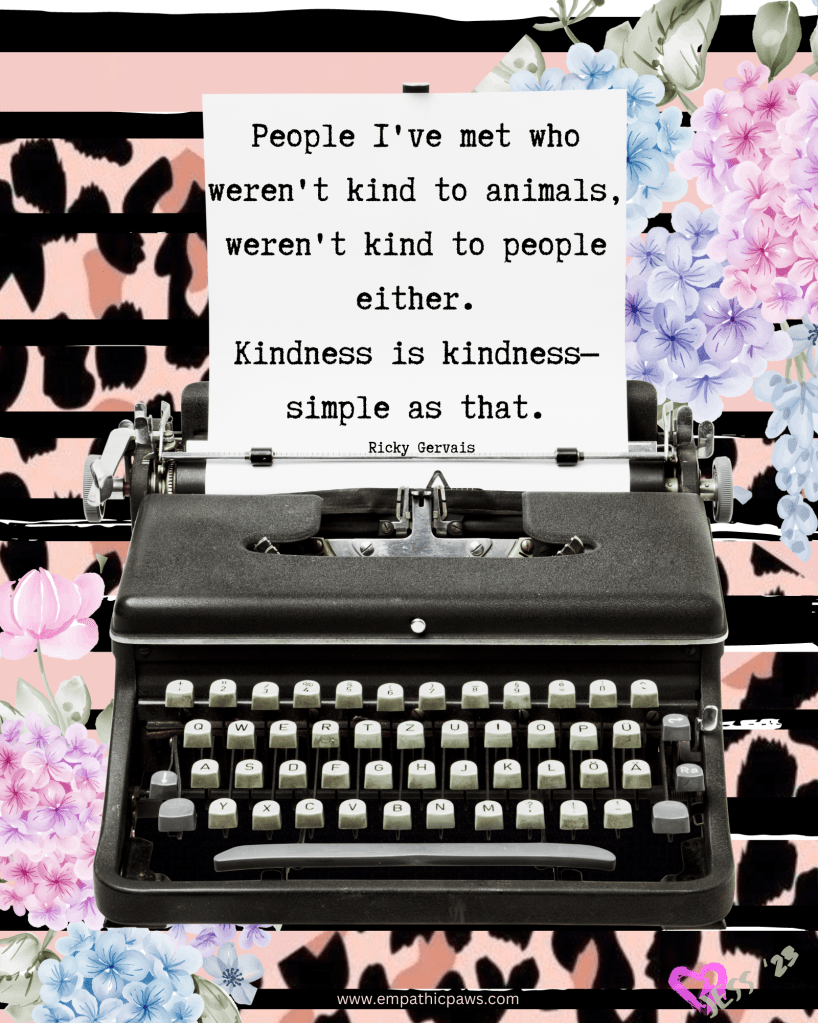
My most recent original graphic design is inspired by the words of comedian and humane advocate, Ricky Gervais. Let’s further the conversation around the interconnectedness of the human-animal relationship and social-emotional competency development and use Mr. Gervais’s words as a springboard.

©️ J. Maricevic, 2023

The human-animal bond serves as a positive influence upon one’s social-emotional competency development, the sustainability of SECs and subsequent evolution of these traits throughout a person’s lifetime. And with that in mind, more consideration is needed within learning organizations on ways to infuse the human-animal relationship to further the radius of influence upon the social capital within the organization.

Allow Mr. Gervais’s words along with my original visual creation to serve as a conversation starter around the human-animal bond and the need to increase opportunities for such bonding in the high school setting.

The Act of Being: A Kermit-Like Mindset to Leadership and Beyond

TikTok Inspired

I recently stumbled upon a TikTok post featuring a table-read for the sketch comedy show, The Muppet Show (1976 – 1981). The clip, posted by TikTok user, @muppetmarissa, includes the voice-overlay of creative mind and Muppet creator, Jim Henson, along with his perspective on the collaborative creative process. The clip progresses, there are many other voices of Muppet Legendary, and then comes the wave of nostalgia.

The Fabric

Now, if you made it this far, it should come as no surprise to learn the obvious. I am a huge Jim Henson fan. I mean, I am writing a reflection on educational leadership with an ode to The Muppets. Don’t worry, it has a purpose, I promise.

I am unsure where @muppetmarissa found this particular clip, but very much look forward to viewing what appears to be a documentary on Jim Henson that I have yet to review. I do know there is a highly anticipated documentary in the works about Jim Henson, directed and produced by the dynamic duo of Ron Howard and Brian Glazer. The release date of the Disney Original Documentary is still to be determined and you can read more about it here in this 2022 press release by The Jim Henson Company.

You see, I consider myself a creative. I allow myself the time, space, and flexibility to be creative in all aspects of my personal and professional interests. I credit my creative identity and all my ventures, from childhood to this very moment, to Jim Henson, his circle of like-minded creatives, the imaginary world they conjured for us kids in the 80s, and how that imaginary world has now transcended space and time.

Ed Sullivan, Kermit the Frog and Jim Henson; The Ed Sullivan Show, N.D.

Shared Experience

I also know, I am not the only one who feels this way. Take actor Jason Segel, for example. Segal is best known for his role in the sitcom How I Met Your Mother (2005 – 2014), writing and starring in the iconic film, Forgetting Sarah Marshall (2008), writing and staring in the recent the AppleTV series, Shrinking (2023), and [drumroll please], his love of The Muppets.

Segel does not shy away from his love and appreciation for The Muppets, and even refers to them as his “childhood idols.” An additional interest worth noting is Segel’s idolization of Kermit the Frog, the amphibian embodiment of Henson’s legacy. Segel reveres Kermit almost as much as I revere the little green frog. During an interview to promote his mid-2000s film, The Muppets (2011), Segel was asked to divulge his favorite Muppet, to which he replied “… it’s Kermit. It’s always been Kermit.” I get it.

I get Segel’s #ItsAlwaysBeenKermit belief statement because quite frankly, I have an #ItsAlwaysBeenKermit belief statement, too. So here it goes, my Kermit belief statement:

Everything I learned in life, I learned from a little green frog

I really get it.

In 2011, Segal took it upon himself to dust off the Muppet memories for us “80s kids,” thanks to writing and staring alongside them for their return to the big screen. That summer, I took my son, who was then 4 years old, along with his cousins, to see Segal’s major motion picture production. We sat in a quaint, Berkshire, Massachusetts movie theater. What could be better than a summertime movie, in the Berkshires, and watching The Muppets? Nothing. There is nothing better. Trust me.

The lights dimmed. The credits rolled, and so did the tears. Let me be more specific. The credits rolled, and so did my tears.

I wish I could say I was overcome with emotion because it was my son’s first time in a movie theater– it wasn’t that. No, it wasn’t tears of joy. Tears of sadness? Nah. Nope, not tears longing for the days of yesterday. I pretty much cried throughout the entire movie. 

The Act of Being

For the duration of the film, the adult me was very cognizant of the fact that I was in a theater, surrounded by children, one of them being my own, to watch a film in which my own childhood icons paraded on screen. The film, for all intents and purposes, was presented under the auspices of a children’s movie. But to me, I knew this film was not exclusively targeted to the 4-12 year old demographic, but to their parents, guardians, aunts, uncles, neighbors– to those “80s kids.”

The Muppets (2011) was a film targeted to me, and my tears were tears of being; being seen, heard and valued

It was so very apparent, how by watching this film, my personal roadmap, goals, dreams, and aspirations were emphatically validated, and not just by any other person, by another like-minded creative, personally and professionally influenced by Henson and his Muppets.

Jason Segel got it– he got me.

I was being seen, valued, and heard as a person in need of a reminder, a reminder to remember….and I wasn’t the only one. I wasn’t the only one positively influenced by the creative masterminds behind The Muppets. I wasn’t the only one still using the efforts of ingenious creatives, like Henson, to fuel my purpose. I wasn’t the only one who wanted to genuinely find opportunities to advocate for empathy and understanding, to leave my mark on this world, and make it just a little brighter than it was the day before.

There are people, like Segel, who are like me. There are people, like Segel, who, like me, want others to know that even during some of life’s most [fill in the blank] moments, they are seen, heard and valued.

Educational Leadership

As I reflect on my own educational leadership journey, there is the running motif and thematic concept within my writing and it is centered around those three words: seen, valued, and heard (I’ve coined it “the trifecta”). All individuals in an organization need to feel truly seen, valued, and heard for a plethora of reasons; the multitude of stakeholders: who is the cultivator of “the trifecta” one day and who is the receiver the next; interwoven relationships between district, school building leadership and the trickle down effect; leadership philosophy and philosophical approaches to management, transactional vs. transformational…

Now, enter students into the equation. Students must feel seen, heard and valued, and if teachers are the ones to help cultivate and nurture “the trifecta,” then teachers must also be a receiver of those feelings, which then means district and school building leadership must …. round and round we go.

All stakeholders must have equitable access to “the trifecta.” Easier said than done? Meh.

Everything I learned in life, I learned from a little green frog.

I get it, because I believe it. And I also believe in order to cultivate authentic opportunities for others to feel all those things, and more, it takes creative ingenuity, it requires safety and security, transparency, honesty, love, kindness, trust, empathy …. it requires a Kermit-like mindset.

A Kermit-Like Mindset to Leadership and Beyond! That reads as if it’s got some potential, and that is where the next chapter of my leadership journey will start.

Let Me Remind You

An excerpt from my most recent blog, “Dog Save the People: My Conversation with John Bartlett.”

21st century students need more of the tangible, more ways to feel safe, secure, valued and loved, with opportunities to reciprocate those feelings towards another, without judgement (Maricevic, 2022).

Dr. Jessica Maricevic
Why therapy dogs? Why now?

This pseudo post-COVID America has unearthed a tremendous amount of pain, a pain some have tried desperately to suppress, or flat out ignore. Secondary stakeholders who acknowledge the macro reality of the invasive impact of the current geo-political climate are better equipped to consider the micro implications in the high school setting. And to those stakeholders who believe they must personally observe the influence of the macro reality in the micro setting, see with their own eyes presentable evidence of societal stressors, complex anxieties and invisible traumas to adequately address the social and emotional needs of students…

Well, read a little bit more of this post, because today’s high school students are carrying more than a load of books and a laptop with little to no storage.

So say you.

I’ll hold off on the details of my own research and findings for the time being simply to prove you don’t need to read academic journals and peer reviewed articles to establish an understanding of this crisis.

Yet, even with their respective leans, the conscious decision to report on the social and emotional concerns of teens suggests a unified effort to convey the severity of this stark reality.

Dr. Jessica Maricevic

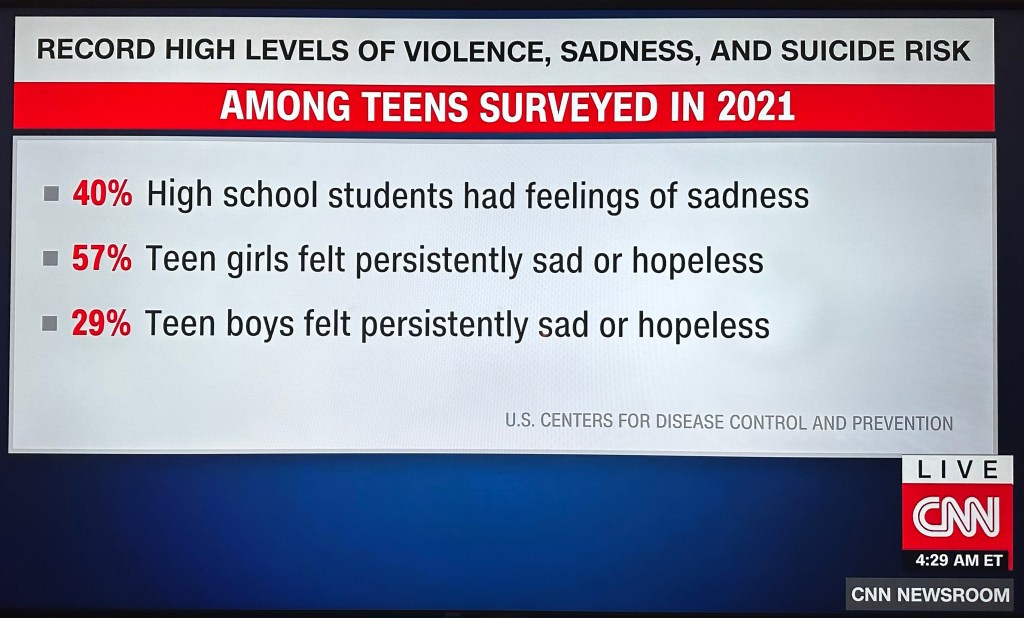
Here are some statistics presented from three national cable news outlets within the last 12 months:

An image I captured from my television during an early morning CNN live broadcast (February 14, 2023).
Read Elizabeth Pritchett’s article in its entirety: Teenage brains aged faster
April 26, 2022 segment from MSNBC’s Morning Joe; guest Harvard University’s John Della Volpe.

Understand, the above sources are a mere snapshot of reporting from three national cable news outlets, and yes I am well aware each source brings with it their own distinct bias. Yet, even with their respective leans, the conscious decision to report on the social and emotional concerns of teens suggests a unified effort to convey the severity of this stark reality.

It is extremely important to note the three news outlets referenced here in this post have observed an increase in viewership during the years of 2016 – 20220 (Pew Research Center, 2023). The research suggests such an increase in viewership is most likely connected to presidential elections, societal conflicts, and the coronavirus pandemic (Pew Research Center, 2023).

Hypothetically, if the Pew Research Center reports either (1) a decrease the numbers of viewers, (2) a plateau of viewership (it remains at its current rate), or (3) a continued upward viewership trend for the period of 2020-2023, millions of Americans would still receive the message loud and clear, teens are hurting, they need something more, and it’s up to the adults in their lives to make it happen.

Back in my day…

As students go from class to class, they carry the weight of the world and the plight of America’s transgressions on their shoulders, they are accompanied by feelings of sadness, hopelessness, feeling down, and depressed. And then, some students hold their breath when a school wide announcement interrupts a class period without warning, flinch upon hearing an unsuspecting sound, and ask what if questions the day after cable news outlets, those very outlets referenced above, consume airwaves with incessant reporting of yet another unthinkable event.

Even with all of this chaos, students aren’t desensitized by their reality. They remain hyper vigilant, in-tune to their emotional responses, and astute to the emotional affect of others in their orbit. But that doesn’t mean they are okay.

The last thing adolescents need is another adult telling them how to manage life as a teenager, or why they need grit and perseverance to get through “these unprecedented times.” Unfortunately, the reality for today’s teens requires more than “Back in my day” talks and harping on trendy jargon (I wish it were that easy). Couple that with the contradictory expectations to prioritize emotional wellbeing and academic performance— students need something more than whatever is provided at the secondary level to meet or exceed their social and emotional needs.

I can hear stakeholders’ “yeah, but…” phrases, ready to launch their counter claims:

Yeah, but their grades are fine.

Yeah, but they’re participating in sports.

Yeah, but they’re not alone in the cafeteria.

Yeah, but they’re taking selfies.

Yeah, but they’re friends with that student; they’re not a bully.

Yeah, but they seem happy.

It’s time to stop assuming. It’s time to stop dismissing the teenage experience. It’s time to start listening, and infuse differentiated support systems that are more real-world centric.

21st century students need more of the tangible, more ways to feel safe, secure, valued and loved, with opportunities to reciprocate those feelings towards another, without judgement (Maricevic, 2022).

Establish a therapy dog program (start today).

Now more than ever, therapy dogs are a viable resource to meet those needs for all high school students— no matter the zip code, regional location or poverty designation of a given school or district.

Yeah, but…

I know, I know! You’re asking yourself, “Yeah, but what about the challenges?” Mitigating challenges, is a totally different blog all together, but believe you me, I’ve got it all covered. I will tell you this, any perceived challenges from fears to allergies can be addressed to ensure the efficacy of board policy and the sustainability of an in-house therapy dog program in your high school (Maricevic, 2022).

This is my original gif which includes slides displaying my research and findings. These slides appeared in my Fall 2022 presentation to members of Association of Professional Humane Educators (and that presentation was an awesome experience).

I’ll also tell you that any stakeholder who flat out says no to an in-house therapy dog program to meet the social and emotional needs of students, is saying no for the sake of saying no (Maricevic, 2022). Don’t forget it.

The student-therapy dog relationship in the high school setting is an indelible, transformative fixture, a relationship with the infinite ability to transcend the four year high school experience. My findings suggest the omnipresence of a therapy dog in the high school setting does more than influence the social-emotional competency development in adolescents (Maricevic, 2022). In fact, the organic development of the student-therapy dog relationship may very well be the antidote to [feel free to fill in the blank to reflect the needs of your students and high school] (Maricevic, 2022).

My study reveals much more about the therapy dog phenomenon, its profound impact on secondary students and the high school setting. I’m proud to say my study also exposes inequities that must be addressed to ensure all students are afforded the opportunity to benefit from the student-therapy dog relationship during their high school years.

The above is a mere snippet of some of the points touched upon during my conversation with John Bartlett, host and founder of Dog Save the People. I encourage you to listen to the podcast in its entirety through any of the following platforms:

And let’s connect! Share your thoughts! Questions! I look forward to it.

Now #Trending…

Collaboration, in any organization, is key— especially when the goal is to create an inclusive environment for all individuals to feel valued and respected. The people within an organization, for the most part, want to experience an enriching workplace. Some may even wish to pay it forward.

Five years ago, a fellow English teacher and myself wanted to do just that, pay it forward. We took it upon ourselves to complete our Google Certification. We taught an in-district summer professional development course. We were selected to present at an annual English Teachers Conference in Albany, New York.

Our vision, The Trendy English Teachers, was coming to fruition, website and all. Unfortunately, the vision was placed on the back-burner, and not entirely from our doing alone.

Once the 2022-2023 school year rolled around, my fellow English teacher (yes, that same fellow English teacher), shared how she wished to somehow participate in my school building leadership internship experience. Like many other educators, my colleague is very much aware of the strengths she has to offer to the organization. Me, being the collaboration, true collaboration, advocate that I am, excitedly said, “Of course!”

So, as we always do, we got to work.

We sat down, made a tentative date and schedule for school-day availability, how we would construct courses based on teacher-driven needs. What would that look like? How would that look? What is required of us, and our participants (faculty and staff), to prepare for, and participate in, meaningful, voluntary, school day professional learning opportunities?

We listed “trendy” articles, “trendy” videos watched on social media, and shared our own “trendy” creations with one another.

We made a list of all the topics to cover, the target audience, the faculty. But there are others to consider, like the staff members of our building. The staff need to be equipped with the technology foundation because students look to them for support and guidance.

Would we include the administration? Yes! Of course! Why not? If the administration suggests technology be used in the 21st century classroom, then they too should have the knowledge of the types of technologies readily available to enhance student learning, performance and progress.

The origin of transformative change rests upon transformative leadership. Highlighting the positive contributions of others within an organization can possibly ruffle some feathers. However, the positives outweigh the negatives. As a future school building leader, I know I must honor the strengths of others within an organization. I must, in some way, make certain the individuals who wish to be directly and indirectly a part of the vision and mission’s sustainability be included, supported, and celebrated for their efforts.

#TrendThePositive

Trending Together with T & J, © J. Maricevic (2022)

Priorities.

My recent post is associated with a school building leadership assignment. Below is the task and my response.

Task: Read the article ‘When It Comes to the Teacher Shortage, Who’s Abandoning Whom?’. How do you see this article as relevant to school leadership? Cite one example.


Humanity-Based vs Business Capital

Nothing speaks more to me as an aspiring school building leader than the concept of enacting transformational change rooted in a “humanity-based model” (Fullan & Rizzotto, 2022). It seems as though the attention given to the “business capital” model (before the pandemic), inspired what now appears, in hindsight, as empty promises— promises to value innovation and creativity, for students and teachers, when things returned to normal. There was hope that maybe a silver lining coming out of this pandemic would be society’s acknowledgement of education as a non-gendered profession, compensate teachers for their years of expertise and degrees, etc. Unfortunately, the swift arrival of phrases like learning loss, constant references to a blanket academic deficit plaguing the intellectual development of America’s children, and the politicizing of education, accompanied fingers pointing in one direction, the classroom teacher.

Interconnected: Teacher-Leader Relationship

Interconnected with a teacher’s post-COVID experience is the role of the school building leader, district leader, and respective leadership teams. Individuals in these leadership positions must counter the destructive noise from outsiders and demonstrate to their faculty and staff that they are seen, valued, and heard (the essence of the Humanity-Based model). If students are deserving of an environment “where ‘belonging, purpose, individual and collective problem solving’ is fostered,” so are teachers. It comes as no surprise that many people will take the stance, teachers are abandoning students! Teachers are leaving the profession not because they forgot why they entered the teaching profession. Teachers are leaving the classroom because they never lost their “why” for entering the teaching profession in the first place, and their “why” is no longer valued.

The System Failed the Teacher

As a parent and educator, I sadly agree with the conclusion presented in the article, “that the old, deeply flawed system has de facto abandoned the teachers, not the other way around” (Fullan & Rizzotto, 2022). The challenges plaguing education, its teachers and students, are systemic, and any systemic challenge should be of great concern for educational leaders. Whether a school building leader or a district leader, those in coveted leadership positions must not only prioritize supporting students in all facets associated with the learning experience. School and district leaders must also prioritize and demonstrate to stakeholders how, and why, they support teachers in all facets of the post-COVID professional demands. A model of appreciation on the part of school and district leaders yields tremendous transformational power, exactly what the profession needs and deserves; nothing less.